
Контур
- Введение
- Why Does Cover Material Selection Matter in Engineering-Grade Outdoor Управление освещением?
- Why Is “Maximum Transparency” a Misleading Assumption for Outdoor Фотодатчик Accuracy?
- What Environmental Stresses Do Outdoor Фотоконтроль Covers Face Over Their Lifetime?
- What Long-Term Problems Do Fully Transparent Covers Introduce?
- Why Do Fully Transparent Covers Suffer from Yellowing and Material Aging?
- How Do Transparent Covers Cause Lux Threshold Drift in Outdoor Датчики фотопереключателя?
- Why Are Fully Transparent Covers More Vulnerable to Stray and Reflected Light?
- Why Have Black Translucent Covers Become the Preferred Engineering Solution?
- What Is the Recommended Engineering Selection Strategy for Датчики наружного освещения?
- When Should Transparent Covers Still Be Evaluated—and Under What Conditions?
- Заключительные слова
The color of a photocell cover matters so much outdoors. Because it directly affects how accurately light is sensed over time.
In real street lighting environments, conditions are harsh and unpredictable. A poor cover choice can cause early switching or delayed shutoff.
That leads to complaints, higher maintenance, and system inconsistency. This article explains why black translucent covers outperform fully transparent ones in long-term outdoor use.
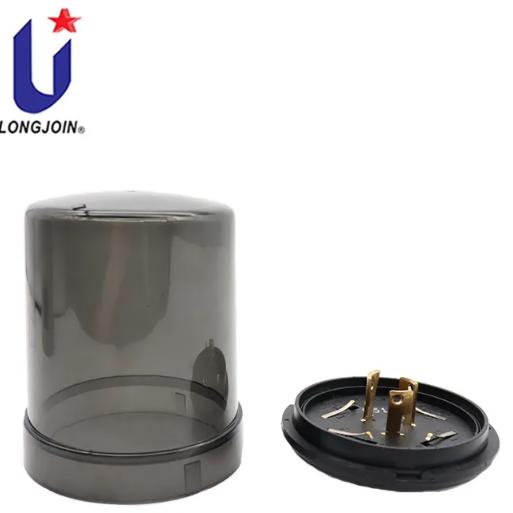
Why Does Cover Material Selection Matter in Engineering-Grade Outdoor Управление освещением?
Choosing the right cover material isn’t a small detail. It directly affects how light reaches the sensor. Outdoor фотоэлементный выключатель faces extreme conditions like:
- UV
- Heat
- Dust
- Влажность
These factors can change optical properties over time and skew readings. Outdoor environments are far harsher than lab settings, where initial transparency looks good.
In the field, plastics can degrade, reducing accuracy. A UV-resistant cover protects internal components and keeps the sensing stable longer.
Without the right material, фотоэлементные датчики освещения fail early, leading to maintenance pain and inconsistent lighting in municipal and smart city projects. Professionals design covers to balance protection, stability, and real-world performance.
Why Is “Maximum Transparency” a Misleading Assumption for Outdoor Фотодатчик Accuracy?
Many buyers think a fully transparent cover means better light sensing. At first glance, more light seems better.
But raw transparency doesn’t guarantee long-term stability. Outdoor UV exposure breaks down many clear plastics, causing yellowing and reduced transmission. Initial transmission only predicts performance in ideal conditions, not after years outside.
What matters is how consistently the cover maintains its optical behavior.
A cover that starts clear but degrades quickly will shift sensing thresholds, leading to early or late switching. Engineers prioritize materials that resist UV ageing and maintain stable transmission over time, even if they aren’t fully transparent.
Long-term optical stability beats short-term clarity every time.
What Environmental Stresses Do Outdoor Фотоконтроль Covers Face Over Their Lifetime?
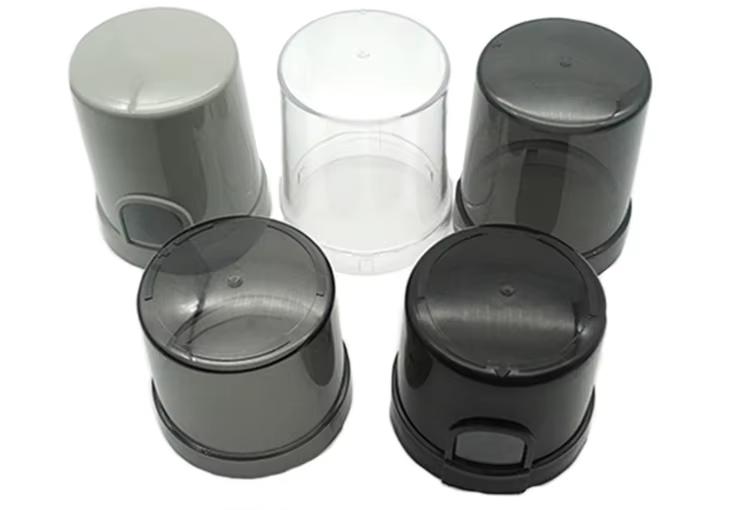
Constant UV and Solar Exposure
Управление освещением face direct sunlight every day. This makes them vulnerable to UV radiation attacks. Ultimately, plastic surfaces weaken and impact molecular bonds. Over time, this reduces optical clarity and stability.
Weather Extremes
Street lighting experiences hot afternoons and cold nights. This thermal cycling causes repeated expansion and contraction. Small cracks, along with surface fatigue, gradually appear.
Moisture and Reflected Light
Outdoor environments introduce multiple stress sources:
- Rain and condensation
- Salt mist in coastal areas
- Dust and industrial pollution
- Reflected light from roads, signs, and luminaires
These factors distort incoming light paths. Together, they accelerate optical instability and reduce long-term sensing reliability.
| Environmental Factor | Exposure Frequency | Optical Risk Level | Primary Impact on Cover |
| UV radiation | Continuous | Очень высокий | Yellowing, haze formation |
| Temperature cycling | Ежедневно | Высокий | Micro-cracking, fatigue |
| Высокая влажность | Seasonal / Daily | Середина | Fogging, condensation |
| Salt mist (coastal) | Location-based | Высокий | Surface degradation |
| Air pollution | Urban / Industrial | Середина | Light scattering |
What Long-Term Problems Do Fully Transparent Covers Introduce?
Aging Even in High-Grade Plastics
Поликарбонат and PMMA use is quite common for transparency. They also age under UV and heat. Protective additives slow degradation but do not stop it.
Transmission Loss
As aging progresses, transparent covers develop:
- Yellow discoloration
- Surface haze
- Increased light scattering
Light transmission drops unevenly. The sensor no longer receives consistent illumination.
Risk Grows Over 5–10 Years
Outdoor lighting systems are designed for long lifecycles. Transparent covers degrade gradually but continuously. After years of exposure, optical behavior shifts enough to affect sensing accuracy, increase maintenance, and reduce system consistency across large installations.
Here is a comparison table of black and transparent covers for their aging over time.
| Property Over Time | Fully Transparent Cover | Black Translucent Cover |
| UV resistance | Умеренный | Высокий |
| Yellowing tendency | Высокий | Низкий |
| Optical stability | Decreases non-linearly | Remains stable |
| Surface haze risk | Высокий | Низкий |
| Lifespan predictability | Низкий | Высокий |
Why Do Fully Transparent Covers Suffer from Yellowing and Material Aging?
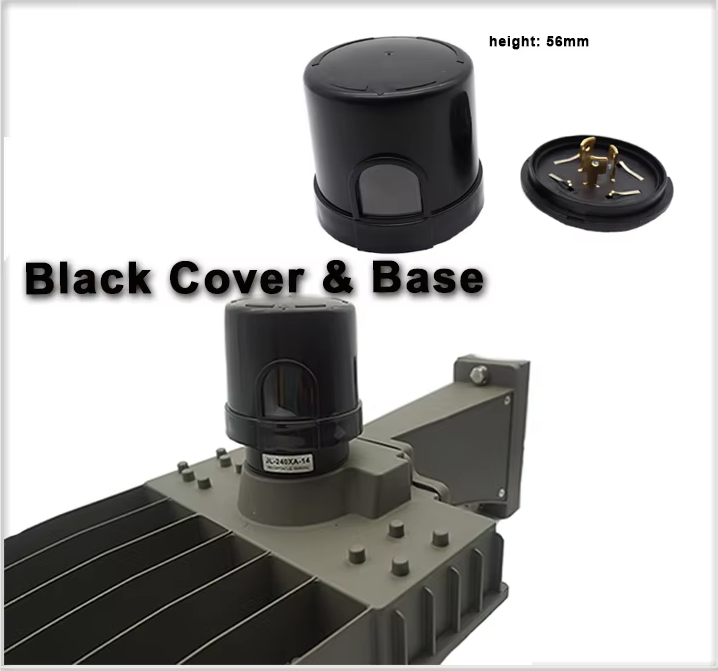
UV-Driven Molecular Breakdown
Transparent covers are usually made from PC or PMMA. Both materials react poorly to long UV exposures. UV energy breaks polymer chains and forms chromophoric compounds.
These compounds absorb blue light. This causes visible yellowing.
Light Transmission Changes Unevenly
Aging does not reduce transmission in a straight line. It changes unevenly across wavelengths.
This leads to:
- Haze formation
- Increased light scattering
- Reduced effective люкс reaching the sensor
Impact on Calibration
Датчики фотоэлементов света are calibrated for a fixed optical path. As the cover ages, that path changes. Calibration accuracy is gradually lost. The sensor no longer receives the light level it was designed for. Performance drifts silently over time.
How Do Transparent Covers Cause Lux Threshold Drift in Outdoor Датчики фотопереключателя?
Optical Degradation Alters Sensor Input
As transparent covers yellow or haze, less usable light reaches the sensor. The управление датчиком освещенности does not “fail.” It misreads ambient conditions. This is the root of lux drift.
Typical Field Symptoms
Small optical changes create big system effects:
- Early turn-on at dusk
- Delayed turn-off at dawn
- Random switching differences between fixtures
Network-Level Consistency Problems
In large street lighting networks, not all covers age the same. This causes:
- Uneven lighting behavior
- Increased complaints
- Higher maintenance and recalibration costs
That is why optical stability, not transparency, defines long-term accuracy.
Why Are Fully Transparent Covers More Vulnerable to Stray and Reflected Light?
Luminaire Self-Reflection
Fully transparent covers allow light from the luminaire to re-enter the sensor. This includes reflected light from the fixture housing and optical chamber. The sensor misreads this as ambient light.
Side-Entry and Ground Reflection
Transparent materials offer little control over unwanted light paths. Stray light enters from:
- Road surface reflections
- Building facades and signage
- Adjacent luminaires
This distorts real ambient readings.
Upward-Facing Sensor Challenges
Upward-facing designs are common in street lighting. Transparent covers amplify the problem. They allow low-angle and reflected light to reach the sensor easily. The result is false brightness detection, unstable switching, and inconsistent on-off behavior across installations.
The table below maps different light sources and how they impact severity.
| Stray Light Source | Entry Path | Impact on Sensing | Уровень риска |
| Luminaire housing | Reflection | False brightness | Высокий |
| Road surface | Upward reflection | Delayed turn-off | Середина |
| Nearby signage | Side-entry | Random switching | Середина |
| Adjacent luminaires | Lateral entry | Threshold noise | Высокий |
Why Have Black Translucent Covers Become the Preferred Engineering Solution?
Decisions Backed by Field Data
The industry shift did not happen overnight. Long-term field data showed that controlled light filtering performs better than full transparency. Black translucent covers age more predictably and maintain stable sensing behavior.
European and Municipal Adoption
European street lighting standards prioritize lifecycle stability. Municipal projects increasingly specify black translucent covers for:
- Reduced stray light sensitivity
- Better lux threshold consistency
- Lower recalibration and maintenance needs
Large-scale deployments confirmed the results. Performance remained consistent year after year. This evidence drove wider adoption. Today, black translucent covers are viewed as a mature, risk-controlled engineering choice rather than a design compromise.
What Is the Recommended Engineering Selection Strategy for Датчики наружного освещения?

The most reliable setup is of an upward light sensor with a black translucent cover. This ensures the sensor detects true ambient light and not reflections.
Идеальные варианты использования
This configuration is suited for long-life infrastructure projects such as:
- Муниципальное уличное освещение
- Traffic and roadway systems
- Smart city installations that require stable operation
Основные преимущества
Using this setup delivers measurable engineering advantages:
- Stable lux thresholds over time
- Consistent switching behavior across networks
- Reduced maintenance and recalibration
- Lower total cost of ownership due to predictable long-term performance
When Should Transparent Covers Still Be Evaluated—and Under What Conditions?
Transparent covers are only suitable for sampling, prototypes, or design validation. They should not be considered for mass deployment.
If evaluation is necessary:
- Conduct UV aging tests to assess long-term yellowing
- Run comparative illumination studies against black translucent versions
- Monitor the lux threshold drift over months or years
Transparent covers degrade unpredictably outdoors. Without proper testing, relying on them can result in higher lifecycle costs. Controlled evaluation keeps risks visible and manageable.
Заключительные слова
Outdoor photocell performance depends on long-term optical stability, not initial transparency. Black translucent covers deliver consistent sensing and reduced maintenance across the product lifecycle. For projects that demand proven reliability, Чи-Клятва works closely with Long-Join to supply field-tested photocontrollers backed by engineering expertise.


 Russian
  English
  Spanish
  Arabic
  Italian
  Japanese
  Portuguese