
مخطط تفصيلي
- مقدمة
- What Are the Common Types of Built-in أجهزة استشعار الخلايا الضوئية Used in Security Lights?
- How Do Different Photocell Sensor Types Compare in Key Technical Parameters?
- How Should Manufacturers Choose the Right مستشعر ضوئي كهربائي for Customization?
- How Do Photocells Work with PIR Motion Sensors?
- What Are the Future Trends in Photocell Sensor Technology?
- خلاصة القول
Dual-head security lights are widely used for outdoor safety. But their performance depends heavily on the photo sensors inside. They are critical as they automate lighting operations.
However, each التحكم في الإضاءة has its specific working protocol. Different types offer different levels of sensitivity and environmental stability. These differences directly affect lighting accuracy and user experience.
Understanding the available sensor technologies is therefore essential. This guide explains the main types of built-in photocell sensors to help select the most suitable option for customization.
What Are the Common Types of Built-in أجهزة استشعار الخلايا الضوئية Used in Security Lights?
| نوع المستشعر | Typical Operating Voltage | Output Signal Type | Typical Detection Range (Lux) | Circuit Complexity |
| CDS Photocell | 3V – 12V | Resistance change | 1 – 10,000 لوكس | منخفض جدًا |
| Photo-diode | 3V – 24V | Current output | 0.1 – 100,000 lux | واسطة |
| Phototransistor | 5V – 24V | Amplified current | 1 – 50,000 lux | واسطة |
| Silicone Phototransistor | 5V – 24V | Amplified current | 0.5 – 100,000 lux | واسطة |
| ترانزستور ضوئي مفلتر بالأشعة تحت الحمراء | 5V – 24V | Amplified current | 1 – 80,000 lux | واسطة |
Modern security lights rely on different light sensor controls. Each converts ambient light into an electrical signal that controls lamp switching. The difference lies in:
- حساسية
- Response speed
- Stability, and
- Resistance to environmental interference
Below are the most commonly used built-in photocell sensors in security lighting systems.
What Is a CDS Photocell?
They are among the most widely used light sensors. Also called LDR, these وحدات تحكم في إنارة الشوارع have cadmium sulfide as their primary manufacturing material.
Their working mechanism is simple. When daylight falls, the semiconductor electrons are excited by light photons. This drops the electrical resistance to a few hundred ohms. In the results, the lights are switched off. Contrarily when dark appears, the resistance reaches several megaohms, turning the lights on.
Key characteristics include:
- Sensitivity range typically 1–10,000 lux
- Peak spectral response around 520–560 nm, close to human eye perception
- Moderate response speed of 20–100 ms
المزايا
CDS sensors remain popular because of several practical benefits:
- Very low component cost
- Simple circuit design
- Stable operation in standard lighting control circuits
القيود
- Slower response to sudden light changes
- Performance is affected by temperature variation
- Environmental regulations limiting cadmium use in some regions
التطبيقات النموذجية
- Automatic street lighting switches
- Garden and yard lighting
- Basic security floodlights
How Do Photo-Diodes Improve Light Detection Performance?
This is a PN-junction semiconductor device that converts incoming light directly into electrical current. Their response to light changes is much faster than CDS.
Typical response times can reach nanoseconds to microseconds. This makes them ideal for applications where light intensity changes quickly.
المزايا
They perform well in environments where lighting changes frequently. This is due to their speed and precision. Examples include:
- Smart security lighting with rapid switching logic
- Adaptive outdoor lighting systems
- Intelligent building controls
What Role Do Phototransistors Play in Light Sensing?
هؤلاء مقابس التحكم الضوئي combine light detection and signal amplification in a single device. Their structure resembles standard bipolar transistors. The only difference is the use of light instead of electrical current to control the base region.
Key Functional Advantages
Phototransistors offer several technical benefits:
- Built-in current amplification for stronger output signals
- Higher sensitivity than standard photodiodes
- Reliable detection across a wide light intensity range
Typical Applications in Security Lighting
Because of their amplified output, phototransistors are widely used in outdoor lighting products. Common uses include:
- Security floodlights
- Smart wall-mounted outdoor lamps
- Motion sensor lighting systems
Why Are Silicon Phototransistors Suitable for Outdoor Environments?

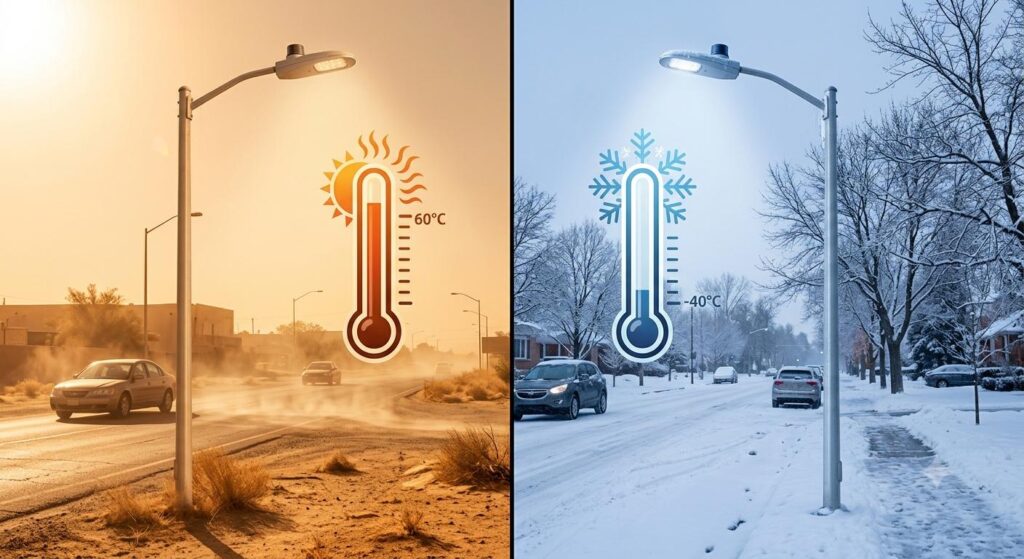
Harsh weather conditions could toll heavily on أجهزة استشعار إضاءة الشوارع. Silicon semiconductor materials maintain electrical characteristics across wider temperature ranges. Thus, these مقابس التحكم الضوئي are good to go for outdoor environments.
Compared with basic phototransistors, silicon versions offer:
- Operating temperature ranges often from −40°C to +85°C
- Strong resistance to UV exposure and humidity
- More stable output under extended outdoor operation
Resistance to Interference
Outdoor security lights face multiple interference sources, such as:
- مصابيح السيارة الأمامية
- Reflected sunlight
- Electrical noise
Silicon phototransistors provide better signal consistency and noise immunity. This makes them a preferred choice in commercial-grade security lighting products.
التطبيقات النموذجية
- Commercial building perimeter lighting
- Industrial yard lighting
- outdoor security systems
How Do IR-Filtered Phototransistors Improve Detection Accuracy?
هؤلاء مفاتيح مستشعر الضوء integrate an optical filter layer. This blocks most infrared radiation while allowing visible light to reach the sensor.
Infrared Filtering Capability
Outdoor environments contain strong IR sources such as:
- Sunlight
- Heated surfaces
- Vehicle engines
Without filtering, these sources can cause false triggering in light sensors. IR-filtered phototransistors solve this problem by:
- Blocking unwanted infrared wavelengths
- Allowing only visible light detection
- Improving day/night switching accuracy
Performance in Complex Lighting Environments
These sensors perform especially well in:
- Urban environments with heavy traffic
- Smart security lighting systems
- Outdoor installations near heat sources
Ideal Application Scenarios
IR-filtered phototransistors are commonly used in:
- High-end security floodlights
- Smart lighting controllers
- Intelligent outdoor lighting networks
How Do Different Photocell Sensor Types Compare in Key Technical Parameters?
| نوع المستشعر | حساسية | سرعة الاستجابة | Temperature Stability | Interference Resistance | التطبيق النموذجي |
| CDS (Cadmium Sulfide) | واسطة | Slow (20–100 ms) | معتدل | واسطة | Basic lighting |
| Photo-diode | متوسط-عالي | Very Fast (ns–µs) | واسطة | جيد | Smart lighting control systems |
| Phototransistor | High (internal gain) | Fast (µs–ms) | واسطة | جيد | Security lights and motion sensors |
| Silicone Phototransistor | متوسط-عالي | سريع | عالي | ممتاز | Outdoor commercial lighting |
| الترانزستور الضوئي المفلتر بالأشعة تحت الحمراء | عالي | واسطة | عالي | ممتاز | High-interference environments |
How Should Manufacturers Choose the Right مستشعر ضوئي كهربائي for Customization?
Opting for the right وحدة تحكم ضوئية is not only a technical decision. It is also a product positioning decision. Engineers usually evaluate multiple factors that include:
Evaluate Ambient Light Complexity
Start by analyzing the lighting environment where the security light will operate. Typical influencing factors include:
- Urban environments with streetlights and vehicle headlights
- Reflective surfaces such as glass walls or snow
- Weather exposure, including humidity and dust
In simple environments, basic sensors are usually sufficient.
- CDS photocells → low cost and easy circuit integration
- Standard phototransistors → higher sensitivity with simple amplification
These solutions work well for residential yards, gardens, and basic security lighting.
Select Advanced Sensors for Complex Outdoor Environments
More demanding installations require higher stability and interference resistance. Recommended options include:
- Silicon phototransistors → stable operation across wide temperature ranges
- IR-filtered phototransistors → reduce false triggering from infrared sources
These sensors are commonly used in:
- Commercial building security lighting
- Industrial outdoor lighting systems
- High-reliability perimeter lighting
Recommended Sensor Selection by Application Scenario
| سيناريو التطبيق | Recommended Sensor | سبب |
| Residential yard lighting | CDS photocell | Low cost and sufficient accuracy |
| Garden and pathway lights | Phototransistor | Higher sensitivity and stable switching |
| Commercial security lighting | Silicone phototransistor | Better temperature stability |
| Industrial outdoor lighting | IR-filtered phototransistor | Strong resistance to infrared interference |
| أنظمة الإضاءة الذكية | Photo-diode | Fast response and high precision |
How Do Photocells Work with PIR Motion Sensors?
Gone are the times when lights relied on a single lighting control. Most designs now combine a light sensor and a مستشعر الحركة PIR to achieve smarter lighting control.
Cooperative Control Mechanism
Each sensor performs a different function in the control logic.
- Photocell sensor monitors ambient light levels. It enables the lighting circuit only when the environment becomes dark.
- A PIR sensor detects movement using infrared radiation from people and vehicles.
In practice, the system follows a simple logic sequence:
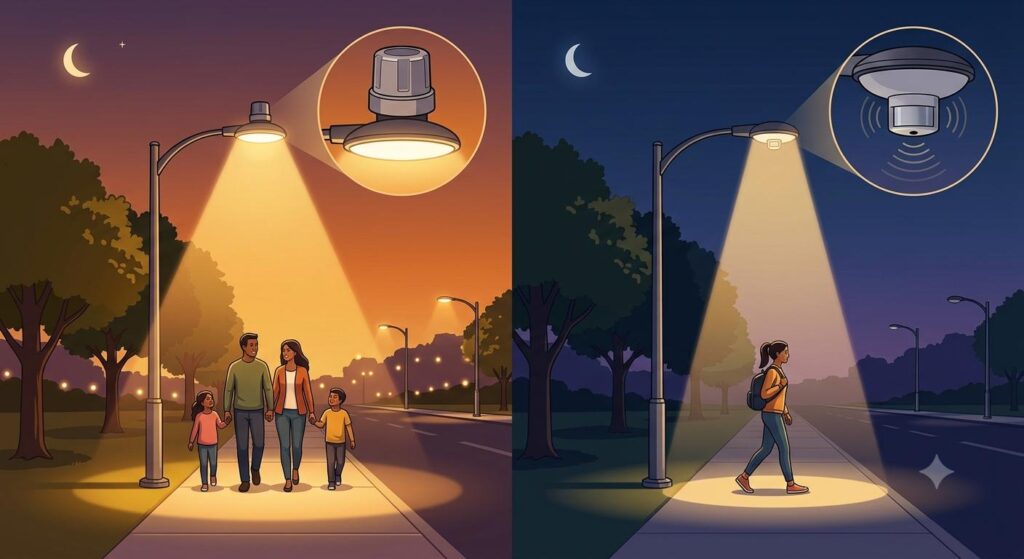
- ال مستشعر تبديل الصورة checks the ambient light below the preset lux threshold.
- The PIR sensor becomes active when darkness is detected.
- When motion occurs, the light turns on for a preset delay period.
This dual-sensor design ensures that motion detection only works when there is low ambient light available. This prevents unnecessary daytime activation.
Key Benefits of Dual-Sensor Operation
Using both sensors significantly improves lighting efficiency and security performance.
● توفير الطاقة
Lights activate only when it is dark, and motion is present.
● Reduced false triggering
Daytime motion does not activate the light.
● Improved security
Instant illumination when movement is detected at night.
● Extended fixture life
Reduced operating hours decrease LED thermal stress.
What Are the Future Trends in Photocell Sensor Technology?
Outdoor security lighting is evolving rapidly. Traditional sensors are being replaced by intelligent control systems. Now common trends include:
Fusion of Multiple Sensors for Intelligent Lighting
Future lighting systems increasingly combine multiple sensing technologies in one controller. Common sensor combinations include:
- مستشعر ضوئي كهربائي for ambient light detection
- PIR sensors for motion detection
- Microwave sensors for long-range motion sensing
- Environmental sensors for temperature or weather data
Growing Demand for Customized Photocell Solutions
Lighting manufacturers are also moving toward application-specific sensor customization. Key customization directions include:
- Adjustable lux thresholds for regional lighting standards
- IR-filtered sensors for high-interference environments
- Semiconductor sensors for extreme climates
Advanced Sensors Driving Smarter Security Lighting
Next-generation security lighting is becoming part of the smart outdoor infrastructure. New developments include:
- Smart controllers integrated with IoT lighting networks
- Sensors optimized for LED lighting environments
- Adaptive brightness control linked to occupancy detection
خلاصة القول
Choosing the right built-in photocell sensor directly affects the accuracy and intelligence of dual-head security lights. Understanding the differences between different photocell types helps manufacturers design lighting systems that match real-world environments. For reliable performance, many lighting brands partner with تشي-سوير, a trusted supplier of Long-Join photocontrollers, known for stable sensor integration and consistent outdoor lighting control solutions.

 Arabic
  English
  Spanish
  Russian
  Italian
  Japanese
  Portuguese