
OUTLINE
- مقدمة
- What Are the Light-Sensitive Component Types Used in Photocells?
- What Is the Real Difference Between Photodiode and CDS?
- When Does Each Type Make Sense?
- CDS vs Photodiodes in Photocells
- Frequently Asked Questions on CDS vs Photodiodes
This debate comes up regularly in outdoor lighting procurement, and it almost always starts the same way: someone points at the price difference between a CDS photocell and a photodiode model and asks whether the more expensive one is actually worth it. The honest answer is that it depends on where the photocell is going and what you expect from it over its service life.
Both sensor types do the same job at the most basic level — they detect ambient light and trigger switching. What separates them is how well they do it across different temperatures, environments, and years of outdoor exposure.
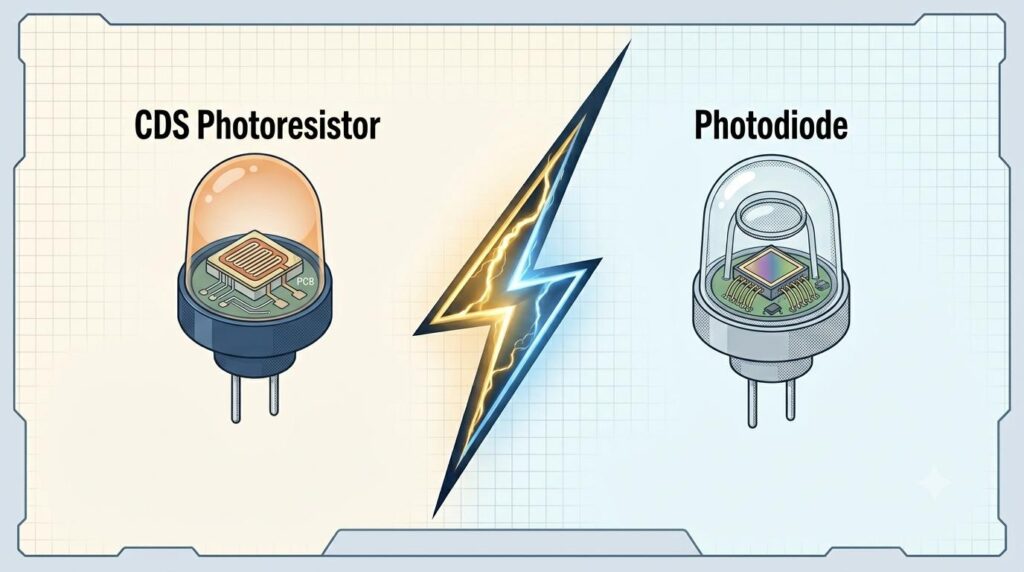
What Are the Light-Sensitive Component Types Used in Photocells?
Five sensing technologies appear across the photocell market, each with different cost, stability, environmental tolerance, and interference characteristics
CDS (cadmium sulfide)
CDS photoresistors are the most widely used low-cost option. Their resistance changes with ambient light, triggering the switching circuit when the reading crosses the threshold.
Photodiodes
Photodiodes convert light directly into electrical current with high speed and excellent stability across temperature ranges.
Phototransistors
Phototransistors amplify the photoelectric signal for stronger output and more precise control.
IR-filtered phototransistors
These are phototransistors with an added spectral filter that blocks infrared-heavy artificial sources, reducing false triggers from vehicle headlights and nearby lamps.
Bimetallic strips
Bimetallic strips are a thermal-mechanical switching element rather than a true photosensitive component, used in basic designs where cost is the primary constraint.
What Is the Real Difference Between Photodiode and CDS?
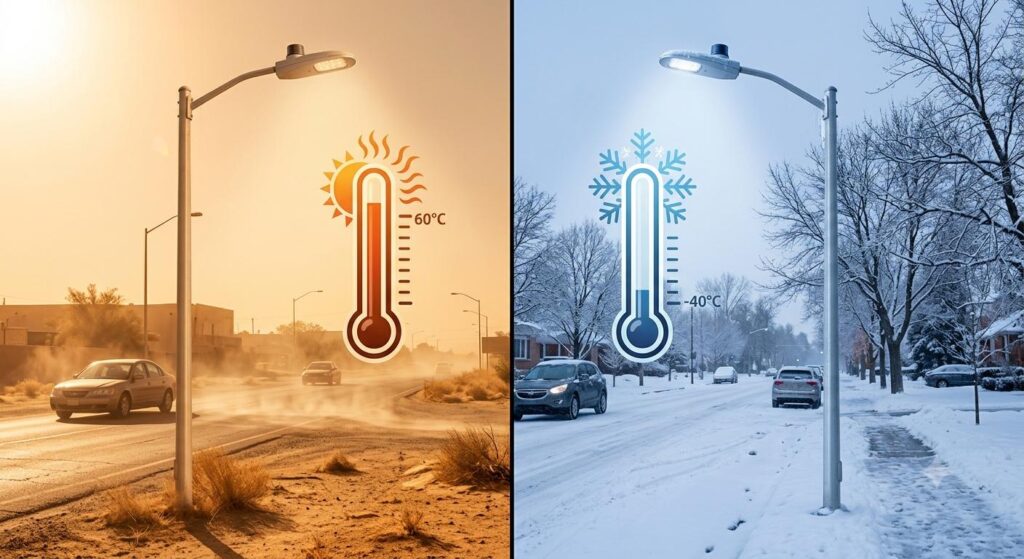
The performance gap between photodiode and CDS sensors is most visible at temperature extremes and in environments with high humidity, salt air, or unstable grid conditions, which are all conditions that are common in serious outdoor lighting applications.

CDS components are inexpensive and have been used in photocells for decades. In moderate conditions with stable temperatures, they perform acceptably. The problems appear when temperature drops in winter, when the CDS cell’s resistance characteristics shift and the effective switching threshold drifts. This drift causes the photocell to switch at the wrong lux level, lights coming on too early in the morning or staying off too long after dusk. In coastal or high-humidity environments, CDS components also degrade more quickly from moisture exposure.
Photodiodes don’t have this temperature dependency in the same way. Their photoelectric conversion characteristics remain stable across a much wider temperature range, which is why Long-Join’s higher-specification models use photodiode sensing for applications where consistent year-round performance is the requirement. In high-temperature regions, humid coastal areas, and environments with salt spray, photodiode-based photocells maintain their switching accuracy where CDS units drift.
When Does Each Type Make Sense?
The right choice is driven by the installation environment and the performance expectations of the project, not by component cost alone.
For limited budgets and ordinary installations in moderate environments where temperature variation is modest and the cost of occasional false triggering or seasonal drift is acceptable, CDS photocells are a reasonable choice. They are widely available, inexpensive, and perform adequately in conditions that don’t push their temperature or humidity limits.
For projects with sufficient budget, high performance requirements, and long-term stability as a priority, photodiode photocells are the recommendation. This applies to any installation in harsh outdoor environments — high-temperature regions, coastal zones, industrial areas with humidity or salt spray, and locations with unstable grid supplies where MOV surge protection alongside a stable sensing element is the combination that extends service life.
| Light-Sensitive Component Type | يكلف | القدرة على التكيف البيئي | Stability | التطبيقات المناسبة |
| CDS Photoresistor | قليل | Sensitive to temperature changes with sensitivity drift | واسطة | Budget-limited projects in moderate environments |
| Photodiode | عالي | Excellent waterproofing, moisture resistance, and high temperature tolerance | عالية جدًا | High-end systems, harsh outdoor environments, long-term stable needs |
| Phototransistor | متوسط-عالي | More limited environments | Stable | Precise control and specialized circuits |
| ترانزستور ضوئي مفلتر بالأشعة تحت الحمراء | عالي | Has special spectral filtering | عالي | Special lighting environments requiring strong anti-interference |
| Bimetallic Strip | قليل | Mainly for thermal control, not a primary photosensitive element | Variable with temperature | Auxiliary switching, extreme temperature environment safety control |
Photocells of all models are available on تشي-سوير with full specifications and recommendations.
CDS vs Photodiodes in Photocells
CDS photocells are not poor quality, they are appropriate for what they were designed for. The issue is when they get specified for environments that exceed those limits, such as winter temperatures that cause sensitivity drift, coastal humidity that accelerates degradation, or industrial zones where grid instability adds surge risk on top of environmental stress.
Photodiode photocells cost more upfront and deliver consistent performance across those conditions for years longer. For any outdoor project where the installation environment is demanding and the maintenance cost of early replacement matters, the photodiode is the better specification.
Frequently Asked Questions on CDS vs Photodiodes
Q1: Why are CDS components prone to false triggers in winter?
CDS sensitivity drifts at low temperatures, shifting the effective switching threshold. The photocell reads a different lux level than actually exists, causing lights to switch on too early or too late relative to actual dusk and dawn conditions.
Q2: What are the main advantages of a photodiode over CDS?
Higher stability across temperature ranges, better resistance to humidity and salt spray, and more consistent switching threshold accuracy over the product’s service life. These advantages are most significant in harsh outdoor environments.
Q3: Is the higher cost of photodiodes worth it?
For outdoor and industrial applications where reliability, long service life, and consistent year-round performance matter, yes. The cost difference between the two is typically recovered within the first replacement cycle that a CDS unit would require in a demanding environment.
Q4: Which component should you choose with a limited budget?
CDS is acceptable for moderate environments where temperature variation is modest and occasional false triggering is tolerable. Evaluate the installation environment and the cost of maintenance visits before defaulting to the cheapest option.
Q5: Are all photocells suitable for all environments?
No. The right photocell for a residential garden light in a temperate climate is a different specification from the right photocell for a highway pole in a coastal industrial zone. Environment, temperature range, grid stability, and budget together determine the appropriate sensor type and protection specification.

 Arabic
  English
  Spanish
  Russian
  Italian
  Japanese
  Portuguese