
Describir
- Introducción
- How Do JL-423C Receptáculo de fotocontrol and JL-403C Control del sensor de luz Compare in Electrical Specifications and Core Performance?
- Which Application Scenarios Are Best Suited for JL-423C and JL-403C?
- How Should U.S. Buyers Choose Between JL-423C and JL-403C?
- Palabras finales
Elegir lo correcto interruptor de fotocélula can directly affect lighting performance and energy efficiency. Many U.S. projects still rely on the stable and bestselling JL-403C. But Long-Join recently introduced the JL-423C, a new negative proportional switch with smarter control features.
So which one should you choose?
Both models support 120–277VAC systems commonly used in the United States. However, they differ in power consumption and lighting control flexibility.
This article compares the JL-423C and JL-403C to help lighting buyers and project planners select the right solution.

How Do JL-423C Receptáculo de fotocontrol and JL-403C Control del sensor de luz Compare in Electrical Specifications and Core Performance?
Selecting a sensor de fotocélula is not just about price. Electrical specifications determine how well the device performs in real lighting networks. There are multiple factors that directly affect reliability and operating costs.
The sections below break down the most important performance parameters.
Rated Voltage Range and Sensor Types of JL-423C and JL-403C
Ambos interruptores de fotocélula are built for multi voltages lighting systems commonly used in North America. They have
- Voltage range of 120–277VAC
- Operating range extending from 105VAC to 305VAC
This ensures compatibility with most American outdoor lighting circuits.
This wide voltage tolerance allows installers to use the same device across different lighting infrastructures, including:
- 120V residential lighting circuits
- 208V commercial systems
- 240–277V municipal street lighting networks
However, their sensing technology differs.
JL-423C sensor technology
- Uses an IR-filtered phototransistor
- Filters infrared interference for more stable light detection
- Works with an integrated MCU electronic circuit
JL-403C sensor technology
- Typically uses a CdS photocell with thermal switching
- Simpler analog detection design
- Reliable but less adaptive in varying light conditions
In short, both models have good integration capability, but the JL-423C provides more advanced sensing stability.
Power Consumption Difference Between JL-423C and JL-403C

Power consumption may seem small per device. But across thousands of lighting nodes, it becomes a measurable operational cost.
The JL-423C sensor de iluminación de fotocélula is designed as a low-power digital photocontrol. Its power consumption is about 0.4–0.5W, thanks to MCU-based electronics and optimized switching circuits.
The JL-403C consumes around 1.8W at 120VAC, which is typical for traditional thermal photocell designs.
In large lighting networks such as municipal street lighting or parking lot systems, the difference becomes significant. Lower device consumption means:
- Reduced standby electricity usage
- Lower long-term operational cost
- Higher system efficiency in smart lighting deployments
Power Consumption Comparison
| Modelo | Consumo de energía | Technology Type | Efficiency Impact |
| JL-423C | ~0.5W | MCU electronic control | Very low standby loss |
| JL-403C | ~1.8W | Thermal / CdS switch | Higher internal consumption |
Model That Has Higher Load Capacity for Outdoor Lighting Systems
This parameter determines how much lighting equipment an sensor de luz de fotocélula exterior can safely control. This is particularly important for installations with multiple fixtures.
The JL-423C provides significantly higher load capability. Its higher rating allows it to control:
- Larger street lighting fixtures
- High-power HID or LED drivers
By contrast, the JL-403C is better suited for smaller installations, such as:
- Residential outdoor lights
- Porch and wall-pack fixtures
- Landscape lighting systems
In other words, JL-423C scales better for municipal or commercial lighting networks. Further, here is a quick comparison table.
| Parámetro | JL-423C | JL-403C |
| Tungsten Load | 1000W | 500W |
| Ballast Load | Up to 1800VA | 850VA |
| e-Ballast Support | Sí | Limitado |
Operating Light Thresholds and Control Mechanisms Difference
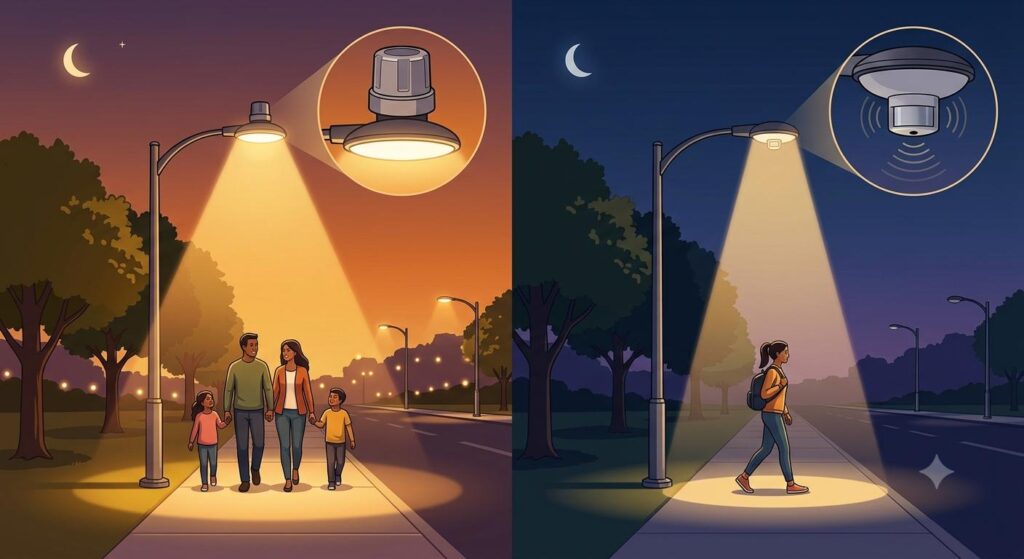
Sensor fotográfico switching thresholds determine when the lights will switch. Precise control helps prevent unnecessary switching and improves lighting efficiency.
The JL-423C uses a negative proportional switching mechanism. This allows adjustable lux thresholds. Its typical factory setting is:
- Turn on at 16 Lux
- Turn off at 24 Lux
This proportional design ensures a balanced difference between on and off levels. It reduces flickering and improves stability during dawn and dusk transitions.
The switching thresholds of JL-403C are usually within the range of:
- Turn on around 10 to 20 Lux
- Turn off around 30 to 80 Lux
These levels are not adjustable. So, the installers have less flexibility when adapting the photocell to different environments.
Key control difference
- JL-423C offers customizable switching logic with proportional control
- JL-403C has fixed switching automation
For projects requiring precise lighting control, the JL-423C clearly offers more flexibility.
Additional Smart Features and Certifications Difference
Beyond basic switching, the JL-423C interruptor de fotocélula con sensor de luz integrates several smart electronic features designed for modern lighting systems.
JL-423C advanced features
- Comisión Federal de Comunicaciones (FCC)-compliant electronic design
- Optional zero-cross switching technology
- Selectable failure modes
- Adjustable delay switching of about 5 to 10 seconds
- Optional surge protection up to 460J and 10kA
These features improve reliability in outdoor environments. This is especially crucial where lightning and electrical noise are common.
The JL-403C features
- Fixed fail-off mode
- Opciones de personalización limitadas
- Basic switching automation functionality
This simplicity makes the 403C easy to deploy. However, it also means fewer configuration options for advanced lighting systems.
Which Application Scenarios Are Best Suited for JL-423C and JL-403C?
JL-423C
Este fotocontrol is designed for modern lighting networks that demand efficiency and higher electrical capacity. Its electronic control circuit and higher load rating allow it to support larger lighting systems.
Typical applications include:
- Municipal lighting systems
- Ciudades inteligentes
- Commercial parking lots
- Industrial projects
- Large campus and facilities
These projects often require stable switching and adjustable operating parameters. The JL-423C is better suited for such environments.
JL-403C
Este control de iluminación focuses on simplicity and cost efficiency. It uses a straightforward switching automation design and supports moderate loads such as 500W tungsten and 850VA ballast lighting systems.
Because of its simple design, it is widely used in:
- Residential projects
- Porch and garden lights
- Wall-pack fixtures
- Doorway and pathway lighting
- Small commercial buildings
These installations usually require reliable automation rather than advanced configuration.
Quick Application Comparison
| Tipo de aplicación | JL-423C Suitability | JL-403C Suitability |
| Alumbrado público municipal | Excelente | Limitado |
| Smart lighting projects | Excelente | Not ideal |
| Commercial outdoor lighting | Very good | Moderado |
| Residential lighting | Bien | Excelente |
| Budget-sensitive projects | Moderado | Excelente |
How Should U.S. Buyers Choose Between JL-423C and JL-403C?
The selection of the right product mainly depends on the project’s technical requirements and budget.
El JL-423C is built with:
- An electronic MCU circuit
- Low power consumption around 0.4 to 0.5W
- Higher load capability up to 1000W tungsten and 1800VA ballast
With these features, this sensor fotoeléctrico is good to go for demanding lighting systems and large installations.
By contrast, the JL-403C follows a simpler thermal photocell design. It supports moderate loads such as 500W tungsten and 850VA ballast, which keeps the cost lower and installation straightforward. Here is a quick selection guide for buyers.
| Project Requirement | Modelo recomendado | Project Requirement | Modelo recomendado |
| Sistemas de iluminación inteligentes | JL-423C | Municipal and roadway lighting | JL-423C |
| High-load lighting fixtures | JL-423C | Iluminación exterior residencial | JL-403C |
| Small commercial projects | JL-403C | Budget-sensitive installations | JL-403C |
Palabras finales
JL-423C delivers higher load capacity and smarter control. JL-403C remains a stable and cost-effective choice for standard outdoor lighting projects. For buyers sourcing Long-Join photocontrollers, Chi-Swear is a reliable supplier with consistent product availability and technical support. Working with an experienced distributor helps ensure the right model selection for each lighting project.

 Spanish
  English
  Russian
  Arabic
  Italian
  Japanese
  Portuguese