
OUTLINE
- Introduzione
- 1. Low Sun Angle in Winter Causes the Sensing Window to Be Shadowed
- 2. Thick Clouds and Rapid Weather Changes Cause Large Light Fluctuations
- 3. Low Temperatures Cause Sensitivity Drift in Photosensitive Elements
- 4. Snow Reflection Causes Self-Excited On/Off Cycling
- 5. Large Temperature Differences Cause Internal Condensation
- 6. Power Grid Fluctuations in Winter Increase Interference Risk
- How Do Low-End and Long-Join Photocontrols Compare Across These Factors?
- Winter-suitable Photocells
- Frequently Asked Questions on Photocontrols in the Winter
Summer gets most of the attention when outdoor photocell performance is discussed. High temperatures, intense UV, and surge risk from lightning are real problems.
However, winter has its own set of challenges that cause a different category of failures, and they’re less intuitive.
A photocell that performs flawlessly through August can start cycling erratically in December without any obvious cause. Usually one of these six factors is responsible.
1. Low Sun Angle in Winter Causes the Sensing Window to Be Shadowed
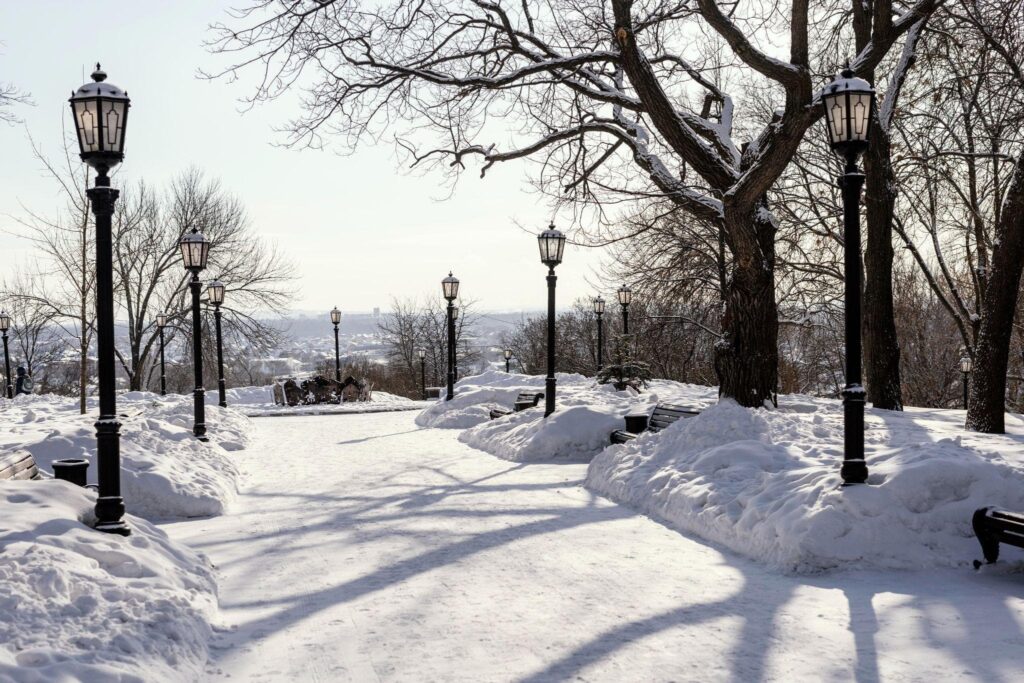
The sun’s lower elevation angle in winter places the photocell’s sensing window in shadow for longer portions of the day, producing unstable light readings and misjudged switching.
A photocell mounted on a pole that receives consistent open sky exposure in summer may find that a nearby roofline, tree, or structure casts a shadow across the sensor for hours each winter day as the sun tracks lower across the sky.
The sensor reads this shadow as dusk and switches the light on, then reads the return of open sky as dawn and switches it off again, repeatedly. Repositioning the sensor or selecting a mounting position that accounts for winter sun angle eliminates this at the installation stage.
2. Thick Clouds and Rapid Weather Changes Cause Large Light Fluctuations
Variable winter weather produces sudden and severe changes in ambient light that push the lusso reading across the switching threshold repeatedly, causing frequent false triggering.
A photocell set for a specific on-threshold may trigger dozens of times during a day of rapidly shifting overcast and clear sky conditions. Without adequate time delay and hysteresis between on and off thresholds, each passing cloud bank that drops lux below the threshold triggers a switch.
Long-Join’s photocell designs include built-in time delay and separated on/off thresholds specifically to filter these short-duration lux variations before acting on them.
3. Low Temperatures Cause Sensitivity Drift in Photosensitive Elements

Traditional CDS (cadmium sulfide) fotoresistori experience significant performance drift at low temperatures, reducing sensitivity and shifting the effective switching threshold in ways that produce incorrect switching.
CDS cells are temperature-dependent by nature. As temperature drops in winter, the dark resistance and light resistance characteristics of the CDS cell shift, causing the photocell to behave as though the ambient light is different from what it actually is.
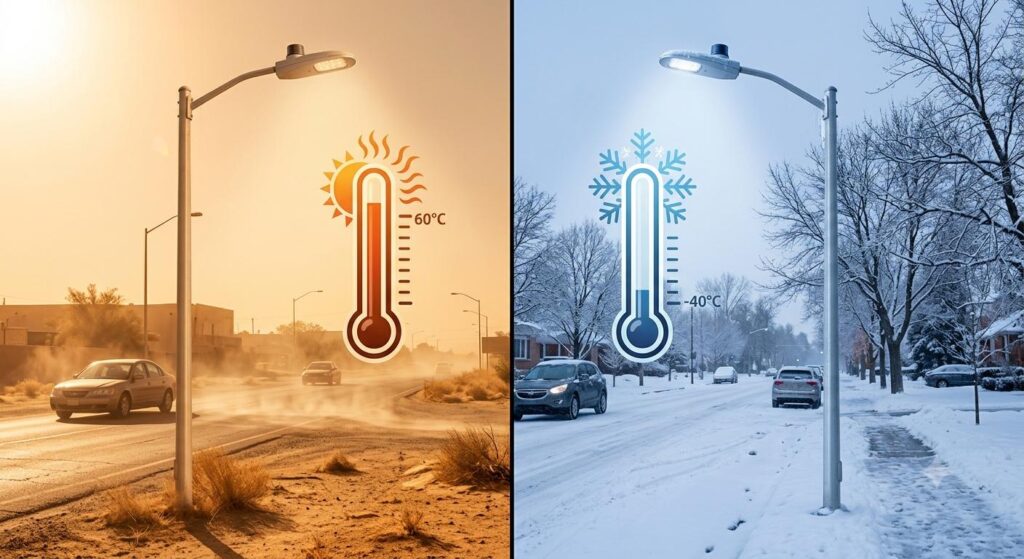
Alcuni higher-specification models of Long-Join’s Photocells use photodiode sensing rather than CDS, which provides more stable sensitivity characteristics across the full operating temperature range from -40°C to +70°C.
4. Snow Reflection Causes Self-Excited On/Off Cycling
Strong light reflection from snow-covered surfaces creates an artificially elevated ambient lux reading that causes the photocell to switch off the connected light, which then allows the sensor reading to drop, triggering it back on again in a continuous cycle.
This is one of the more disruptive winter failure modes because it produces obvious, rapid cycling that is immediately visible and generates complaints. The reflected lux from fresh snow can be high enough to push the sensor well above the off-threshold even at dusk.
IR-filtered sensing, as used in Long-Join’s JL-207C, reduces sensitivity to the IR-heavy component of reflected snow light. Anti-interference and light filtering design in the control circuit further stabilises operation against this effect.
5. Large Temperature Differences Cause Internal Condensation
Sharp temperature swings between day and night in winter cause moisture to condense inside inadequately sealed photocell housings, damaging electronic components and creating short circuit risk.
When a warm photocell housing cools rapidly after sunset in winter, any moisture that has entered the housing through imperfect seals condenses on the internal components. Repeated condensation cycles cause progressive corrosion of relay contacts and PCB traces.
Ultrasonic welding housing technology creates a permanent seal at the housing joint rather than relying on adhesive or compression gaskets that can lose integrity under thermal cycling. This is the most important winter-specific protection feature in modern housing design.
6. Power Grid Fluctuations in Winter Increase Interference Risk
Higher electrical loads in winter from heating systems cause more frequent voltage fluctuations on the distribution network, increasing Electromagnetic Interference (EMI) that triggers false switching in poorly protected photocontrols.
Cold weather drives up residential and commercial heating loads, which creates more grid switching events and voltage transients on the same lines that power outdoor lighting. A photocontrol without adequate EMI filtering in its circuit reads these transients as switching signals.
Long-Join’s industrial-grade MCU and filtering design provide strong interference protection that maintains stable operation through the increased grid noise of winter peak load periods.
How Do Low-End and Long-Join Photocontrols Compare Across These Factors?
| Impact Factor | Low-End Photocontrol Performance | Long-Join High-End Photocontrol Advantage |
| Low-Temperature Sensitivity Drift | CDS drift, unstable performance | Uses stable Photodiode with high and stable sensitivity |
| Condensation Protection | Standard sealing, prone to water ingress | Ultrasonic welding sealing technology effectively prevents moisture and condensation |
| Reflection Light Protection | No filter design, prone to self-excited cycling | Includes light filtering and anti-interference design to stabilize operation |
| Power Grid Interference Resistance | Weak interference resistance, vulnerable to voltage fluctuations | Industrial-grade MCU and filtering design offering strong interference protection |
| Adaptability to Variable Climate | Unresponsive, higher failure rates | Intelligent dynamic adjustment technology adapting to light fluctuations and climate changes |
Full specifications for Long-Join’s winter-suitable photocontrol range are available on Chi-Swear’s photocell product pages.
Winter-suitable Photocells
Winter false triggers are not random. They follow predictable patterns outlined in this piece. Long-Join’s high-end photocontrols address each of these through photodiode sensing, ultrasonic welded housing, IR and anti-interference filtering, industrial-grade MCU design, and intelligent dynamic adjustment. Specifying a photocell built for year-round outdoor performance eliminates these winter failure modes before they show up as complaints.
Frequently Asked Questions on Photocontrols in the Winter
Q1: Why are photocontrols more prone to false triggers in cold winter weather?
CDS photosensitive components drift in performance at low temperatures, reducing sensitivity and shifting the switching threshold. Photodiode-based designs like those in Long-Join’s higher-specification models maintain stable sensitivity across the full temperature range.
Q2: What specific effect does snow reflection have on photocontrols?
Reflected lux from snow-covered surfaces pushes the sensor reading above the off-threshold even at dusk, causing the photocell to switch off the light. The drop in reflected light when the light switches off then triggers it back on, producing continuous cycling.
Q3: How can internal condensation in winter be prevented?
Choose a photocell with ultrasonic welded housing rather than adhesive or standard gasket sealing. Ultrasonic welding creates a permanent mechanical bond at the housing joint that maintains integrity through repeated thermal cycling.
Q4: What are the risks of grid fluctuations to photocontrol operation in winter?
Voltage transients from increased heating load switching cause electromagnetic interference that poorly protected photocontrol circuits read as switching signals. Industrial-grade MCU and filtering design prevents these transients from triggering false switching events.
Q5: How does Long-Join improve photocontrol reliability for winter use?
Through stable photodiode sensing, ultrasonic welded housing, light filtering and anti-interference design, industrial-grade MCU, and intelligent adjustment that adapts to the rapid lux fluctuations typical of variable winter weather conditions.




 Italian
  English
  Spanish
  Russian
  Arabic
  Japanese
  Portuguese