
OUTLINE
- Introduzione
- What Technical Features Make Twist-Lock Photocells Suitable for High Temperatures?
- What Does High Temperature Actually Do to Internal Components?
- What Do Users in Different Regions Actually Think?
- What Advantages Does Long-Join’s Temperature Range Provide?
- Photocells and High Temperatures
- Frequently Asked Questions on High-temperature Resistant Photocells
Outdoor lighting markets are not uniform. A street light photocell installed operates in fundamentally different ways depending on the thermal environment of its installation.
As lighting procurement becomes more global, the question of high-temperature tolerance has moved from a regional concern to a specification standard that affects which products can enter which markets.
Regarding whether photocells should support high temperatures, the short answer is yes, and the reason goes beyond marketing claims about durability.

What Technical Features Make Twist-Lock Photocells Suitable for High Temperatures?
Long-Join twist-lock photocell range is engineered across seven technical dimensions that together determine how reliably a unit performs under sustained thermal stress.

Waterproof Sealing
Alto IOP-rated waterproof sealing ensures the housing remains sealed in both rain and humidity, which matters in high-temperature environments where condensation from rapid cooling after hot days is a regular occurrence.
Gamma di tensione
Wide voltage support from 110-277VAC through to 480VAC variants eliminates compatibility problems across different regional power infrastructure.
Protezione contro le sovratensioni
Built-in surge arresters protect against lightning and voltage spikes, which are more frequent in tropical high-temperature regions with active storm seasons.
Switching Technology
Cross-zero switching technology extends the life of internal components by switching the relay only at the zero-voltage crossing point of the AC waveform, which reduces arcing and thermal stress on the contacts during every switching event.
Intervallo di temperatura
The working temperature range of -40°C to +70°C meets commercial-grade temperature standards for the most demanding outdoor environments globally.
UV-Resistance
UV-resistant housing material prevents the brittleness and cracking that intense solar radiation causes in standard plastics.
Sensor Range
The choice of photosensitive component ranges from CDS to photodiode, phototransistor, or IR-filtered phototransistor, and is selected based on the performance requirements of each model, with higher-specification models using components that maintain their characteristics more reliably under thermal stress.
What Does High Temperature Actually Do to Internal Components?
Sustained high-temperature exposure increases thermal stress across every internal component, from the sensing element through to the relay contacts and PCB. Each component has a different threshold at which performance degrades.
Thermal stress also accelerates the aging of electronic components by increasing leakage current and reducing material integrity over time. CDS photoresistors are particularly temperature-sensitive: their resistance characteristics drift as temperature rises, shifting the effective lux threshold at which switching occurs. Photodiode-based models maintain more stable characteristics across this temperature range, which is one reason Long-Join’s higher-specification models use photodiode or phototransistor sensing rather than CDS.
Long-Join reduces these effects through high-temperature rated materials in the housing and internal construction, combined with circuit design that manages thermal dissipation around heat-sensitive components.
What Do Users in Different Regions Actually Think?
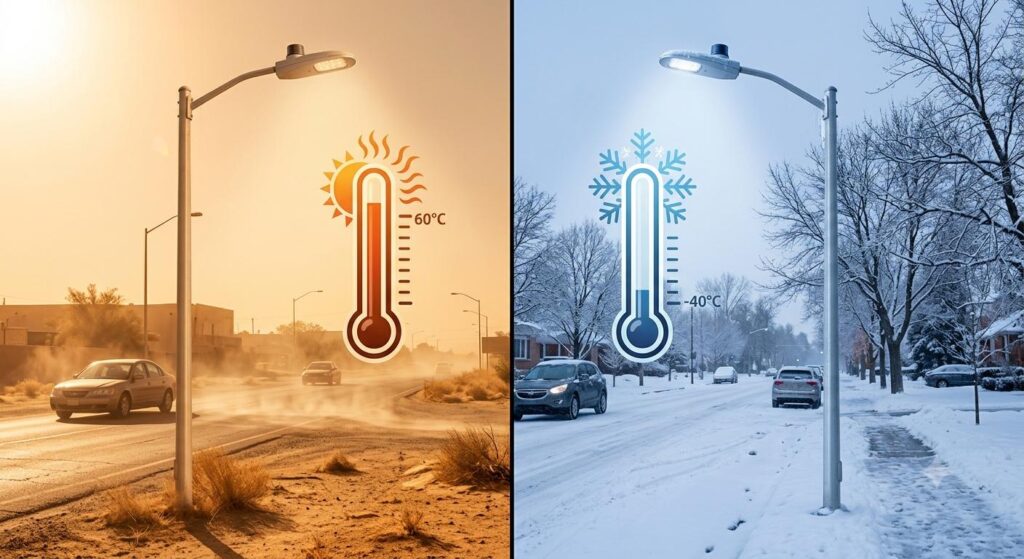
User opinions on high-temperature tolerance split along geographic lines, and both perspectives reflect legitimate regional realities.
High Temperature Regions
Users in the Middle East and hot regions of Africa consider 60°C tolerance non-negotiable. Surface temperatures on pole-mounted equipment in the Gulf regularly exceed 60°C during summer months, and a photocell with a lower rating simply won’t maintain switching accuracy or service life in that environment. For these buyers, the -40°C to +70°C range is the minimum acceptable specification.
Lower Temperature Regions
Some users in parts of North America consider 40°C sufficient for their climate conditions, which is a reasonable position in temperate regions where ambient temperatures rarely push pole-mounted equipment above that threshold. The argument that high-temperature problems are primarily a luminaire design issue rather than a photocell issue also has some merit. Proper thermal management in the luminaire housing can reduce the temperature the photocell experiences relative to ambient. But this relies on the luminaire design being correct, which cannot always be assumed in retrofit or multi-supplier projects.
The practical procurement position is straightforward: a photocell rated to 70°C works in both 40°C and 60°C environments. One rated to 40°C creates a risk in the 60°C environment. Specifying the higher-rated product eliminates that risk without creating any disadvantage in the cooler environment.
What Advantages Does Long-Join’s Temperature Range Provide?
The -40°C to +70°C working temperature range covers the full spectrum of outdoor lighting environments from subarctic to tropical, making Long-Join’s twist-lock range a single specification that works globally without regional variants.
The effective models are displayed in detail on Chi-Swear’s product page and tick all the boxes for the necessary indicators.
| Indicatore | Feature or Data | Applicable Environment | User Concerns |
| Working Temperature | da -40°C a +70°C | Middle East, hot Africa, North America, extreme climates | Meets high-temperature needs, prevents temperature-related failures |
| Waterproof | High IP rating, reliable sealing | Outdoor rain, snow, and harsh environments | Extends equipment life, ensures continuous operation |
| UV-Resistant Housing | UV-resistant material prevents sun damage | Strong sunlight environment | Prevents fading, prolongs housing durability |
| Photosensitive Elements | CDS, photodiode, phototransistor, etc. | Maintain sensitivity in potential high-temp environments | Ensures accurate sensing, reduces false trips |
| Electrical Protection | Surge arrester and cross-zero technology | Lightning and voltage fluctuations | Reduces accidental damage, ensures safety |
Photocells and High Temperatures
High-temperature resistance in a photocell is not a premium feature for specialist markets, but a baseline reliability requirement for any product operating in exposed outdoor positions. Long-Join’s -40°C to +70°C working temperature range covers the Middle East, tropical Africa, North America, and extreme climate zones within a single specification. Combined with other features, this temperature range reflects an engineering position that outdoor photocells must be built for the environments they actually operate in, not the environments that are easiest to design for.
Frequently Asked Questions on High-temperature Resistant Photocells
Q1: Why do photocells need to support 60°C high temperature?
High temperatures accelerate component aging and cause sensing threshold drift. A 60°C rating confirms the photocell can maintain accurate switching and service life in the sustained thermal conditions that exposed outdoor positions in hot climates actually produce.
Q2: What temperature tolerance do users in North America mainly require?
Generally, around 40°C suits most temperate North American scenarios. However, specifying a product rated to 70°C covers both temperate and hot climate installations without any performance disadvantage in cooler conditions.
Q3: Does high temperature shorten photocell lifespan?
Yes, thermal stress accelerates component aging. High-temperature rated materials and circuit design that manages thermal dissipation around heat-sensitive components mitigate this effect significantly in Long-Join’s range.
Q4: Is high-temperature tolerance purely a luminaire design issue?
Partly — good luminaire thermal management reduces the temperature the photocell experiences. But this cannot be assumed in all installations, and a photocell rated for the actual outdoor thermal environment provides reliability that doesn’t depend on the luminaire design being optimal.
Q5: Where does Long-Join show advantages in high-temperature resistance?
Through a broad -40°C to +70°C working temperature specification, UV-resistant housing, multiple electrical protections including surge arresters and cross-zero technology, and a choice of photosensitive components that includes high-stability photodiode options for the most demanding environments.


 English
 Spanish
 Russian
 Arabic
 Italian
 Japanese
 Portuguese