
OUTLINE
- Introducción
- How does a dusk-to-dawn photocell switch work?
- What Are the Main Types of Long-Join Photocell Products?
- Which Photocell Type Fits Which Application?
- En conclusión
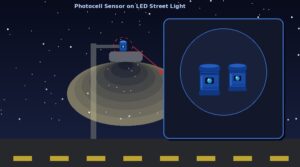
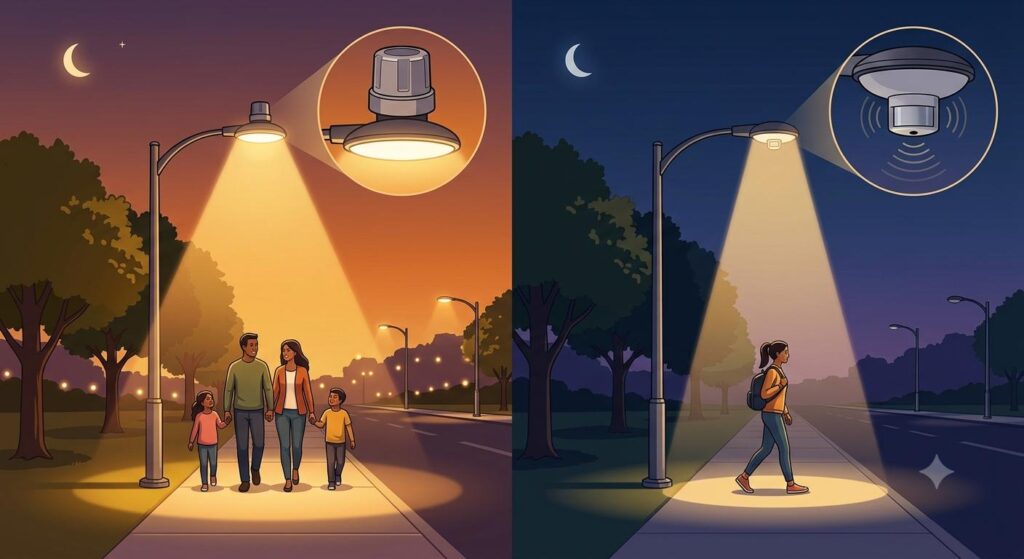
The most common street lights you will find now are intelligent light controls. They come on and off automatically at the appropriate times of the day, with the help of photocells.
Dusk-to-Dawn photocell switches are little devices that go in our outdoor lights and manage their controls by sensing the surrounding light level.
There are different types of photocells and selecting the right one depends on factors such as the voltage rating, installation style, and other specific application needs.
Having a basic understanding of how they work makes it easier to choose the right one for any outdoor lighting setup.
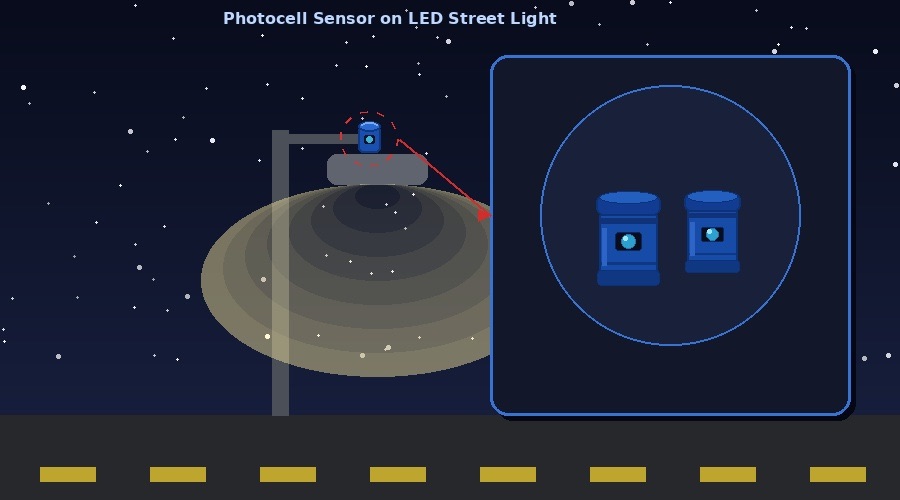
How does a dusk-to-dawn photocell switch work?
A photocell senses changes in light intensity and uses that information to control a lighting circuit automatically.
This happens in about three main steps:
Detecting light (photoelectric conversion)
The photocell uses a light-sensitive component to monitor ambient light, usually measured in lujo. This component converts light into an electrical signal.
There are 2 common types of sensors::
- Light Dependent Resistors (LDRs), where resistance increases as it gets darker, affecting the flow of current
- Phototransistors, where reduced light lowers current flow, signalling that it is time to turn the light on
Processing the signal
The electrical signal from the sensor is then sent to a control circuit inside the device.
This circuit compares the signal to a preset light level:
- When light falls below this level (at dusk), the system prepares to switch the light on
- When light rises above it (at dawn), it prepares to switch the light off
Most photocells also include a short delay feature. This prevents sudden changes, such as car headlights or lightning, from triggering the light unnecessarily.
Switching the light
Once the next action is decided, the system activates a switch that either completes or breaks the circuit, in turn switching the light on or off.
The response time of the photocell sometimes depends the type of sensor that it has. There are 4 common ones:
- Thermal bimetal sensors: Very stable and less affected by brief light changes
- CDS (cadmium sulfide) photoresistors: Offer a good balance between cost, sensitivity, and performance
- Phototransistors: Respond faster and more accurately to light changes
- IR-filtered phototransistors: Designed to ignore infrared-heavy light sources like vehicle headlights
What Are the Main Types of Long-Join Photocell Products?
Long-Join’s photocell range covers different installation formats, load requirements, and levels of system intelligence. There are four main categories of designs you will find.
Wired Photocells
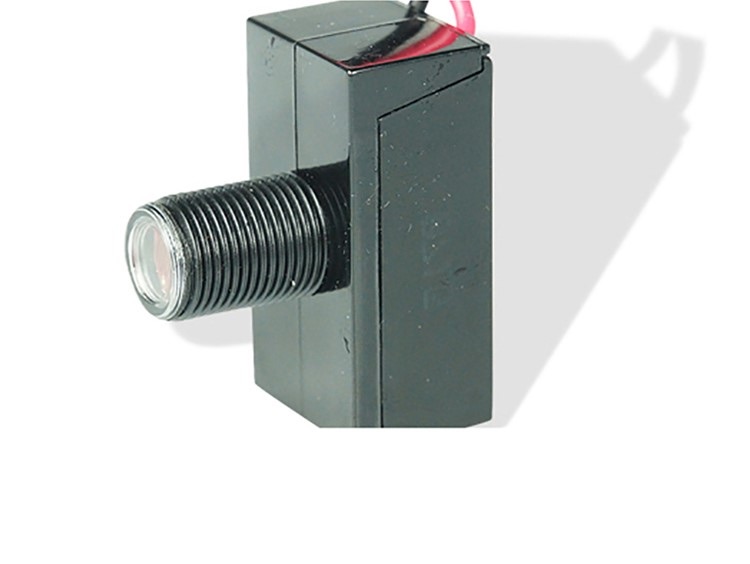
Wired photocells are directly connected to the wiring of their fixtures. They are super easy to install, making them a popular choice for replacing the regular traditional switches and for photocell beginners.
- JL-103A — A thermal bimetal design. The go-to choice for residential post lights, garden fixtures, and yard lighting where simplicity and long service life matter most.
- JL-403C — An electronic phototransistor design Ideal for commercial building exteriors and applications where a single model needs to cover multiple voltage environments.
- JL-118A — Stem-mounted swivel photocell with bimetal thermal sensing. The swivel head allows directional adjustment after installation, which is useful where the fixture position or local obstructions mean the sensor needs pointing in a specific direction.
Key advantages of wired photocells:
- Drop-in replacement for existing switch positions
- No receptacle required, mounts directly through a knockout hole
- Compatible with a wide range of fixture types, including wall packs, post lights, and barn lights
- Lower cost per unit compared to twist-lock or intelligent alternatives
Fotocélulas Twist-Lock
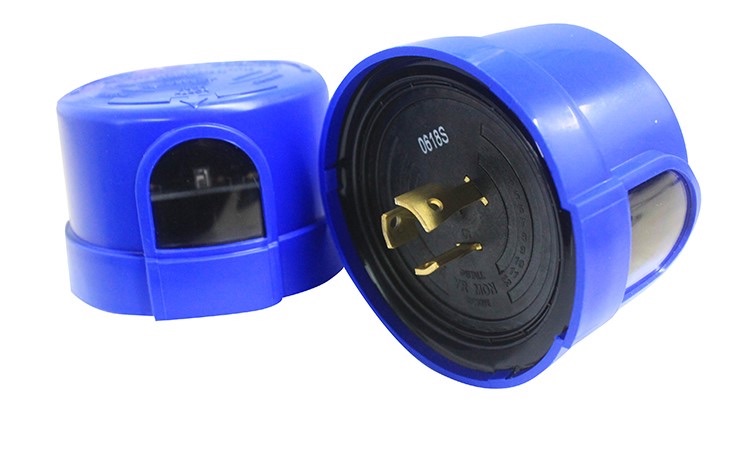
Twist-lock photocells plug into a NEMA-standard receptacle on the fixture. This format is dominant in municipal street lighting and large-scale commercial deployments because it allows the photocell to be swapped without rewiring.
- JL-205C — A Phototransistor design. The standard workhorse across street lighting, parking lots, and industrial area lighting globally
- JL-207C — IR-filtered phototransistor. Preferred in complex light environments such as highways, industrial zones, and anywhere artificial light sources could otherwise cause false switching
- UM-205C — A phototransistor in Long-Join’s UM series. Shares core electrical characteristics with the JL-205C at a lower price point, suited to budget-controlled projects without compromising on weatherproofing
Key advantages of twist-lock photocells:
- Tool-free installation and replacement via NEMA receptacle
- High load ratings suitable for large fixtures and multiple luminaire configurations
- Wide voltage range covers different regional power standards in a single model
- Robust housing designed for years of continuous outdoor exposure
Intelligent Photocells

Intelligent photocells add remote monitoring and real-time communication on top of standard photocell switching. They connect each fixture to a centralised management platform and have features like fault reporting and scheduled dimming.
- JL-245CN — NB-IoT wireless smart photocell, connects directly to the cloud via telecom infrastructure. Suited to large municipal deployments where ongoing maintenance cost reduction is the primary goal
- JL-246CG — ZigBee wireless smart photocell, acts as a node in a mesh network coordinated by a ZigBee gateway controller. Better suited to campus environments, smart parks, and urban precincts where a local gateway is already in place and mesh networking provides redundancy
Key advantages of intelligent photocells:
- Real-time fault detection and instant alerting
- Remote parameter adjustment
- Atenuación programada
- Data connectivity
Miniature Zhaga Photocells
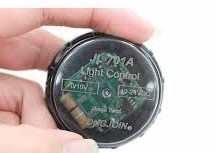
These models use the Zhaga Book 18 interface standard. It is a plug-and-play connector system that allows sensors and controllers to be swapped between compatible luminaires from different manufacturers. The compact form factor makes them suitable for fixtures where a full-size NEMA receptacle isn’t practical.
- JL-701A — Ultra-low-cost Zhaga Book 18 twist-lock photocell. Suited to small street lamps, compact garden fixtures, and billboard lighting, where the Zhaga interface is already present
- JL-723A1 — Zhaga Book 18 controller combining light sensing with PIR (passive infrared) motion detection and DALI 2.0 dimming output. A more capable option where the installation requires both presence detection and ambient light control in one unit
Key advantages of Zhaga miniature photocells:
- Fast installation and easy replacement
- Compact size
- Flexible installation position
- Seamless integration with compatible smart lighting ecosystems
Which Photocell Type Fits Which Application?
Matching the photocell type to the application environment is the single most important step in specifying outdoor lighting control — the right model reduces maintenance, extends product life, and ensures the system performs as intended.
| Tipo de fotocélula | Representative Models | Typical Application Scenarios | Main Advantages |
| Wired Photocell | JL-103A, JL-403C, JL-118A | Residential yards, commercial building exteriors, barn lights, pathway lighting | Easy installation, wide fixture compatibility, standardised interface |
| Twist-Lock Photocell | JL-205C, JL-207C, UM-205C | Municipal street lighting, parking lots, industrial plants, and highway lighting | Robust structure, tool-free swap, high load rating, stable long-term performance |
| Intelligent Photocell | JL-245CN, JL-246CG | Smart buildings, smart city infrastructure, remote or large-scale centralised control | Remote adjustment, real-time fault detection, energy-saving dimming, data connectivity |
| Zhaga Miniature | JL-701A, JL-723A1 | Small street lamps, billboard lighting, compact garden fixtures, Zhaga-compatible luminaires | Small size, plug-and-play Zhaga interface, flexible mounting, high sensitivity |
En conclusión
Understanding how a dusk-to-dawn photocell switch works removes the guesswork from lighting control specification. Long-Join’s range covers all four main categories of photocells, and all the photocells can be found in Chi-Swear’s catalogue. With this knowledge, you can make the right choice to guarantee efficient intelligent lighting.
Enlaces externos



 Spanish
  English
  Russian
  Arabic
  Italian
  Japanese
  Portuguese