
NEMA vs Zhaga: Which Smart Lighting Ecosystem Will Dominate Future Cities?
OUTLINE Anyone specifying smart city lighting infrastructure right now is working with two competing interface standards that have different geographic strongholds, different design philosophies, and different answers to the same fundamental question: NEMA has North America. Zhaga has Europe and parts of Asia. Neither has gone away, and increasingly, serious smart pole deployments are building infrastructure for both. This article looks at what differentiates NEMA and Zhaga, where each performs best, and why the most thoughtful answer to “which one wins” is probably “both, depending on where you are and what you’re building.” How Do Zhaga and NEMA Interface Standards Compare? Straight to the most important question in everyone’s mind. […]
How to Protect Your Outdoor Lighting: Effective Strategies and Long-Join Photocell Features
OUTLINE Outdoor lighting takes a sustained beating. Rain, UV radiation, temperature swings, voltage spikes, dust, salt air, and mechanical impact from installation and maintenance accumulate over the years. Most outdoor lighting failures are not sudden catastrophic events. They’re the result of gradual degradation across one or more of these stress vectors that eventually crosses a threshold. The good news is that each of these failure paths has a corresponding protection strategy, and most of them are addressed at the specification stage rather than in reactive maintenance. This guide covers the five main protection dimensions for outdoor lighting and the Long-Join photocell features that directly address each one. 1. What Physical […]
Selection Guide for Wire-in vs Twist-Lock Photocontrols: Featuring Long-Join JL-207C, JL-200X, and JL-403C
OUTLINE Choosing between a wire-in and a twist-lock photocontrol comes up on almost every outdoor lighting project, and the answer is rarely complicated once you know what each format is actually built for. The installation method determines maintenance speed, fixture compatibility, and how easy the system is to service years down the line. If you get it right at the specification stage, the photocell becomes a non-issue for the life of the project. This guide focuses on three Long-Join models that cover this selection headache, and explains where each one belongs. What Makes Twist-Lock Photocontrols the Right Choice? Twist-lock photocontrols use the ANSI C136.10 standard interface to plug directly into […]
Why UL Certification Matters for Outdoor Photocontrols in North America
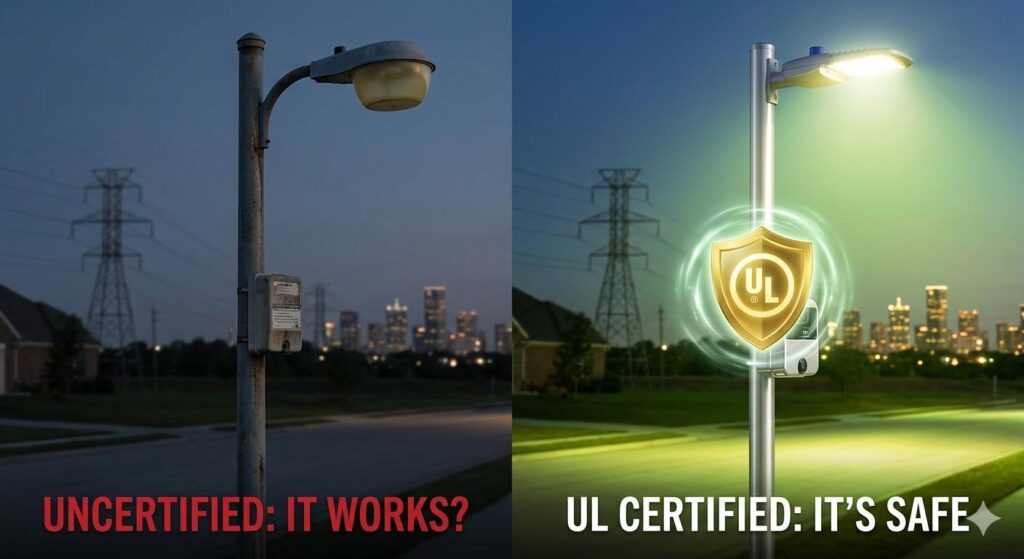
OUTLINE Verification that things meet strict safety and compliance standards is very important in North America, and this applies to outdoor lights and their photocontrol sensors (photocells). For photocells, certifications are the go-to, and anyone as experienced as I am in the business will tell you that UL and cUL certifications are considered some of the most important requirements. What UL certification does is separate “it works” from “it’s safe.” Those are two different things, and in North America, the latter requires independent verification from a recognised testing body, not just a manufacturer’s claim on a datasheet. Let’s dive into how UL certification helps evaluate photocontrols for electrical safety, fire […]
Common Failures in Outdoor Light Sensors and How to Avoid Them

OUTLINE Photocells are becoming an ever-present part of most outdoor lighting. Failure of these light control sensors could lead to flickering lights, lights coming on at the wrong times, and costly maintenance visits. Most outdoor photocell failures are preventable. They follow predictable patterns tied to environmental exposure, poor product selection, and installation mistakes that experienced buyers learn to screen for before committing to a supplier. To have a reliable dusk-to-dawn sensor that appropriately automates operations and saves energy and maintenance costs, you need to be conversant with the most common outdoor sensor failure modes. This guide covers eight of the most common failures, real-world examples of how they present, and […]
How Dusk-to-Dawn Sensors Reduce Energy Costs for Parking Lot Lighting
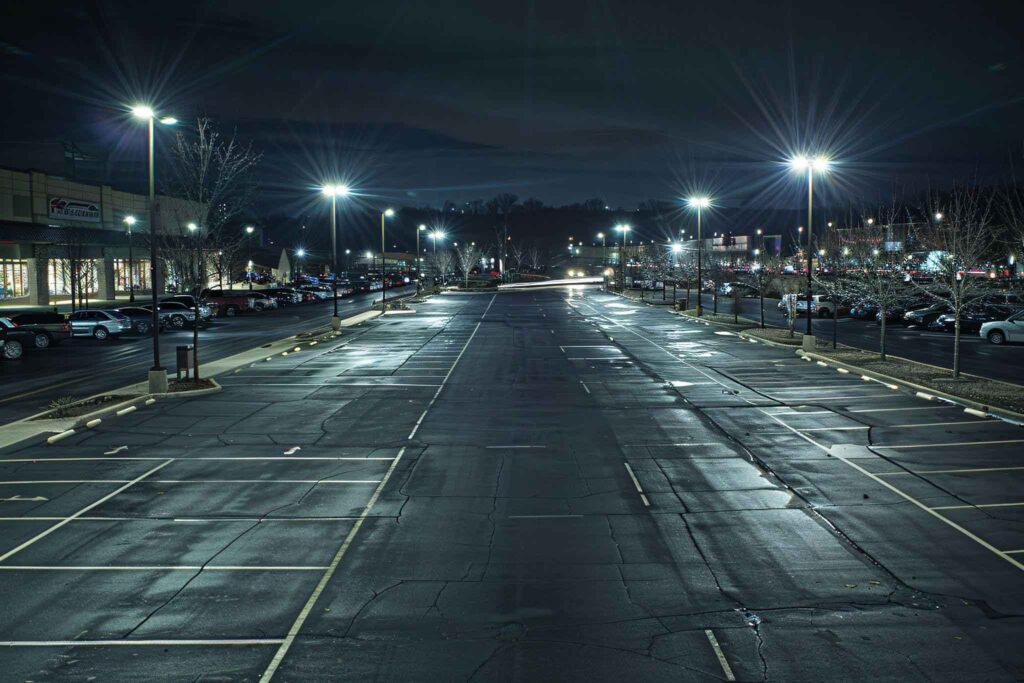
OUTLINE Something most parking lot managers don’t think about until they see the electricity bill is that the lights are running whether anyone is in the lot or not. A 500-fixture parking lot is burning the same wattage at midnight as it burns at peak traffic days. Energy wasted, high cost. Dusk-to-dawn sensors solve this problem by responding to what’s actually happening outside. When it gets dark, the lights come on. When it gets light, they go off, without any manual intervention. This is a change that provides real and measurable impact on energy costs for commercial and municipal parking lot operators. Let’s dive into how it works, which products […]
Small Dusk to Dawn Sensors for Compact Outdoor LED Fixtures: Long-Join Photocell Solutions
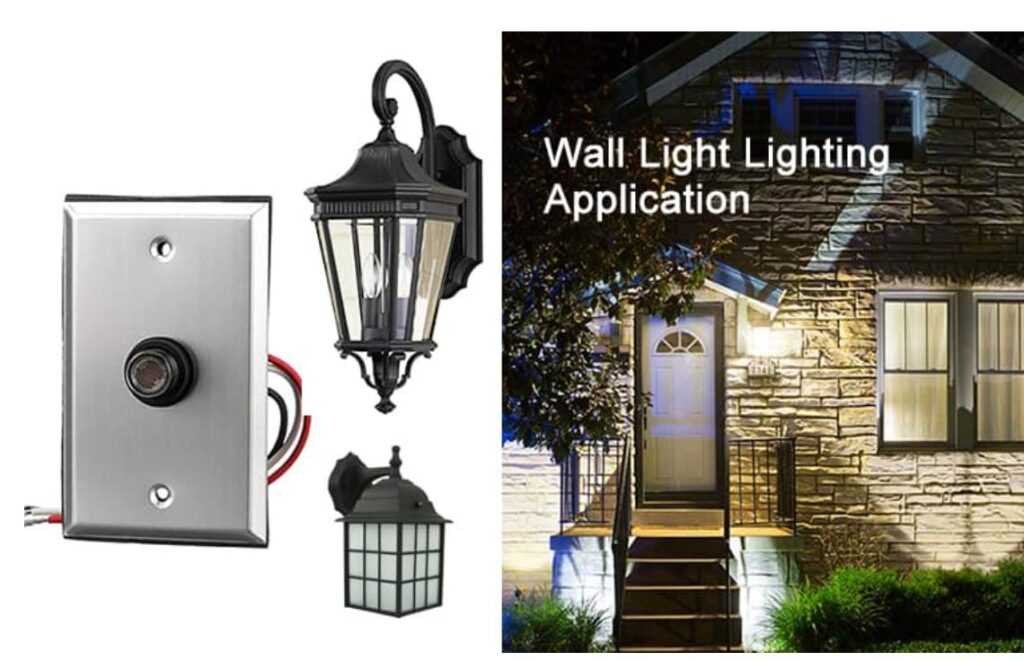
OUTLINE Compact outdoor LED fixtures create a photocell problem that larger outdoor lighting fixtures don’t have: space within. Fixtures such as mini wall packs, garden spotlights, or 60W post lights have small housings, limited knockout clearance, and in some cases, no room for a full-size button photocell at all. The photocell still needs to perform reliably, switch cleanly with an LED driver load, and survive the same outdoor conditions as any other installation. In such cases, it is better to opt for wire-in photocells that don’t take up much space and are fixed with the fixtures. Long-Join’s wire-in range covers compact fixture applications from 10W decorative sconces through 500W flood […]
Best Adjustable Dusk to Dawn Sensors for Commercial Outdoor Lighting
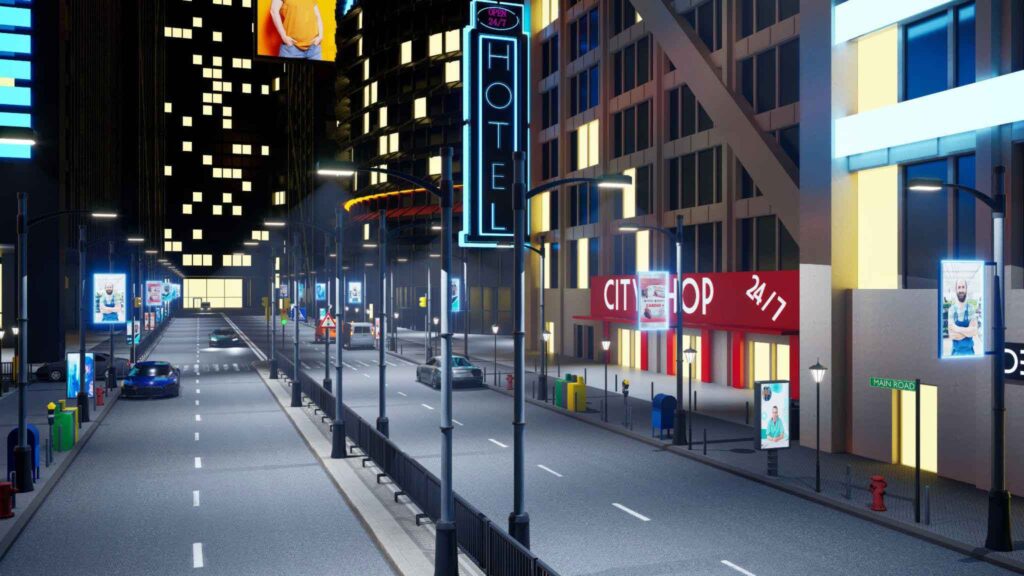
OUTLINE In photocell installation, some things are clear: A photocell mounted on the north face of a building reads a very different light environment from one on the south face. A sensor installed under a canopy sees less direct sky than one on an open pole. A unit next to a billboard picks up reflected artificial light that a unit in an open car park never encounters. These differences matter because a fixed photocell set to a standard lux threshold assumes a consistent light environment, and commercial outdoor lighting installations are rarely consistent. False switching, premature activation, delayed deactivation, and unstable cycling are the symptoms of a photocell that can’t […]
NEMA vs Hard-Wired Dusk to Dawn Sensors: Which Is Better for Street Lighting?
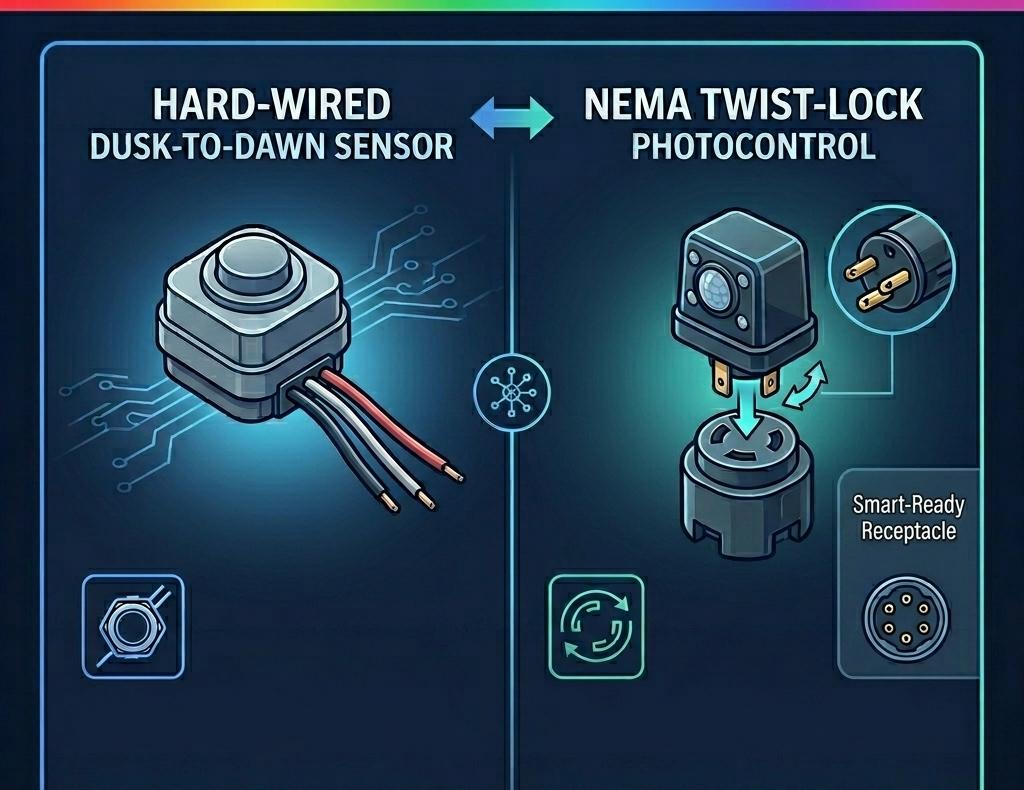
OUTLINE Every outdoor photocell does the same core job: switch outdoor lighting on at dusk, and back off at dawn. Where they differ is in how they connect to the fixture, and that difference has real consequences for installation speed, maintenance cost, and the ability to upgrade the system later. For a single residential wall pack, the distinction barely matters. For a municipal street lighting network running thousands of fixtures, it determines how much the maintenance programme costs every year. Here, I’ll compare hard-wired and NEMA twist-lock photocontrols across the factors that matter for street lighting projects. What Is a Hard-Wired Dusk to Dawn Sensor? A hard-wired photocontrol connects permanently […]
Integration of Photocontrol and Smart Controllers: The Future of Lighting Trends
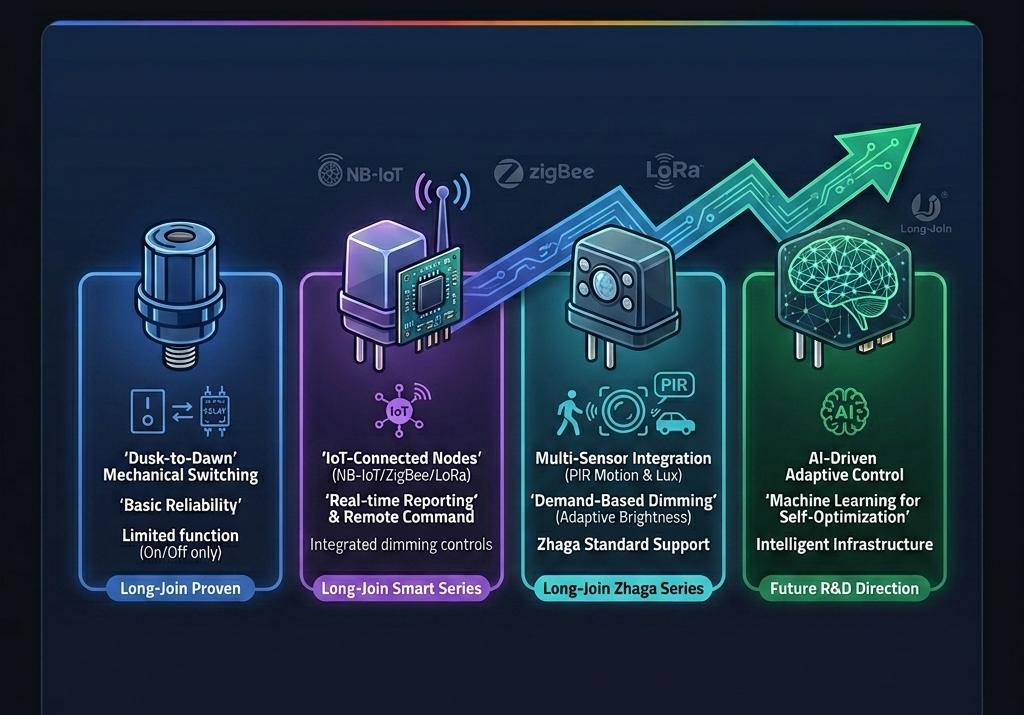
OUTLINE Street lighting looked roughly the same for decades. A photocell sat on top of a pole, sensed when it got dark, switched the light on, and switched it off at dawn. That was the whole system. This system worked, and for basic outdoor lighting, it still does. But the environments these systems operate in have changed, and the expectations placed on them have changed with it. Cities now want to know which lights are on, which ones have faults, how much energy each circuit is consuming, and whether dimming can be adjusted remotely based on traffic conditions as late as 2 am. None of that is possible with a […]
 English
 Spanish
 Russian
 Arabic
 Italian
 Japanese
 Portuguese