
OUTLINE
- 導入
- What Does the Delay Function Actually Do?
- What Problems Can the Wrong Delay Setting Cause?
- How Long Should the Delay Be?
- Which Long-Join Products Combine Delay with Other Sensing Modes?
- Getting the Photocell Delay Right
- Frequently Asked Questions on the Delay Function
The delay function in a photocell is one of those features that most users either never think about or blame for problems it didn’t cause.
When a light is slow to come on at dusk, the delay gets blamed. When a light flickers repeatedly from a passing car, the lack of adequate delay is the actual problem.
Understanding what the delay actually does, how long it should be, and which products let you combine it with other sensing modes is what separates a well-specified installation from one that generates complaints.
What Does the Delay Function Actually Do?
The delay is not a response lag; rather, it is a time window filter that requires the ambient lux reading to hold consistently above or below the switching threshold for a set period before the photocell acts on it.
Without a delay, a photocell would react to every brief change in ambient light, be it a cloud passing in front of the sun, a vehicle headlight sweeping the sensor, or a lightning flash. Each of these would trigger a switching event.
The delay prevents this by requiring the lux reading to remain consistently in the switching zone for the full delay period before the relay operates. A 10-second delay means a 9-second headlight sweep produces no switching response. A 3-second delay means the same sweep might still trigger it.
The delay does not make the photocell slower at detecting genuine dusk. It makes it more selective about what counts as a genuine light level change worth acting on.
What Problems Can the Wrong Delay Setting Cause?
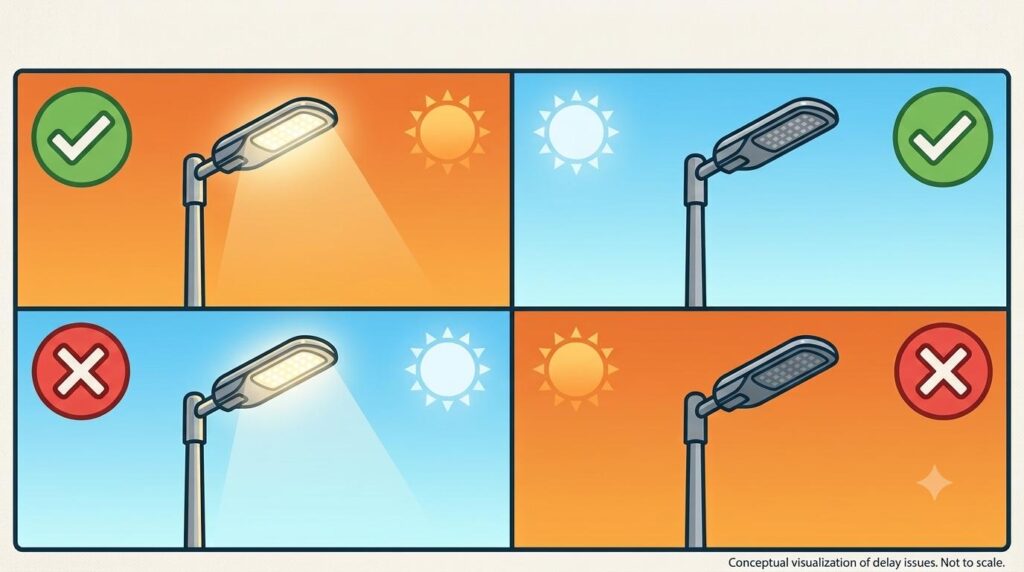
Both too-long and too-short delay settings create operational problems, and the right setting depends on the specific environment the photocell is operating in.
Users often misunderstand delay as simply avoiding flicker. It actually acts as a time window filter against all external light interference, not just flicker specifically.
- Excessive delay (5 to 10 minutes, for example) creates a noticeable lag between actual dusk and the light switching on, which can cause safety concerns in locations where prompt illumination matters.
- Too short a delay (such as 1 to 2 seconds) allows vehicle headlights and transient light events to trigger false switching, causing premature lighting activation or repeated cycling that wears the relay and generates complaints.
How Long Should the Delay Be?
The right delay length depends on factors such as:
- Environmental light stability
- Traffic density
- Safety requirements
- Energy saving priorities
There is no single setting that is universally correct. Here are some typical application scenarios for various delay durations:
| Delay Duration | 利点 | デメリット | Typical Application Scenarios |
| 3 seconds | Fast response, less unnecessary waiting | More susceptible to flicker or false triggers | High-traffic areas like commercial corridors |
| 5秒 | Balance between response speed and stability | Some extreme light changes may still cause false triggers | Public outdoor lighting, residential areas |
| 10 seconds | Significantly filters out transient light changes | Slightly prolonged dark-to-light transition | Lines where energy saving is a priority and safety considerations are lower |
| 30秒 | Strong robustness to prevent repetitive triggering | May delay light in low-traffic or remote areas inconveniently | Low-traffic remote locations or low-frequency environments |
High-traffic commercial areas benefit from shorter delays because the people using those spaces need prompt illumination at dusk and the convenience cost of a 30-second wait is noticeable. Remote or low-traffic locations tolerate a longer delay without consequence, and the robustness against false triggering that a 30-second delay provides is more valuable there than fast response.
Which Long-Join Products Combine Delay with Other Sensing Modes?
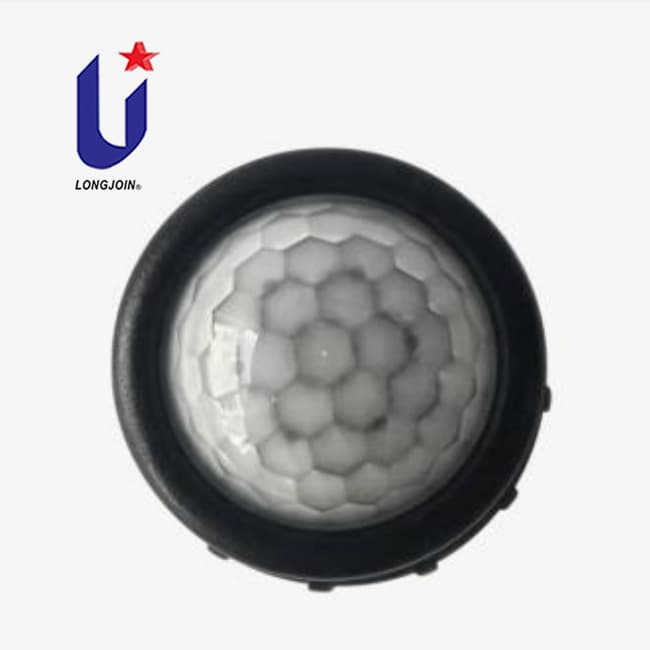
For environments where photocell delay alone is insufficient, either because of persistent light interference or because demand-based dimming is also required, Long-Join offers combined sensor models that pair photocell detection with パッシブ赤外線 または microwave motion sensing.
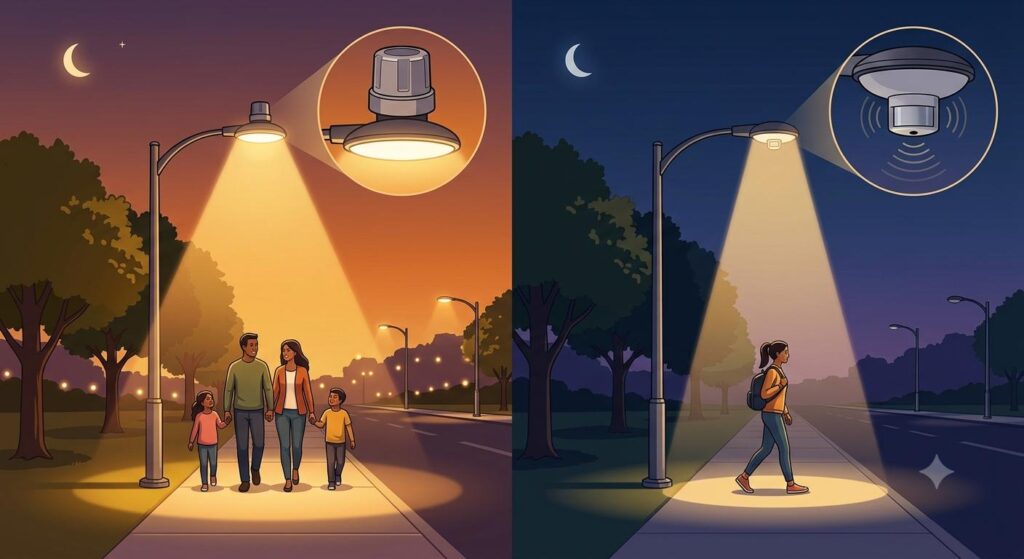
その JL-723A1H combines PIR and photocell modes within the Zhaga Book 18 format. It gives both night control and motion-based energy savings, meaning the photocell handles dusk-to-dawn switching while the PIR sensor manages dimming based on occupancy during the night. This combination is particularly useful in pedestrian environments where full brightness is only needed when someone is actually present.
その JL-712 series covers microwave-plus-photocell combinations. Microwave sensors have higher sensitivity and can penetrate obstacles such as glass and thin wood boards, with a wider sensing range suitable for areas with large traffic volumes. Pairing microwave detection with photocell control gives the system both the environmental awareness of the photocell and the presence detection of the microwave sensor, enabling precise dimming without false triggers from non-human sources.
Both approaches ensure quick nighttime response while avoiding false switching actions. The photocell handles the ambient condition, and the motion sensor handles the occupancy dimension of the control decision.
You can find Long-Join’s delay-enabled and combined-sensor product range on チ・スウェア with a detailed product breakdown.
Getting the Photocell Delay Right
The delay function in a Long-Join photocell is not a design inconvenience; it is the mechanism that makes outdoor photocell switching reliable in real environments full of transient light events. The right delay length depends on the balance between response speed and false-trigger resistance that the specific installation requires. For environments where delay alone is insufficient, the JL-723A1H PIR-plus-photocell and JL-712 series microwave-plus-photocell models provide combined sensing that handles both ambient light and occupancy in a single unit.
Frequently Asked Questions on the Delay Function
Q1: Why do photocells have a delay setting?
To filter out transient light disturbances like vehicle headlights, lightning, and cloud shadow before acting on a lux reading. The delay requires the reading to hold consistently in the switching zone before the relay operates, preventing false switching and relay wear.
Q2: What issues arise with overly long delays?
The light switches on noticeably late after actual dusk, which can be a safety concern in locations where prompt illumination matters. Delays of several minutes can cause visible periods of darkness after sunset in high-traffic areas.
Q3: What risks come from too short a delay?
False triggers from brief light events cause the light to switch at the wrong moment. Vehicle headlights in parking lots, lightning flashes, and passing clouds can all trigger a 1 to 2 second delay, producing repeated cycling that wears the relay and causes visible flickering.
Q4: Which Long-Join products support combined delay and photocell functions?
The JL-723A1H combines PIR motion sensing with photocell control in the Zhaga Book 18 format. The JL-712 series combines microwave sensing with photocell control for wider-range occupancy detection alongside ambient light switching.
Q5: What factors should be considered when choosing the delay length?
Environmental light stability, foot traffic density, safety requirements, and energy-saving goals together determine the right setting. High-traffic commercial areas favour 3 to 5 seconds. Remote or low-traffic locations favour 10 to 30 seconds where false-trigger robustness matters more than fast response.

 Japanese
  English
  Spanish
  Russian
  Arabic
  Italian
  Portuguese