КОНТУР
- Введение
- What Materials Does Long-Join Use for Photocell Bases?
- What Problems Arise with Metal Bases?
- What Does the Metal vs Plastic Debate Actually Involve?
- Why Is a Plastic Base the Right Recommendation?
- Conclusion on Metal Bases for Photocells
- Frequently Asked Questions on Metal Bases
It comes up in procurement discussions more often than you might expect whether photocells should have metal bases.
Some suggest that a metal base would be stronger, more durable, or better for surge resistance than the plastic bases standard across the industry.
It’s an intuitive argument because of how metal feels more robust than plastic. But intuition and engineering don’t always agree, and in the case of outdoor photocell bases, the engineering case for plastic is clear and consistent.
There are better alternatives, such as those used in LongJoin models, and knowing about the different materials and their efficacy will help in decision-making.

What Materials Does Long-Join Use for Photocell Bases?
Long-Join’s photocell bases use Полибутилентерефталат (PBT) reinforced with 30% glass fibre, combined with UV stabilisers, antioxidants, and waterproof silicone sealing, all carrying UL 94 V-0 flame retardant certification.
PBT with 30% glass fibre reinforcement provides a material that is characterized as:
- Lightweight
- Dimensionally stable
- Significantly stronger than standard unfilled plastic.
The UV stabiliser additive prevents the brittleness and surface degradation that outdoor UV exposure causes in standard materials.
The antioxidant additive slows thermal oxidation that accumulates over years of outdoor service. UL 94 V-0 flame rating confirms the material self-extinguishes under defined fire conditions — an important safety requirement for mains-voltage outdoor equipment.
The photocell contacts use three-pin brass H62 composite material, which provides the conductivity and corrosion resistance needed at the electrical interface. Thermoplastic elastomers rated to 105°C are used for sealing elements, all carrying UL certification for the safety-critical role they play in maintaining housing integrity.
What Problems Arise with Metal Bases?
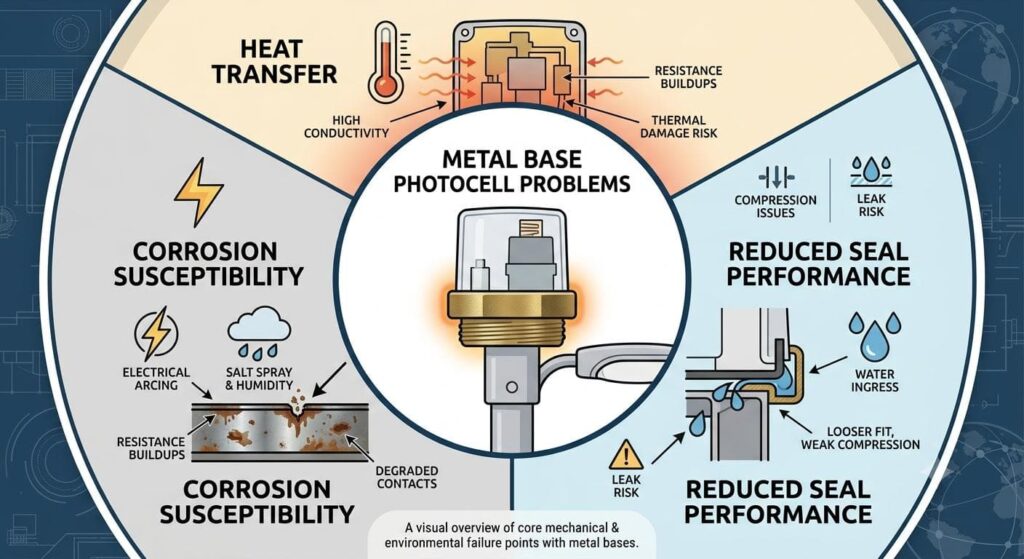
Three specific failure mechanisms make metal a poor material choice for outdoor photocell bases
Передача тепла
Metal’s high thermal conductivity is the most significant problem. In a 60°C outdoor environment, a metal base rapidly conducts heat from the external surface into the internal housing, raising the temperature around the PCB, relay, and sensing components above what the ambient temperature alone would produce. This accelerates component aging and increases the risk of thermal damage in sustained high-temperature conditions. A plastic base with low thermal conductivity acts as an insulating barrier that slows this heat transfer.
Corrosion Susceptibility
Metal bases are susceptible to corrosion from lightning-induced electrical arcing, coastal salt spray, and humidity. Electrochemical corrosion at the metal-to-metal contact points between the base and the receptacle terminals creates resistance that increases over time, generating heat and accelerating further degradation. Plastic bases don’t corrode in this way.
Reduced Waterproof Sealing Performance
The fit between a metal base and the plastic body of the photocell housing is less tight than a matched plastic-to-plastic interface. This looser fit reduces the compression on the sealing gasket and creates more opportunity for water ingress at the housing joint. Long-Join’s plastic bases are engineered to precise dimensional tolerances that maximise gasket compression and sealing performance.
What Does the Metal vs Plastic Debate Actually Involve?
The argument for metal bases rests on assumptions about strength and surge resistance that don’t hold up under examination.
| Base Type | Преимущества | Недостатки | Typical Use Cases |
| Metal Base | Solid structure, resistant to mechanical shocks | High thermal conductivity causes heat damage to components; poor corrosion resistance | Rare and expensive custom or special requirements |
| Plastic Base | Lightweight, low cost, flexible material processing, excellent waterproofing | Prone to aging, though environmental resistance improves annually | Mainstream outdoor photocell applications, standard mass production |
The claim that metal bases provide better heat resistance confuses heat resistance with heat conductivity. Metal withstands high temperatures without melting, but it also conducts heat efficiently into the components that need protection from it. The goal of the base material is to manage thermal transfer, not just survive thermal exposure. PBT performs better on the actual requirement.
The claim that metal bases are more surge-resistant lacks scientific grounding. Surge protection in a photocell is provided by the MOV surge arrester in the circuit, not by the base material. A plastic base with a properly rated MOV provides better surge protection than a metal base without one.
Plastic does age over time, and this is a legitimate concern. But the PBT formulation used in Long-Join’s bases, along with glass fibre reinforcement, UV stabiliser, and antioxidant additives, is designed specifically to resist the aging mechanisms that standard outdoor plastics succumb to. It maintains its mechanical and sealing properties significantly longer than unfilled or unprotected plastics.
Why Is a Plastic Base the Right Recommendation?
Long-Join recommends PBT composite plastic bases for outdoor photocells on cost, waterproofing, and environmental performance grounds, and the industry’s convergence on plastic for mainstream photocell applications reflects the same engineering conclusion.
1. Cost-effectiveness
Glass-fibre-reinforced PBT provides a base that meets all mechanical, thermal, and electrical requirements at a fraction of the material and manufacturing costs of a metal alternative. For high-volume municipal and commercial procurement, this matters significantly.
2, Waterproofing
The dimensional precision achievable in injection-moulded plastic, combined with the flexibility of the thermoplastic elastomer sealing elements, produces consistently tighter gasket compression than a metal base of equivalent design. In coastal environments with salt spray and humidity, this sealing performance is what keeps the internal components functional over years of service.
Environmental stability
In coastal saline environments, high-humidity tropical zones, and lightning-prone areas where photocell failures are most common and most expensive, plastic bases with proper material formulation consistently outperform metal alternatives in long-term service life.
You can find photocells with PBT on Чи-Клятва, along with their full specifications.
Conclusion on Metal Bases for Photocells
Metal bases sound more robust, but the engineering reality is the opposite for outdoor photocell applications. Long-Join’s PBT composite plastic base with glass fibre reinforcement, UV stabiliser, and antioxidant additives addresses all three of these issues while delivering the cost-effectiveness and manufacturing precision that mass-production outdoor photocell applications require.
Frequently Asked Questions on Metal Bases
Q1: Why doesn’t Long-Join choose metal bases?
Metal’s high thermal conductivity transfers heat into internal components rather than insulating them, and metal is more susceptible to electrochemical corrosion in outdoor environments. Both effects reduce service life compared to a properly formulated plastic base.
Q2: Are plastic bases prone to aging from heat and cold?
Standard plastic is, but Long-Join’s PBT with glass fibre reinforcement, UV stabiliser, and antioxidant additives resists the aging mechanisms that affect standard plastics. It maintains mechanical and sealing performance across the outdoor temperature and UV exposure range the photocell operates in.
Q3: Aren’t metal bases sturdier?
Metal has higher hardness, but Long-Join’s glass-fibre reinforced PBT is sufficiently strong for all installation and operational mechanical requirements. The strength advantage of metal does not translate into better photocell performance in outdoor applications.
Q4: Do plastic-based photocells leak water?
High-quality PBT with precise dimensional tolerances and waterproof silicone sealing actually provides superior sealing to metal bases because the plastic-to-plastic fit is tighter and the gasket compression more consistent.
Q5: Can metal bases be used in harsh coastal environments?
Not recommended. Salt spray and humidity accelerate electrochemical corrosion on metal surfaces and at metal-to-metal contact points. Plastic bases are significantly more resistant to these conditions and maintain their sealing and structural performance longer in coastal installations.