
Outline
- Introduction
- How Do JL-711A1 and JL-711A2 Handle Power Supply and Basic Performance?
- How Do the Built-in Light Sensing and Dimming Logic Work in Both Models?
- How Do Initialization and Delay Strategies Enhance System Stability?
- What Are the Key Functional Differences Between JL-711A1 and JL-711A2 Light Sensor Switches?
- How Do JL-711A1 and JL-711A2 Perform in Harsh Outdoor Environments?
- Final Words
The modern-day lighting demands smarter control and higher energy efficiency. The JL-711A photocell switch series answers this need with intelligent photocontrol dimmers built on the Zhaga Book 18 standard.
Both JL-711A1 and JL-711A2 use ambient light sensing to automate switching and dimming. At first glance, they look similar. The real difference lies in the control strategy and energy-saving depth.
This article breaks down:
- How each model works
- Where they differ
- How to choose the right one for your lighting project
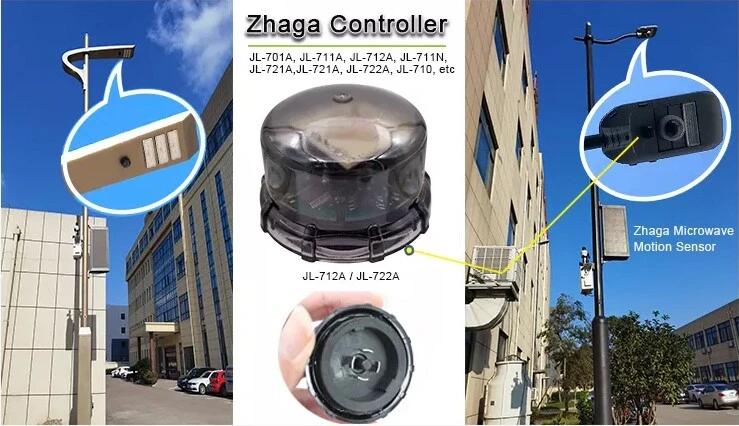
How Do JL-711A1 and JL-711A2 Handle Power Supply and Basic Performance?
Both photocell lighting sensors use a DC power source. They operate on a 12–24V DC range with a very low working current.
The typical draws are 5 mA and 6 mA, respectively, at 12 and 24v DC. This ensures minimal power use and long service life. The low current also reduces heat and improves reliability in outdoor fixtures.
Both models output a standard 0–10 V dimming signal. This signal is widely adopted in LED lighting systems and drives compatible LED drivers reliably.
This dimming interface tells the LED driver how bright the light should be. The JL-711A outdoor photocell light sensor series supports a ±2 % adjustment range and can source around 20 mA of driver current. This gives a stable control without a voltage sag.
With their energy-saving potential and dimming control, these controllers ensure smooth dimming and broad compatibility with most LED drivers that support standard dimming protocols.
The table outlines various driver interfaces and controls stability parameters for both products.
| Parameter | JL-711A1 | JL-711A2 | Practical Impact |
| Dimming Response Type | Linear 0-10V | Linear 0-10V + Smart Curve | Smoother brightness transition |
| Signal Noise Immunity | Standard Industrial | Enhanced Filtering | More stable in noisy grids |
| Driver Compatibility Range | Standard 0-10V Drivers | Wide Driver Tolerance | Better multi-brand support |
| Control Signal Stability | High | Very High | Less flicker risk |
How Do the Built-in Light Sensing and Dimming Logic Work in Both Models?
Both models use an optic photosensitive sensor. The sensor listens to real ambient light. It measures actual illuminance from dark to bright conditions.
The spectral capture covers 350–1100 nm with a peak around 550–560 nm. This wide range lets the controller sense visible light and some near-infrared.
How the Sensor Reads Light?
- Detects lux levels continually.
- Distinguishes real outdoor light from reflected glare.
- Works for dusk-to-dawn sensing without external triggers.
Turn-On and Turn-Off Logic
When outdoor light falls below ~50 lx ±10, the controller prepares to turn on. It waits until this level holds for 5 seconds before switching the light on. The turn-on delay avoids false triggers from passing shadows.
Reflected Light Compensation
Once the lights turn on, the controller adds +40 lx (±10) to real-time ambient readings to set the turn-off point. This prevents lights from turning off too early due to reflected light spikes.
There’s also an upper compensation limit of ~6000 lx to filter out false high lux caused by intense reflection.
This logic ensures stable, accurate automatic switching and dimming in diverse outdoor conditions.
How Do Initialization and Delay Strategies Enhance System Stability?
| Stage | Controller Behavior | Benefit to Installer |
| Power-On First Time | Auto self-check | No manual calibration needed |
| Sensor Initialization | Automatic ambient learning | Faster commissioning |
| Delay Logic Activation | Pre-configured | No parameter setup required |
| Driver Communication | Auto signal output | Plug-and-play installation |
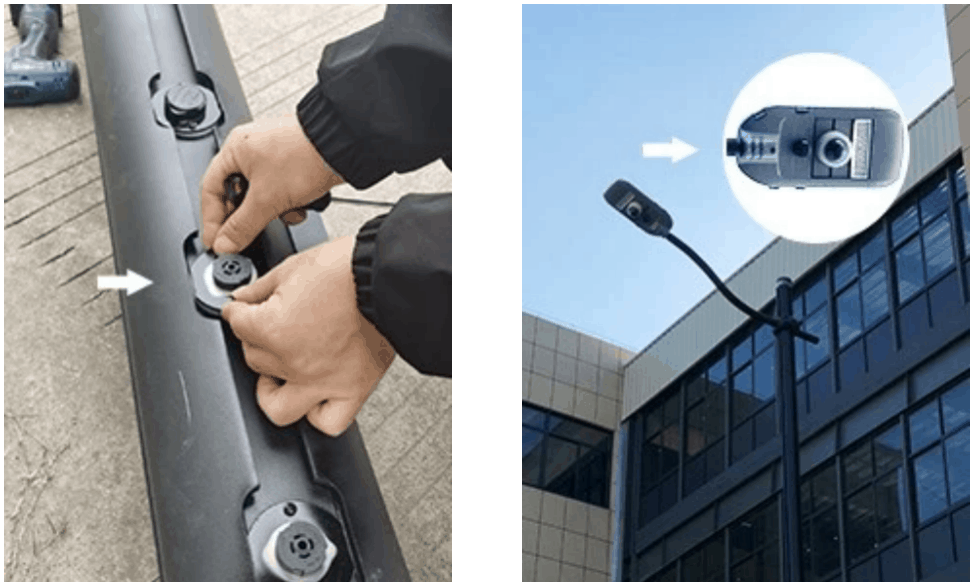
JL-711A1 and JL-711A2 Photocell For Street Light Use a Power-Up Full-Brightness Initialization Process
When power is first applied, both variants turn the light fully on for about 5 seconds. The brightness is full for this brief time. This startup helps the controller calibrate to the true ambient lighting level.
The light automatically switches off then and enters its normal self-sensing mode. This ensures the system does not misread surrounding light at startup due to transient conditions like shadows and reflected glare.
Light-On and Light-Off Delays Prevent False Triggering and Flicker
Both models use built-in delays to boost stability and prevent nuisance switching.
Light-On Delay
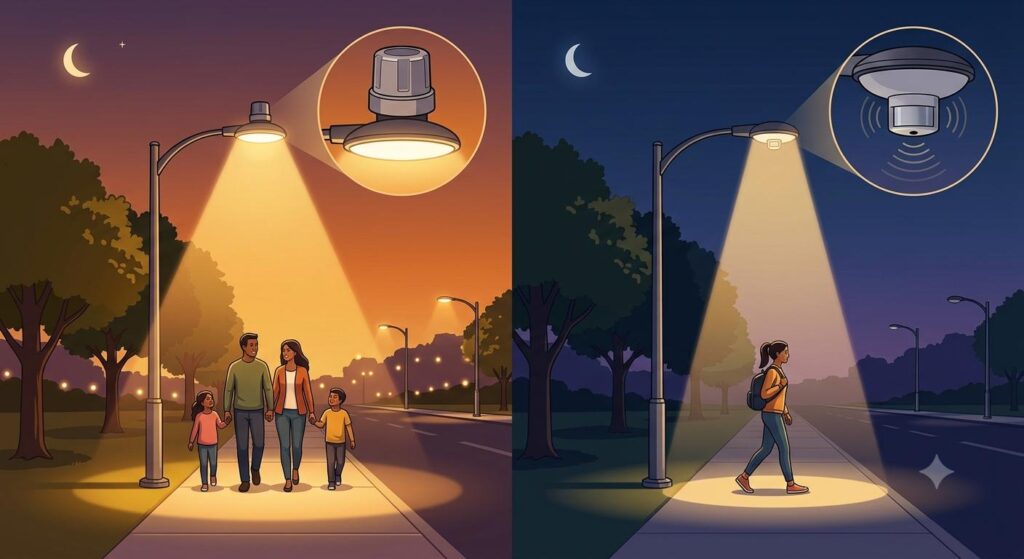
The controller checks that the ambient light meets the “dark” threshold continuously for 5 seconds before switching on. This avoids activation from brief shadows or passing vehicles.
Light-Off Delay
To prevent flicker caused by short bursts of light from artificial sources, the sensor delays turning off the lights for 20 seconds if the brightness exceeds the threshold.
These strategies ensure the controller responds to stable lighting conditions and not momentary fluctuations. This ultimately improves overall reliability.
What Are the Key Functional Differences Between JL-711A1 and JL-711A2 Light Sensor Switches?
Both models share core photoelectric sensor features. However, JL-711A2 adds advanced energy management and midnight dimming functions that A1 lacks. These enhancements make A2 smarter and more efficient for demanding lighting deployments.
| Lighting Scenario | JL-711A1 Saving Potential | JL-711A2 Saving Potential |
| Standard Dusk-to-Dawn | Medium | High |
| Smart Dim Street Lighting | Medium | Very High |
| Midnight Low Traffic Zones | Low | Very High |
| Smart City Adaptive Zones | Medium | Very High |
JL-711A2’s Energy-Saving Strategy Ratio Adjustment
JL-711A2 photocell led street light supports an energy-saving strategy that is factory preset to adjust dimming behavior based on time and lighting conditions. This ratio adjustment lets the controller reduce output more intelligently during low-demand periods.
Instead of staying at full brightness all night, A2 can optimize power usage, cutting energy use while keeping safety and visibility.
The strategy isn’t a simple on/off threshold; it tailors dimming levels to match environmental conditions. The result is lower energy bills and a smarter dimming curve across nocturnal hours.
Midnight Dimming Function and Seasonal Adaptation
JL-711A2’s midnight dimming automatically adjusts brightness for a portion of the night. It calculates the average night duration in the first ten days after installation. Based on this, it sets a midnight base period.
For example, it can default the dimming to around level 50 brightness for about 40 % of the night.
This automation adapts to seasonal changes. Longer nights in winter trigger longer dim periods and vice versa. The result is dynamic energy savings without manual reconfiguration.
Compared to A1, JL-711A2’s features give it greater efficiency and adaptability for projects prioritizing energy management and smart dimming.
How Do JL-711A1 and JL-711A2 Perform in Harsh Outdoor Environments?

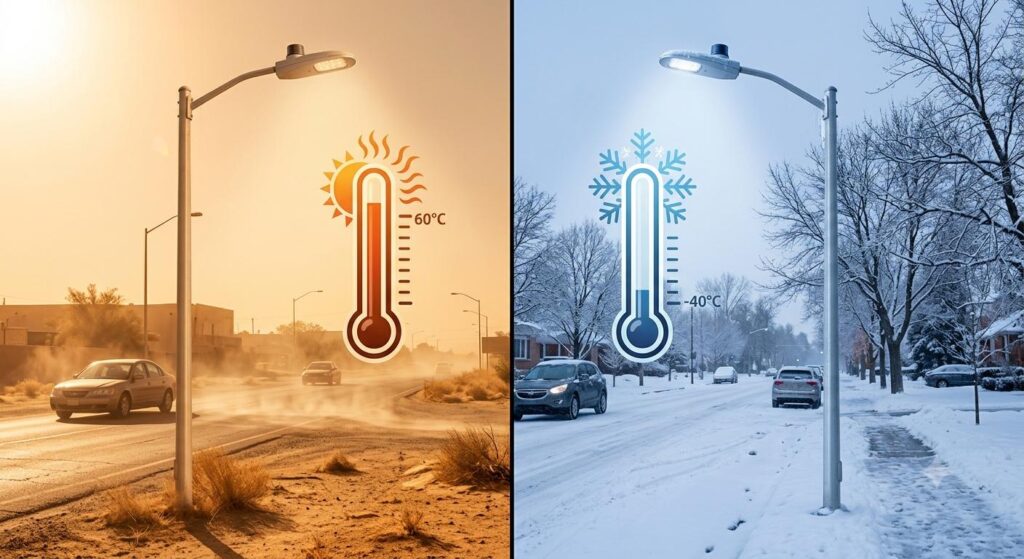
Both models are built to withstand extreme weather and environmental stress. They operate reliably over a wide range of temperatures and relative humidity.
Their internal components resist electrostatic discharge up to ±8 kV (contact) and ±15 kV (air). This limits sensor misreads from static surges. They also comply with IEC mechanical vibration standards. This means normal pole vibration won’t affect the function.
IP66 Protection and Certifications
● IP66 rating
Complete dust ingress protection and ability to handle powerful water jets without leak-through. This keeps circuitry dry and functional in heavy rain and washing.
● CE certification
Confirms conformity with EU electronics safety and environmental requirements. This adds to quality assurance.
● Zhaga Book 18 compliance
Guarantees mechanical and electrical interoperability with Zhaga-standard sockets and luminaire bases. This ensures durable integration.
Together, these protections mean both photocells remain stable and durable in harsh outdoor installations. This minimizes failures and maintenance cycles.
Quick Model Selection Guide
| If Your Project Needs… | Choose |
| Basic Reliable Photocontrol | JL-711A1 |
| Energy Optimization Priority | JL-711A2 |
| Smart City Lighting | JL-711A2 |
| Budget Sensitive Project | JL-711A1 |
| Long-Term Energy ROI | JL-711A2 |
Final Words
JL-711A1 and JL-711A2 both deliver stable, intelligent photocontrol performance for modern outdoor lighting. JL-711A2 adds deeper energy optimization and smarter night dimming for advanced projects. For reliable sourcing, Chi-Swear is known for consistent supply and strong technical support for Long-Join photocontrollers. They are a practical choice for buyers who want stable quality and long-term cooperation.
External Links
- https://en.wikipedia.org/wiki/0-10_V_lighting_control
- https://en.wikipedia.org/wiki/Lux
- https://www.iec.ch/homepage
- https://en.wikipedia.org/wiki/IP_code
- https://europa.eu/youreurope/business/product-requirements/labels-markings/ce-marking/index_en.htm
- https://www.zhagastandard.org/books/overview/smart-interface-between-outdoor-luminaires-and-sensing-communication-modules-18.html

 English
 Spanish
 Russian
 Arabic
 Italian
 Japanese
 Portuguese