OUTLINE
- مقدمة
- How Does a Dusk-to-Dawn Sensor Work with an LED Floodlight?
- What Are the Common Power and Voltage Ranges of LED Floodlights?
- What Should You Check Before Specifying a Photocell for an LED Floodlight?
- How Do the Long-Join Models Compare Against Each Fixture Type?
- Rounding Up
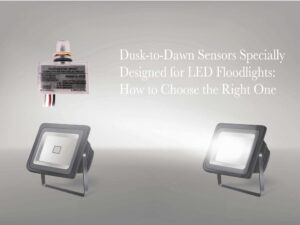
LED floodlights have become very popular in some of the most demanding new-age outdoor lighting systems, such as security and site lighting.
We depend on these essential lights to come on reliably at dusk and go off at dawn, without the need for any human intervention.
That responsibility falls to the dusk-to-dawn photocell sensor. These sensors are the driving force behind accurate and timely control of these lighting systems.
There are Long-Join photocell options for LED floodlights, but only when you know the right specifications can you truly make the right decision.
How Does a Dusk-to-Dawn Sensor Work with an LED Floodlight?
A dusk-to-dawn photocell sensor monitors changes in the intensity of ambient light and uses it to control the switching circuit. The circuit automatically turns on and off the floodlight based on the lux levels.
The core principle is that simple, and involves the photosensitive sensor monitoring the light environment continuously. When ambient lux drops below the preset on-threshold, the relay closes, and the load circuit activates. When lux rises above the off-threshold at dawn, the relay opens, and the light goes off.
For LED floodlights specifically, a few things matter beyond the basic principle:
- LED drivers have different inrush characteristics than traditional HID or tungsten loads. The photocell’s relay needs to be rated for the driver’s startup surge, not just its running wattage
- LED floodlights often run at wider voltage ranges (100–277V or even 277–480V in high-voltage commercial variants), so the photocell’s operating voltage must cover the full supply range
- LED systems are more sensitive to nuisance tripping. A photocell without a proper time delay will cause the fixture to flicker on and off when a vehicle headlight sweeps across the sensor, which accelerates relay wear and disrupts operations
Long-Join’s phototransistor-based models address all three of these points through their sensing accuracy, wide voltage coverage, and built-in delay functions.
What Are the Common Power and Voltage Ranges of LED Floodlights?
LED floodlights can have power values as low as 24W, commonly found in residential security lights, or as high as 200W, like in industrial fixtures.
However, that’s not all. You also have to consider that a photocell must match both the wattage and the supply voltage of the specific fixture, and knowledge of these categories is the first step before selecting a photocell.
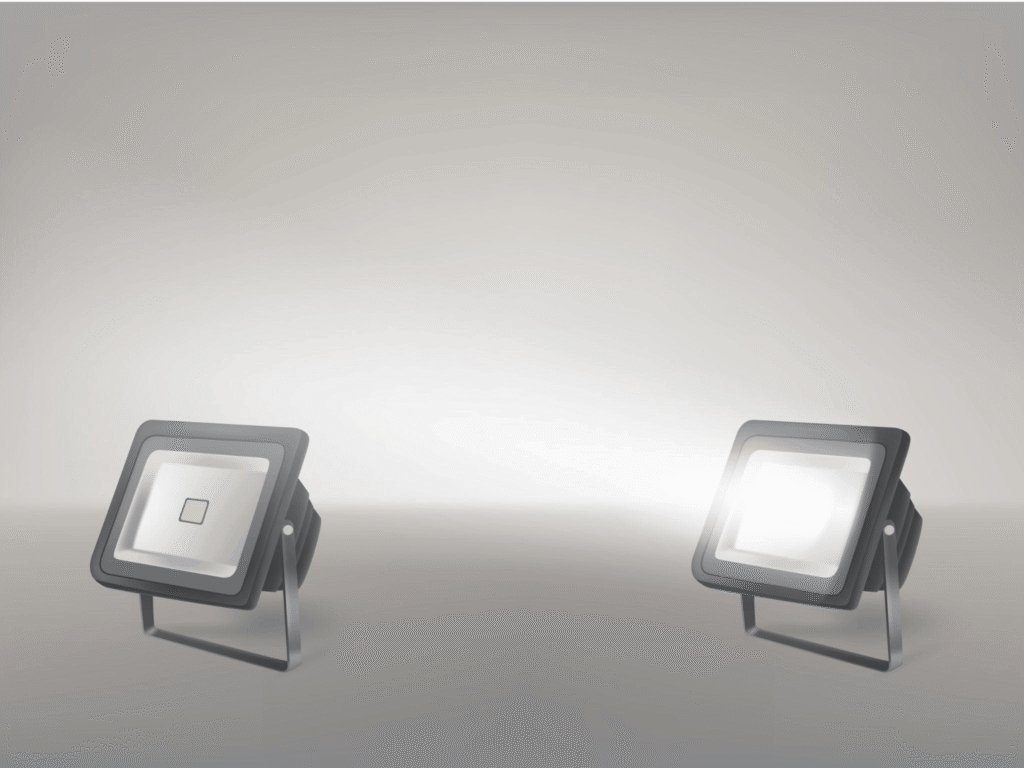
Low to Medium Power LED Dual-Head Security Lights
You could have power as low as 24W, 25W, or 32W. Although low, this category typically covers a wide voltage input range of 120V to 277V. They are most common in residential and small commercial security lights.
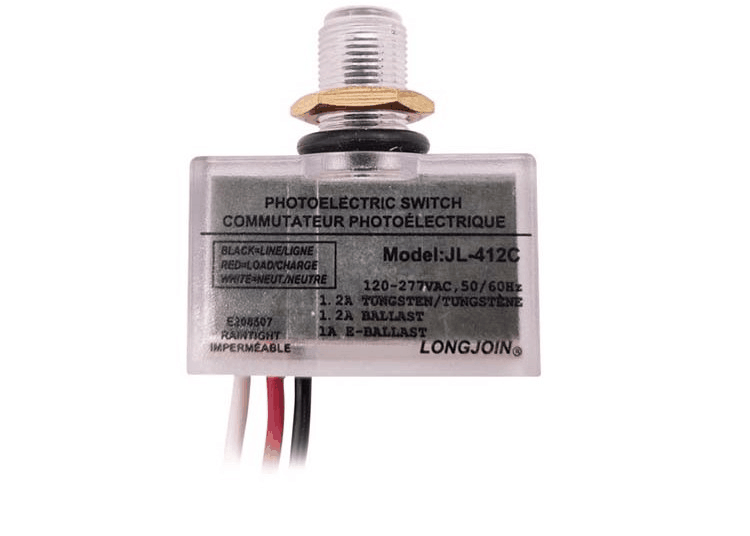
The JL-412 series is the right fit here. Key specs:
- Rated voltage: 120–277VAC
- On/off lux level: 10–30 lux on / 30–60 lux off
- IP rating: IP65
- Compliance: UL773A, CE, RoHS
- Compact button format — fits standard knockout holes on most residential fixtures
ال JL-412 series uses phototransistor sensing, which gives it a more precise switching response than older CDS-based models. For low-to-mid-power fixtures in residential environments, it covers the load comfortably.
High Power LED Dual-Head Security Lights
These heavier fixtures are used in large outdoor sites such as construction yards, industrial perimeters, loading docks, and agricultural outbuildings. They could have between 80W and 200W of power, combining with voltage ranges of 110-120V. They carry a much higher load, and in many North American installations, they run on single-phase 120V supplies.
The JL-403C and JL-103A are the appropriate choices:
- JL-403C — Electronic phototransistor design, 120–277VAC wide voltage range, rated 500W tungsten load. Built-in 3–10 second delay prevents false switching from vehicle headlights. UL773A listed. IP54. Good choice when you need one model to cover varied supply voltages across a larger installation
- JL-103A — Thermal bimetal design, 120VAC, rated 500W tungsten / 850VA ballast. 120V-specific. Simple, long-service-life option for installations where the supply voltage is fixed, and replacement ease is a priority
For fixtures running at very high wattages where load rating is a concern, the JL-103AG (1,800W rated) and JL-103DG (2,000W rated) are available as higher-capacity variants within the JL-103 family.
Short-Arm Barn Lights
Short-arm barn lights are a compact fixture format popular in farm buildings, small workshops, and rural pathway lighting. Their 100–277VAC input range covers both US single-phase and split-phase supplies, and their wattage of about 45W keeps them in the JL-412 series territory.
The JL-412 series handles this application well; its IP65 rating gives it adequate outdoor protection for the exposed wall-mount positions typical of barn installations, and its wide voltage range covers the full 100–277V input without needing a separate model.
Maxlite Barn Lights
Maxlite’s LED barn lights effectively cover a wide range of power (100-175W) and voltage (277-480V). With such high demands, the JL-403C and JL-103A are better suited to handling them.
The Maxlite barn light includes a built-in photocell in most configurations, but in retrofit or replacement scenarios where the factory photocell needs replacing, this is the matching approach.
naturaLED Barn Lights (30W — 120–277VAC)
naturaLED’s security barn light is a 30W LED unit replacing 200W mercury vapor fixtures, rated IP65 with a die-cast aluminum housing. It combines a 30W output with a 120–277VAC input range, which puts it in a similar category as other low-power barn lights.
The JL-412 series is the appropriate match in this case, as the load is well within the rated capacity, the voltage range aligns, and the IP65 rating on the JL-412C matches the fixture’s own environmental rating.
What Should You Check Before Specifying a Photocell for an LED Floodlight?
Four factors determine whether a photocell will work reliably with a specific LED floodlight: rated voltage, load capacity, installation environment, and response characteristics.
Work through these in order before finalising a model:
نطاق الجهد
Confirm the fixture’s rated input voltage and check that it falls within the photocell’s operating range. Don’t just check the nominal voltage; check whether the fixture supports a range (e.g., 100–277V) and confirm the photocell covers that entire range, not just the midpoint.
- Low-to-medium power fixtures at 120–277VAC → JL-412 series
- High-power or wide-voltage requirements → JL-403C
- Fixed 120VAC installations → JL-103A
- 480VAC systems → JL-207F
تصنيف الحمل
Check the fixture’s actual running wattage and its stated inrush current. The photocell’s load rating must exceed the running wattage comfortably. For LED drivers with significant inrush current on startup, confirm the relay is rated to handle that surge repeatedly over thousands of switching cycles.
بيئة التركيب
Outdoor floodlights in exposed positions need IP65 or higher. For coastal environments, dusty industrial sites, or fixtures in agricultural buildings where cleaning fluids or fertilisers may be used nearby, specify IP65 as a minimum; the JL-412C and JL-403C both offer this level.
Response Characteristics
In environments with significant artificial light — vehicle headlights, nearby signs, or adjacent fixtures — a time delay of at least 3–10 seconds is essential to prevent nuisance tripping. Both the JL-403C and JL-412 series include built-in delay functions. For environments with IR-heavy sources, the JL-207C with its IR-filtered phototransistor is worth considering.
How Do the Long-Join Models Compare Against Each Fixture Type?
| LED Fixture Type | Power Range | نطاق الجهد | Recommended Long-Join Models | Key Notes |
| Low-to-medium power dual-head security light | 24W, 25W, 32W | 120–277 فولت تيار متردد | JL-412 series | Residential and small commercial; wide voltage coverage |
| High-power dual-head security light | 80–200W+ | 110–120VAC | JL-403C, JL-103A | Large outdoor sites and industrial areas; check load rating |
| Short-arm barn light | 45W | 100–277VAC | JL-412 series | Farm and rural use; IP65 outdoor protection |
| Maxlite barn light (standard) | 36–60W | 120–277 فولت تيار متردد | JL-412 series | HID replacement; selectable wattage |
| Maxlite barn light (high voltage option) | 36–60W | 277–480VAC | JL-403C / JL-207F | Specify JL-207F at 480V |
| naturaLED barn light | 30W | 120–277 فولت تيار متردد | JL-412 series | Low-power energy-saving type; IP65 environment |
Browse Chi-Swear’s full photocell range for complete JL-412, JL-403C, and JL-103A specifications, and visit Chi-Swear’s wire-in photocell section for mounting options across all fixture types.
Rounding Up
Choosing the right dusk-to-dawn sensor for an LED floodlight involves getting the right combination of voltage range, load rating, IP protection, and response behaviour. On Chi-Swear, you can find Long-Join’s JL-412 series, which covers the majority of standard residential and commercial floodlight applications, as well as the JL-403C and JL-103A, which handle the higher-power and higher-voltage requirements of industrial and agricultural installations. Match the spec, not just the price point.