OUTLINE
- مقدمة
- What Does the JL-207C5-F23-HP-P-IP65 Model Code Actually Mean?
- Why Does ANSI C136.10 Testing Matter?
- What Do Photocell Suppliers Need to Demonstrate Under ANSI Testing?
- Is UL773 Testing Mandatory?
- What Is the Significance of Switch Cycles and Photocell Lifecycle?
- What Is the Minimum Waterproof Rating for Outdoor Photocell Applications?
- Does the JL-207C5-F23-HP-P-IP65 Have Surge Protection?
Have you ever received a photocell datasheet with a string of characters like “JL-207C5-F23-HP-P-IP65” and wondered what each part actually means?
Most photocell sensor buyers focus on the headline specs such as voltage, load, IP rating, and stop there. But the model code tells you a lot more, and understanding it matters especially when you’re evaluating ANSI C136.10-2010 compliance for a procurement decision or a North American market entry.
Let’s take a look at what ANSI C136.10-2010 testing actually covers, what the JL-207C5-F23-HP-P-IP65 model code means, and what the test results tell you about the unit’s suitability for real-world street lighting applications.
What Does the JL-207C5-F23-HP-P-IP65 Model Code Actually Mean?
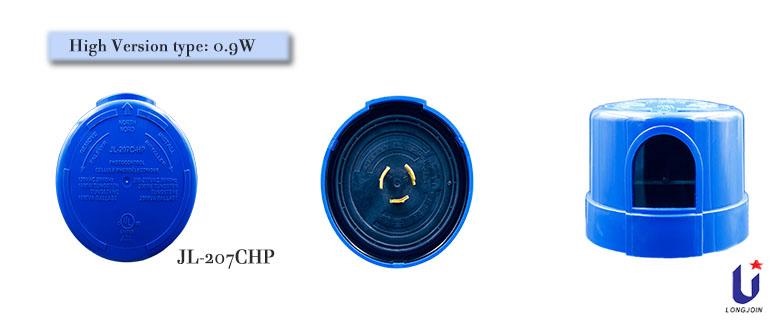
The model number for Long-Join photocells is a structured code where each segment describes a specific technical parameter, and understanding it tells you almost everything about the unit before you read a single line of the spec sheet.
Here’s a breakdown of the code:
| Code Segment | Position | معنى |
| JL-207C | Base model | JL-207 series, 120–277VAC |
| 5 | Fail mode | 5 = Fail-On (light stays on if photocell fails) |
| F | نوع المستشعر | F = IR-filtered phototransistor |
| 23 | MOV surge arrester | 23 = 460 joules / 10,000 amp surge capacity |
| HP | Relay type | HP = High-Power 20-amp relay |
| ص | Enclosure material | P = UV-stabilised polypropylene housing |
| IP65 | Waterproof rating | IP65 = dust-tight, protected against water jets |
In summary, the JL-207C5-F23-HP-P-IP65 is a Fail-On unit with IR-filtered sensing, 460J/10,000A surge protection, a 20-amp high-power relay, polypropylene housing, and IP65 waterproofing. This is a high-specification variant of the JL-207C designed for demanding street lighting and industrial applications.
Why Does ANSI C136.10 Testing Matter?
ANSI C136.10-2010 is the American National Standard governing the physical and electrical interchangeability of locking-type photocontrol devices. Passing it is a prerequisite for supplying twist-lock photocells to North American street lighting projects and a strong credibility signal for international procurement.
Think of it this way. A city purchasing manager in Chicago, Toronto, or any North American municipality can’t inspect every photocell they install. ANSI C136.10-2010 compliance is the shorthand that tells them the product has been independently tested against standardised criteria for mechanical fit, electrical performance, and environmental durability.
Without this test, a photocell can’t physically guarantee compatibility with the مقابس NEMA already installed on their luminaires, and it can’t be specified on any project requiring certified products.
Advantages of ANSI C136.10 Testing
Appropriate testing confirms that the photocell:
- is compatible with certain fixtures
- meets the strict standards of the North American street lighting industry
- is guaranteed safe and reliable
- can enter into the North American and international markets
- meets customer certification requirements
What Do Photocell Suppliers Need to Demonstrate Under ANSI Testing?
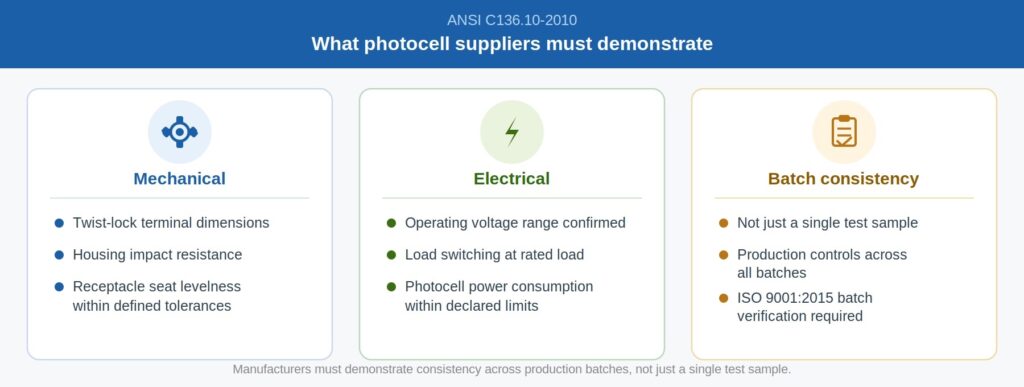
ANSI C136.10-2010 sets out specific performance requirements that manufacturers must meet across mechanical, electrical, and environmental dimensions, and they must demonstrate consistency across production batches, not just a single test sample.
Mechanical requirements
- Twist-lock terminals must conform to the standard’s dimensional specifications
- The housing must withstand impact testing
- The photocontrol receptacle seat must be level to within defined tolerances when installed on a luminaire
Electrical requirements
- Operating voltage must be confirmed across the declared range
- Load switching must be verified at the rated load
- Power consumption of the photocell itself must fall within declared limits
Batch consistency
This is often the difference between a supplier that tests one sample and ships whatever they produce, and one that applies production controls. Long-Join’s ISO 9001:2015-certified manufacturing process (GB/T 19001-2016) covers batch verification to ensure the product you receive matches what was tested.
Is UL773 Testing Mandatory?
UL773 is not universally mandatory, but for any photocell sensor intended for the North American market, it is a practical requirement that determines whether a product can be seriously considered by most buyers.
UL773 is the مختبرات أندررايترز standard specifically for plug-in, locking-type photocontrols used in area lighting. It covers maximum loading testing, high current surge tests, temperature and environmental testing, and lifespan testing, all to verify product load performance at 120VAC.
The JL-207C5-F23-HP-P-IP65 is listed by UL for both the US and Canadian markets under UL773. For procurement teams in North America, this listing, together with the ANSI C136.10-2010 test report, provides the documentation chain needed to specify and purchase with confidence.
When is UL773 not mandatory?
In European, Middle Eastern, and many Asian markets, CE marking and local equivalent standards apply instead. A product can carry CE and RoHS certification without UL773 listing. However, the rigour of UL773 lifecycle testing is often cited by international procurement teams as evidence of quality, even where it is not formally required.
What Is the Significance of Switch Cycles and Photocell Lifecycle?
Switch cycle life is one of the most practical indicators of photocell quality. It directly determines how long the unit lasts in service and how often maintenance teams need to plan for replacement.
A photocell switches twice per day under normal street lighting conditions; on at dusk, off at dawn. That’s 730 cycles per year. Over ten years, that’s 7,300 cycles. JL-207C series products undergo 30,000 switching tests.
The standard JL-207C relay is rated at 10,000+ cycles, covering more than 13 years of daily switching. The HP version in this model is rated at over 50,000 cycles, covering well over 68 years of theoretical relay life at two switches per day.
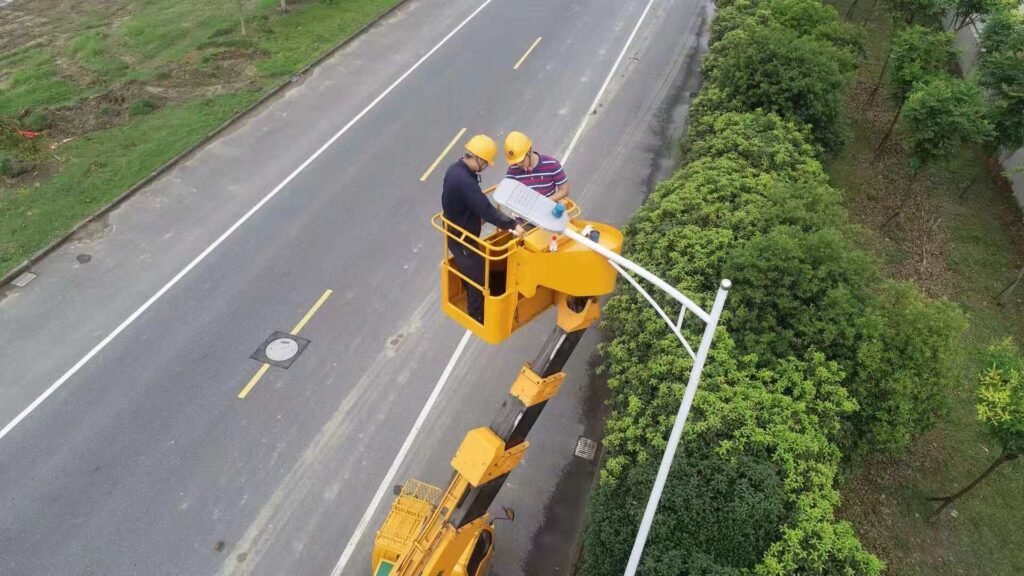
Every photocell replacement on a street light pole involves a maintenance visit. At height, that means a bucket truck or scaffolding. A photocell that lasts twice as long cuts the number of those visits in half, and the maintenance cost savings over 10 years can significantly exceed the cost difference between a standard and high-specification unit.
What Is the Minimum Waterproof Rating for Outdoor Photocell Applications?
IP65 is the practical minimum for any fully exposed outdoor photocell application. It ensures the unit is completely sealed against dust ingress and resistant to water jets from any direction, which covers most outdoor weather conditions globally.
ال IP (Ingress Protection) rating system defines two numbers: the first covers solid particle protection, the second covers liquid protection. IP65 means:
- 6 — Dust-tight. No ingress of dust under any conditions
- 5 — Protected against water jets from any direction at a defined flow rate and pressure
For a photocell mounted on a street light pole, rain hits from any angle, depending on wind direction. IP65 covers this. A photocell without an IP65 rating will often be rejected at the qualification stage, regardless of other specifications. The JL-207C5-F23-HP-P-IP65 meets this requirement by definition.
Does the JL-207C5-F23-HP-P-IP65 Have Surge Protection?
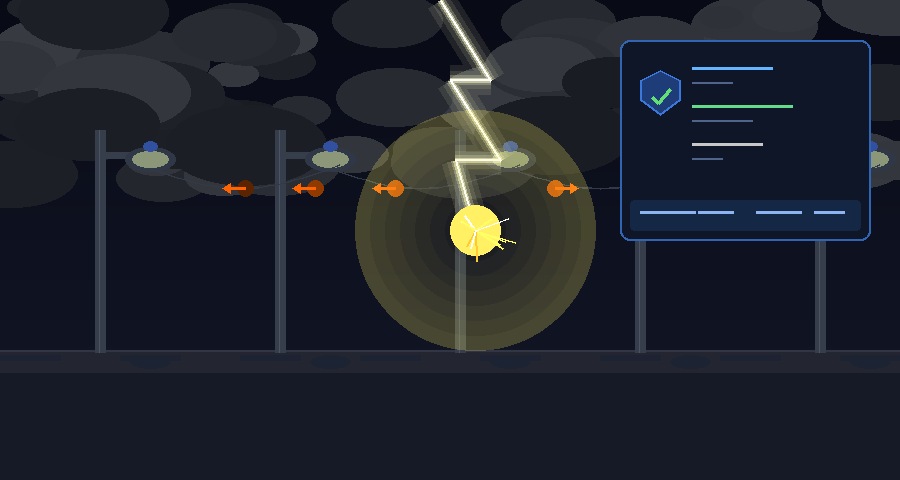
The “-F23-” segment in the model code specifies a built-in MOV (Metal Oxide Varistor) surge arrester rated at 460 joules and 10,000 amps, which protects the photocell and connected luminaire against lightning-induced voltage spikes and grid transients.
Surge protection in photocells matters for two reasons. First, a voltage spike that destroys the photocell also interrupts the street light, creating a safety issue and a maintenance call. Second, without a surge arrester, high-voltage transients can propagate from the photocell into the luminaire driver, causing damage far more expensive to repair than a failed photocell.
As urban lighting networks become more connected, the consequence of a surge event grows. A spike in a smart city or high-end lighting project can now disrupt a network node and trigger a fault alert across dozens of connected fixtures. Adequate surge protection at the photocell level is increasingly treated as a network protection measure rather than just a component protection measure.
The JL-207C5-F23-HP-P-IP65 is not a generic photocell. It’s a specifically configured unit where every segment of the model code represents a deliberate engineering decision. ANSI C136.10-2010 compliance confirms it meets North American interchangeability and performance standards. UL773 listing verifies its load switching performance for the US and Canadian markets.
Browse Chi-Swear’s JL-207C product page for full specifications and model configuration options, and visit Chi-Swear’s twist-lock photocell section for compatible NEMA receptacle options.