
Outline
- Introduction
- What Are the Core Technical Specifications of the JL-215C Light Sensor Switch?
- What Are the Core Technical Specifications of the JL-215E Photocontrol Receptacle?
- How Do JL-215E and JL-215C Compare in Key Technical Parameters?
- In Which Lighting Application Environments Does Each Model Perform Best?
- How Should Users Select Between JL-215E and JL-215C Based on Application Needs?
- Final Words
Why are photoelectric sensors becoming critical in modern outdoor lighting systems?
Cities are upgrading to LED infrastructure. Voltage systems vary across regions. Surge exposure is increasing. Project owners now demand stable switching and longer lamp life.
JL-215E and JL-215C are designed for these evolving needs. Both support wide voltage ranges. Both offer surge protection and outdoor durability. But their technical positioning is different.
Understanding these differences is essential. The right model improves system stability. The wrong choice increases maintenance costs. This comparison helps you select with clarity and confidence.
What Are the Core Technical Specifications of the JL-215C Light Sensor Switch?
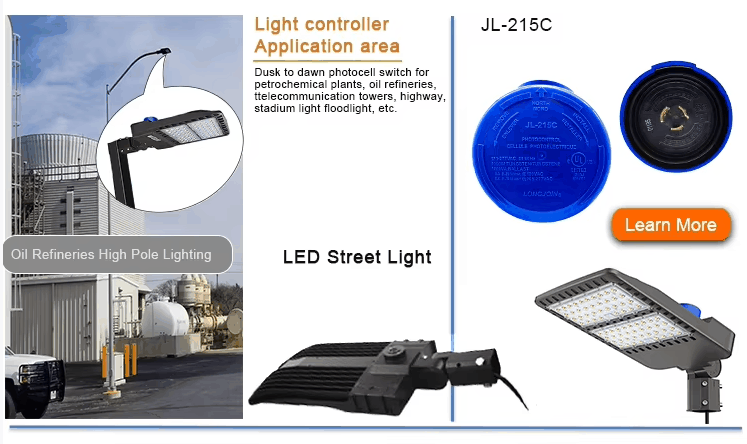
The JL-215C is a robust twist-lock photoelectric sensor designed for outdoor lighting systems. It works with a wide voltage range — rated 120–277 VAC and safely operable from about 105–305 VAC, making it suitable for diverse regional power grids.
Its load handling supports up to:
- 1000 W tungsten lamps
- 1800 VA ballasts
- 8 A @120 VAC or 5 A @208-277 VAC electronic ballasts
while maintaining low power consumption (max ~0.5 W).
The light-sensing thresholds trigger at about 10 to 30 lux for ON. For OFF, it’s 30 to 60 lux. This ensures reliable switching automation.
Weather resistance options include higher IP ratings of up to IP67. This protects against dust and water ingress in harsh conditions.
Integrated surge protection, i.e, MOV, guards against voltage spikes. A 3–20 s delay prevents misoperations from headlights or lightning.
Key features at a glance:
- ANSI C136.10 twist-lock standard
- Fail-ON default mode
- Enhanced power-factor performance over earlier series
What Are the Core Technical Specifications of the JL-215E Photocontrol Receptacle?
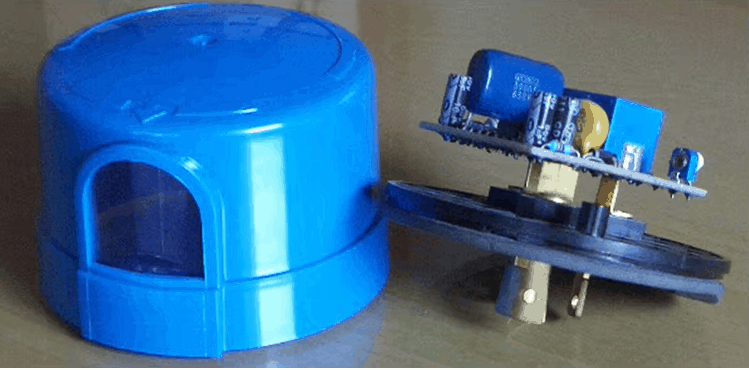
This is a twist-lock light sensor switch built for high-voltage applications. It is rated for 347 VAC and operates over a wide voltage span. This makes it ideal for regions with elevated supply voltages. Its design follows ANSI C136.10 standards for area lighting twist-lock photocontrols.
Electrical and Load Performance
It handles typical street lighting loads efficiently:
- Load supports are up to 1000 W tungsten and 1800 VA ballast.
- Power consumption stays around 1 W. This ensures low standby draw.
Light Threshold and Protection
- Light-on/light-off triggers are tuned for dusk-to-dawn switching.
- Higher IP housing options protect from dust and water in harsh conditions. This extends outdoor life.
Surge Protection & Control Features
Integrated MOV surge protection guards against voltage spikes. This model does not use zero-cross switching, trading advanced switching for simplicity and broad voltage tolerance.
Simple Operation Logic
Unlike its counterpart, the JL-215E light photocell sensor has:
- No preset light sensitivity settings.
- No delay adjustment option. It switches purely based on ambient light. This makes it ideal for stable high voltages rather than feature-rich urban systems.
How Do JL-215E and JL-215C Compare in Key Technical Parameters?
Below is a direct comparison table showing core technical differences between JL-215E and JL-215C photocontrols:
| Parameter | JL-215E | JL-215C |
| Rated Voltage | 347 VAC | 120–277 VAC |
| Applicable Voltage Range | ~120–382 VAC | ~105–305 VAC |
| Rated Load | 1000 W tungsten, 1800 VA ballast | 1000 W tungsten, 1800 VA ballast; 8 A @120 VAC / 5 A @208-277 VAC e-ballast |
| Power Consumption | ~1 W | ~0.5 W |
| Light-ON / OFF Thresholds | Standard dusk-to-dawn switching | Standard dusk-to-dawn switching |
| Protection Rating | IP54 / IP65 / IP67 | IP54 / IP65 / IP67 |
| Surge Protection | Built-in MOV | Built-in MOV |
| Zero-Cross Technology | No | Not specified (varies by variant) |
| Preset Sensitivity / Delay | No | Delay 3-20 s |
| Certification | Typically UL/ANSI (model dependent) | FCC certified |
In Which Lighting Application Environments Does Each Model Perform Best?
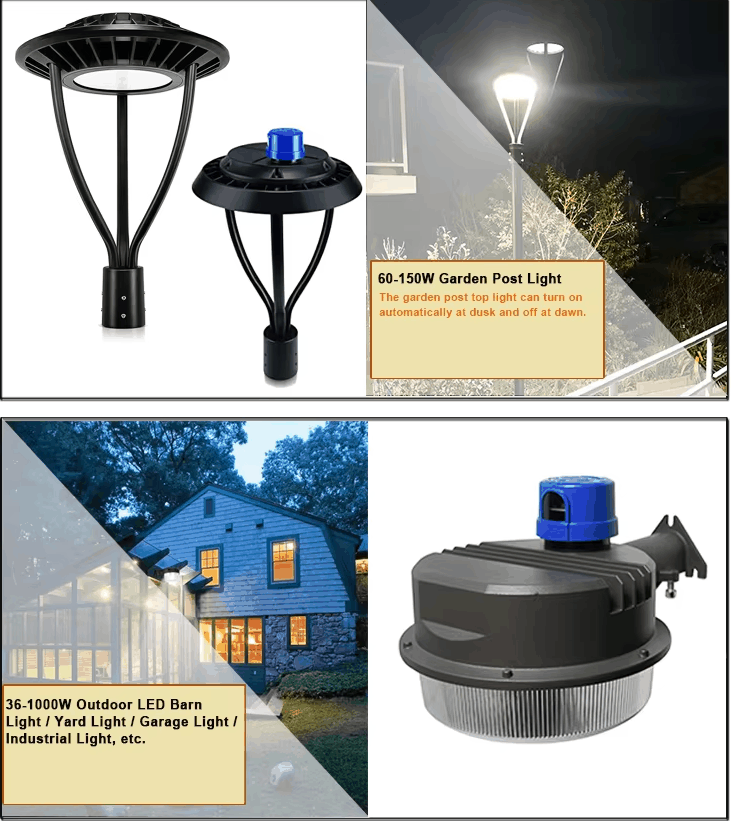
JL-215C Suitable for Urban and Commercial Lighting Projects
This lighting control excels in complex urban lighting systems. Here is why:
- It supports multiple voltage zones common in cities and campuses.
- Its wide voltage tolerance ensures reliable switching automation across different circuits.
- Its preset delay and sensitivity control prevent nuisance switching from brief light pulses such as vehicle headlights.
This makes it ideal for urban street lights and pedestrian pathways where precise switching and energy savings are priorities. Further, the integrated surge arrester also helps protect against line transients in densely wired grids.
JL-215E More Suitable for High-Voltage and Industrial Applications
This light photocell switch is tailored for 347 V environments often found on highways and industrial estates. Its design emphasizes simplicity and durability with fewer adjustable features. This lowers failure points in harsh electrical conditions.
The photoelectric controller has robust MOV surge protection that guards against spikes caused by long cable runs and exposed outdoor infrastructure. Ultimately, the product became a strong choice for lighting and industrial park outdoor luminaires.
Real World Application Scenarios
Real cases show each model has clear strengths and suitable niches:
- JL-215C light sensor control offers feature flexibility. This makes it better for dynamic environments where light levels vary greatly. Its sensitivity and delay help reduce false triggers and save energy.
- JL-215E outdoor light sensor switch delivers operational stability with high voltages. The light circuits are stable and have fewer electronic features to fail. It’s cost-effective where advanced control isn’t needed.
How Should Users Select Between JL-215E and JL-215C Based on Application Needs?

Selecting the right street light controller starts with voltage system matching. Choose JL-215C for standard multi-voltage grids (≈120–277 VAC). Pick JL-215E when your installation runs at 347 VAC or above. Reliable voltage match avoids nuisance trips or early failures.
Environmental and Surge Considerations
- Complex urban grids with rapid load changes benefit from JL-215C’s features and its surge protection.
- High surge zones like highways and industrial yards favor JL-215E for its rugged, simple design and wide range tolerance.
Surge protection in both helps limit damage from lightning or grid spikes.
Control Features and Lamp Life
JL-215C’s preset delay and sensitivity prevent false switching from transient light changes, which protects lamps and reduces switching wear. JL-215E lacks these features but offers stable basic switching with fewer parts to fail.
Practical Stability and Efficiency Impact
● System stability
JL-215C is better for variable environments with sensitive control needs.
● Maintenance
JL-215E’s simpler design can reduce service visits in steady conditions.
● Energy efficiency
Delays in JL-215C prevent unnecessary switching that saves energy over time.
Contractor and Engineer Decision Framework
- Check the supply voltage first.
- Assess how dynamic the lighting site is.
- Prioritize preset and delay functions when false triggers are costly.
- Prefer robust simplicity for high-voltage, stable lighting runs.
This structured approach helps you choose the model that best fits project voltage and extended operational goals.
| Operational Factor | JL-215C | JL-215E |
| False Trigger Resistance | Higher (delay function) | Standard |
| Switching Wear on Lamps | Reduced | Normal |
| Maintenance Frequency | Lower in dynamic sites | Lower in stable sites |
| Installation Complexity | Standard | Standard |
| Long-Term Energy Optimization | Better in mixed-light zones | Best in stable high-voltage zones |
Final Words
JL-215C fits urban projects that need precise control and energy efficiency. JL-215E suits rugged environments where stability and simplicity matter most. The right choice depends on the voltage level and site complexity. For reliable sourcing, consider Chi-Swear as a trusted supplier of Long-Join photocontrollers. They offer authentic models, technical support, and consistent product quality for professional lighting projects.

 English
  Spanish
  Russian
  Arabic
  Italian
  Japanese
  Portuguese