
OUTLINE
- Introducción
- What Is a Hard-Wired Dusk to Dawn Sensor?
- What Is a NEMA Twist-Lock Photocontrol?
- How Do Hard-Wired and NEMA Twist-Lock Photocells Compare?
- When Does Each Format Make More Sense?
- Picking the Right Installation Format
- Frequently Asked Questions on Photocontrols Installation Formats
Every outdoor photocell does the same core job: switch outdoor lighting on at dusk, and back off at dawn. Where they differ is in how they connect to the fixture, and that difference has real consequences for installation speed, maintenance cost, and the ability to upgrade the system later.
For a single residential wall pack, the distinction barely matters. For a municipal street lighting network running thousands of fixtures, it determines how much the maintenance programme costs every year.
Here, I’ll compare hard-wired and NEMA twist-lock photocontrols across the factors that matter for street lighting projects.
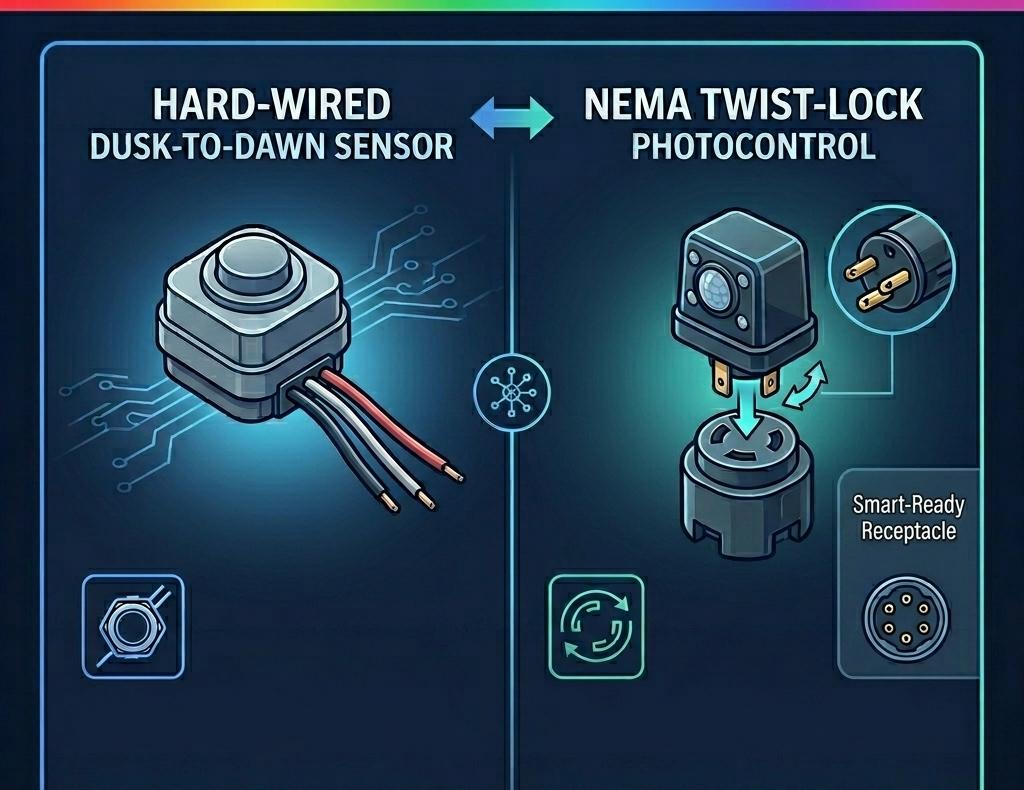
What Is a Hard-Wired Dusk to Dawn Sensor?
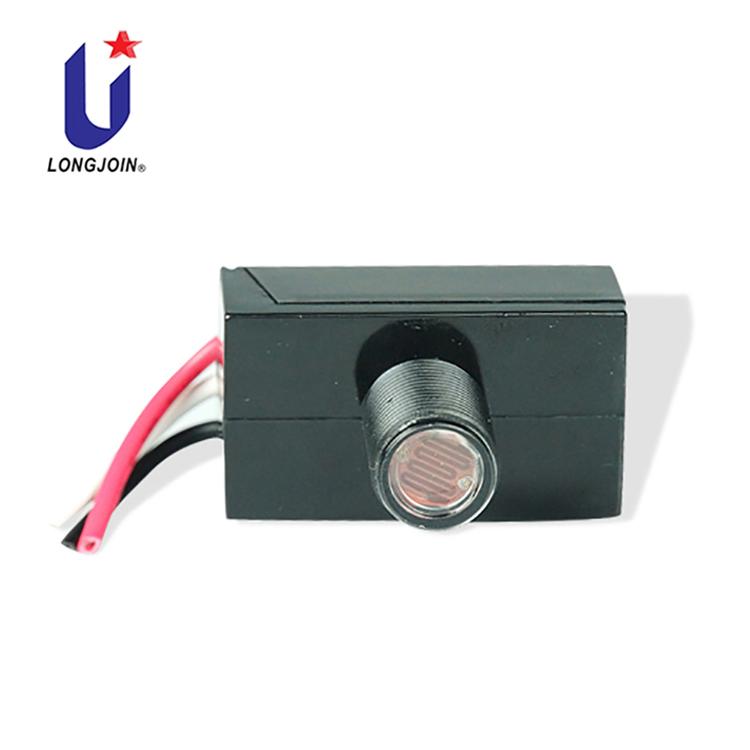
A hard-wired photocontrol connects permanently to the fixture’s wiring through a knockout hole in the luminaire housing, secured with a locknut and gasket.
Replacing a hard-wired photocell means disconnecting the wires, removing the unit, installing the new one, and reconnecting the wiring. On a fixture at the top of a street light pole, that requires a maintenance team and either a bucket truck or scaffolding. The photocell itself is inexpensive. The maintenance visit is not.
Hard-wired models suit compact fixtures, residential applications, and installations where the photocell is expected to outlast any practical need to replace it during the fixture’s service life. Common Long-Join hard-wired models and their applications:
- JL-103A — Compact button format, direct wire, and UL773A listed. Applied in residential outdoor lighting, wall-mounted fixtures, and compact LED luminaires.
- JL-403C — Wide voltage range, 3-10 second delay, stable LED compatibility. Found in commercial outdoor lighting, industrial fixtures, and LED flood lights.
Hard-wired photocontrols are available in #16 AWG and #1+8 AWG wire configurations. The #18 AWG option suits compact fixtures and lower-current applications where installation space inside the housing is limited.
What Is a NEMA Twist-Lock Photocontrol?
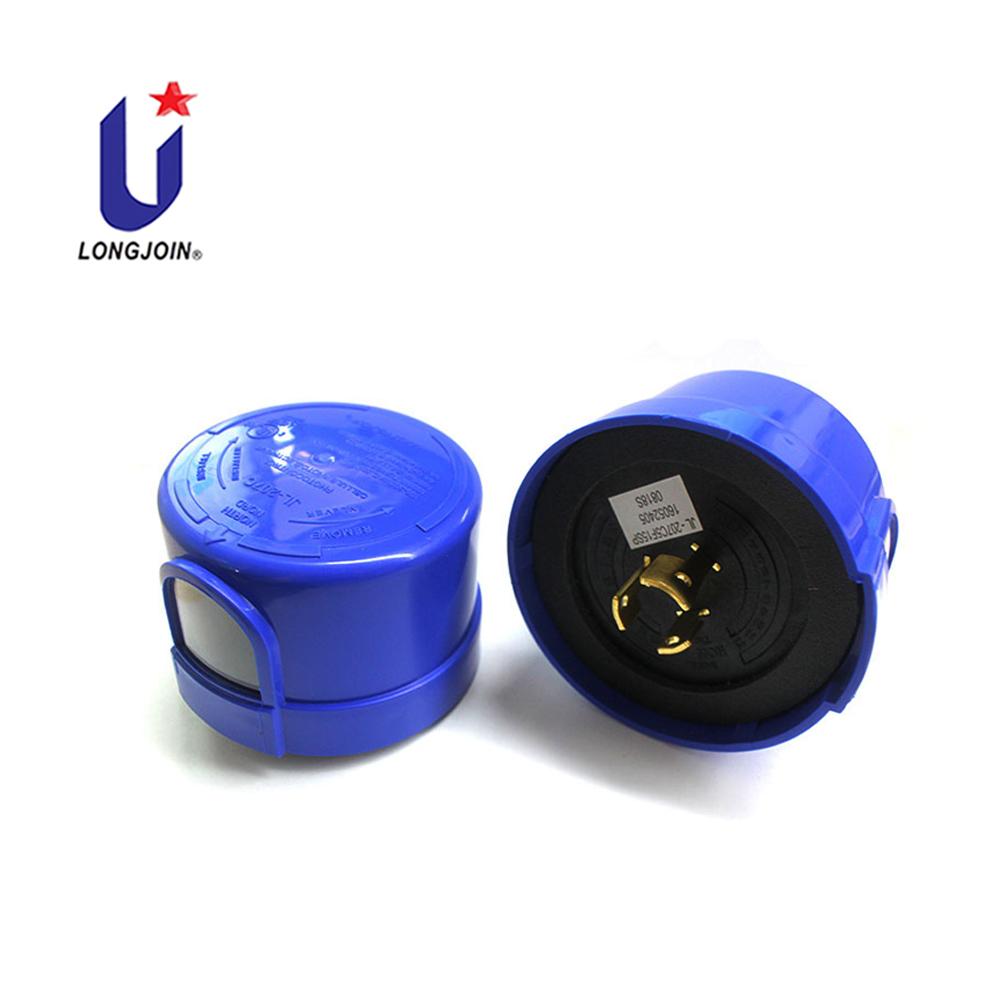
A NEMA twist-lock photocontrol plugs into a standardised receptacle on the fixture and locks with a clockwise quarter-turn rotation, no rewiring, no tools, done in seconds.
El NEMA receptacle system is defined under ANSI C136.10 for 3-pin configurations and ANSI C136.41 for 7-pin smart-ready configurations. This standardisation means any compliant photocontrol from any manufacturer fits any compliant receptacle. This is an important practical benefit for large networks where different fixture brands may be in use across a project.
Replacing a twist-lock photocell on a street light pole does not require disconnecting wiring. A technician removes the old unit by rotating anticlockwise, installs the new one by aligning the pins and rotating clockwise, and is done. On a network of hundreds of fixtures, that time saving accumulates quickly.
The JL-200X Receptacle
El JL-200X is Long-Join’s 3-pin NEMA receptacle base, ANSI C136.10 compliant, compatible with all standard twist-lock photocontrols, including the JL-205C y JL-207C. It is available in multiple wire gauge configurations to suit different load and installation requirements:
| Calibre del cable | Escenario de aplicación |
| #12 AWG | Municipal roadway lighting |
| #14 AWG | Commercial outdoor lighting |
| #16 AWG | Standard LED fixtures |
| #18 AWG | Signal and control applications |
The JL-205C with JL-200X
The JL-205C is the standard recommendation for NEMA twist-lock installations on municipal street lighting, parking lots, and commercial LED fixtures. It is ANSI C136.10 compliant, carries UL and CE certification, IP65 rated, and is optimised for LED driver compatibility. Paired with the JL-200X receptacle, it provides a complete, standardised, tool-free installation and replacement system.
How Do Hard-Wired and NEMA Twist-Lock Photocells Compare?
The fundamental difference between hard-wired and NEMA twist-lock photocontrols is the installation and wiring method, and that difference has downstream effects on maintenance cost, replacement speed, and smart upgrade capability.
When Does Each Format Make More Sense?
Why NEMA Photocontrols Are Becoming More Popular
For municipal and commercial street lighting projects, the NEMA twist-lock is the clear choice. It offers:
- Faster installation
- Tool-free replacement
- ANSI standardisation
- Upgradability to smart 7-pin NEMA systems later
El JL-240XA 7-pin NEMA receptacle base builds on the same infrastructure to add dimming and remote monitoring capability when the project is ready for an upgrade. Full specifications for both hard-wired photocontrols are available on Chi-Swear’s wire-in photocell product pages.
When Hard-Wired Photocontrols Still Make Sense
Hard-wired photocontrols remain the right choice for:
- Compact fixtures without receptacle space
- Decorative luminaires with integrated photocells
- Cost-sensitive residential projects
- Installation where the photocells last the fixture’s full service life
Full specifications for NEMA twist-lock photocontrols on Chi-Swear’s twist-lock photocell product pages.
Picking the Right Installation Format
Hard-wired and NEMA twist-lock photocontrols both serve legitimate roles in outdoor lighting. Hard-wired models offer simplicity and lower upfront cost for compact and residential fixtures. NEMA twist-lock systems offer standardisation, tool-free maintenance, and a clear upgrade path to smart lighting infrastructure for street lighting and municipal applications. For most modern street lighting projects, the maintenance efficiency and future-readiness of the NEMA system make it a better long-term specification.
Frequently Asked Questions on Photocontrols Installation Formats
Q1: What is the main difference between hard-wired and NEMA photocontrols?
The difference is how they connect to the fixture. Hard-wired units go through a knockout hole and are permanently wired in — replacement means disconnecting and reconnecting wires. NEMA units plug into a standardised receptacle and lock with a twist — replacement takes seconds without any wiring. Same sensing function, very different maintenance implications.
Q2: Why are NEMA twist-lock photocells widely used in street lighting?
Three reasons: faster installation, easier maintenance, and standardisation. Any ANSI-compliant twist-lock photocontrol fits any compliant receptacle regardless of manufacturer, which matters on large networks where different fixture brands may be in use. And when a photocell fails on a pole, a tool-free swap is significantly cheaper than a wiring job at height.
Q3: Which wire gauge is commonly used for outdoor photocontrol installations?
For hard-wired installations, #16 AWG covers most standard outdoor applications. #18 AWG is used in compact fixtures with limited housing space. For NEMA receptacle bases, #12 AWG suits high-current municipal roadway applications, #14 AWG covers most commercial work, and #16 or #18 AWG suits standard LED fixtures and control signal applications.
Q4: Is the JL-205C compatible with ANSI C136.10 receptacles?
Yes. The JL-205C is fully compliant with ANSI C136.10 and fits any standard 3-pin NEMA receptacle, including Long-Join’s own JL-200X receptacle base. It can also be used with compliant receptacles from other manufacturers on mixed-brand installations.
Q5: Which type of dusk to dawn sensor is better for smart city lighting projects?
NEMA twist-lock, specifically with a 7-pin ANSI C136.41 receptacle base such as the JL-240XA. The 7-pin system supports dimming control (0-10V and DALI), remote monitoring, and IoT integration alongside standard photocontrol switching — all from the same receptacle infrastructure. A project that starts with a standard 3-pin NEMA system can upgrade to 7-pin smart control without replacing the fixture, just the receptacle and controller.



 Spanish
  English
  Russian
  Arabic
  Italian
  Japanese
  Portuguese