Contour
- Introduction
- Why Do Sports Fields Need Capteurs photoélectriques?
- What Are the Key Benefits of Interrupteurs à cellule photoélectrique in Sports Lighting?
- Où sont Capteurs photoélectriques Most Useful in Sports Field Lighting?
- What Technical Specifications Should You Look for in a Sports Lighting Photocell?
- Comment Capteurs de photocellule lumineuse Enhance Intelligent Lighting Systems?
- What Is the Future of Street Light Controllers in Smart Sports Venues?
- Mots de la fin
Sports fields demand reliable lighting for performance and energy efficiency. But how can these systems run smoothly without constant manual control?
The answer lies in contrôles photoélectriques. A interrupteur à détecteur de lumière detects natural light levels and automatically manages when the lights turn on or off. This makes them vital for modern sports contrôle de l'éclairage. From small school fields to professional stadiums, photocells keep operations smart and sustainable.

Why Do Sports Fields Need Capteurs photoélectriques?
Modern sports facilities must balance visibility with efficient operation. Poor lighting can lead to:
- Player errors
- Spectator accidents
- Security risks
In fact, professional arenas require instant-on, high-quality illumination to maintain match schedules and broadcast standards.
Le capteur de commutation photoélectrique serves as the eyes of an outdoor lighting system. They continuously measure ambient light. When light falls below a threshold, they signal fixtures to switch on; when daylight returns, they turn lights off.
The Role of Capteurs photoélectriques in Lighting Automation
- They act as dusk-to-dawn controllers. This replaces manual or timer‐based switching with real‐time light detection.
- They integrate smoothly with smart lighting systems. This forms the baseline input for zone control or adaptive lighting strategies.
- They reduce dependency on scheduled timers that can misalign with shifting sunrise and sunset times.
What Are the Key Benefits of Interrupteurs à cellule photoélectrique in Sports Lighting?
Here’s a quick look at the top 5 advantages of using capteurs de photocellule de lumière in sports field lighting:
Automatisation intelligente
Le interrupteur à détecteur de lumière extérieure senses real-time changes in daylight. They trigger fixtures to switch without human action. This removes scheduling errors and ensures lights operate exactly when needed.
Économies d'énergie
By shutting off lights during bright periods, photocells drastically reduce wasted energy. In fact, commandes d'éclairage (including photocells) can cut power usage by up to 30–40 % in outdoor area applications.
Sécurité renforcée
Sports fields must be well-lit before darkness fully arrives. Capteurs photoélectriques ensure a smooth transition. This eliminates sudden blackouts and protects athletes, staff, and spectators.
Low Maintenance
Since lighting turns on/off automatically, there’s less manual oversight. Fewer hours of operation also extend LED lifetime by reducing thermal and electrical stress.
Integration Flexibility
Moderne interrupteurs à cellule photoélectrique can interface with DMX, timers, building automation systems, and IoT platforms. This allows smart scene control (e.g., for training, competition, or standby modes). Because they act as basic “light-level triggers,” they enhance LED lighting automation without major rewiring.
Où sont Capteurs photoélectriques Most Useful in Sports Field Lighting?
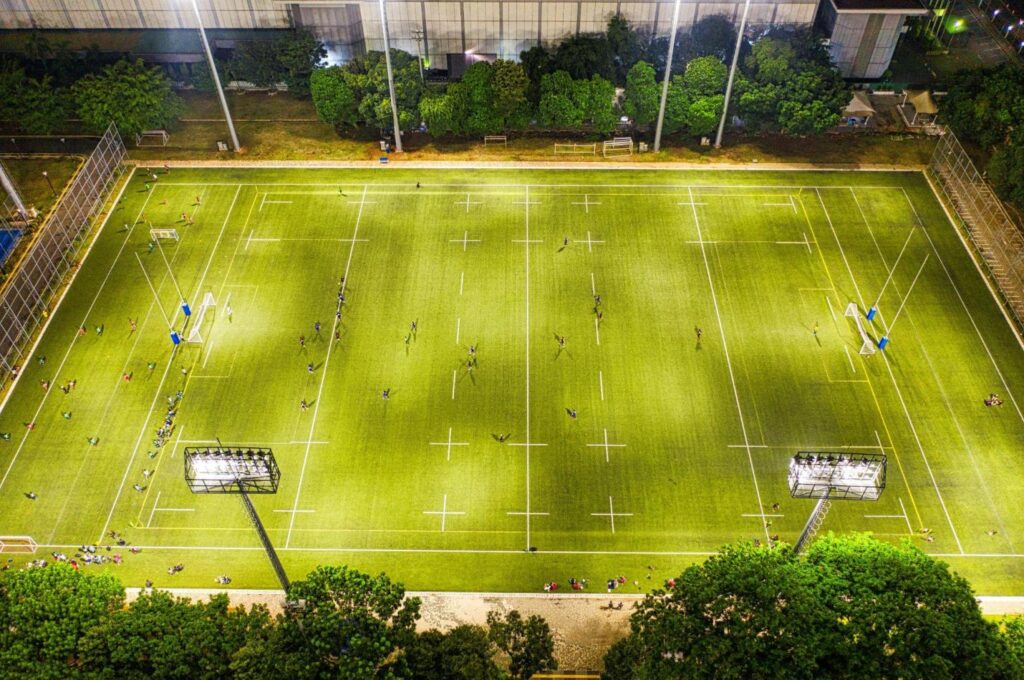
Outdoor LED lights with photocells shine in various settings where outdoor lighting must adapt automatically. Below are three primary arenas where their impact is significant.
School Fields
School sports fields face seasonal shifts—sunrise and sunset times change. Photocells adjust lighting schedules without manual resets. They ensure practice times always operate in safe lighting. When students leave late on gloomy days, the system still triggers lights before darkness.
Community Sports Centers
These venues often run long hours with multiple activities. capteurs d'éclairage public prevent daytime lighting waste when natural light suffices.
Paired with LED floodlights, they reduce energy bills for the entire complex. Less manual oversight is needed, making maintenance easier for community managers.
Professional Stadiums
At this level, lighting isn’t just about visibility—it’s about spectacle, timing, and precision control. In stadiums:
- Photocells feed baseline ambient light data into smart systems.
- Lighting control systems using DMX adjust scenes (e.g., warm-up, game, closing) based on both schedule and sensed light.
- They integrate into IoT platforms, enabling dynamic lighting effects and zone control (stands, pitch, concourses).
What Technical Specifications Should You Look for in a Sports Lighting Photocell?
Here’s a concise table of recommended specs for sports-grade photocells:
| Paramètre | Suggested Value / Range |
| Sensitivity (Turn-ON) | 10 to 20 lux |
| Sensitivity (Turn-OFF) | 30 to 50 lux |
| Protection (IP Rating) | IP65 or higher (dust/water sealed) |
| Control Type | Wire-in, Twist-lock, or Zhaga socket compatible |
| Plage de tension | 120–277 VAC (universal) |
| Extra Features | Time delay OFF, surge protection, anti‐flicker |
Practical Notes for Selecting the Right Model
- Sensor thresholds: Use lower turn-ON lux values in regions with frequent overcast—so lights don’t wait too long to kick in.
- IP rating and durability: In humid or dusty climates, pick IP65+ models to resist ingress. Many outdoor photocells are rated IP65.
- Control interface: If your system uses Zhaga modules (common in advanced LED systems), choose a Zhaga-compatible photocell to plug right in.
- Voltage matching: Always verify the photocell’s voltage rating matches your lighting circuit. Mismatches cause failure or malfunction.
- Extra protections: Time delay OFF helps avoid rapid toggling under transient light (e.g., clouds, passing headlights). Surge protection guards against voltage spikes.
Comment Capteurs de photocellule lumineuse Enhance Intelligent Lighting Systems?
Photocells act as sensor nodes within a broader smart lighting framework. They don’t just turn lights on/off — they feed continuous ambient–light data to higher-level control systems.
Modern “smart photocells” deliver faster response and fewer false triggers thanks to improved filtering and detection algorithms.
Enabling Zoned & Adaptive Lighting Control
Capteur de lumière inputs let lighting systems decide which zones need light and how much. For example, dimming periphery zones while keeping the playing area bright.
In stadium setups, photocells help trigger different scenes (training, match, shutdown) based on ambient light plus scheduling. Some photocontrols support dimming, not just on/off switching, to allow smoother transitions.
Supplying Data for Lighting Algorithms
Smart control platforms use ambient-light readings from the interrupteur à détecteur de lumière as baseline inputs. Algorithms compare that data with target lux levels to decide whether to reduce, maintain, or increase output.
In systems with daylight harvesting, photocell data ensures electric lighting complements natural light.
Working with Motion Detectors, IR, & Remote Controllers
Photocells often pair with motion (PIR/IR) sensors. This ensures the lighting is off during daylight and no motion.
In integrated nodes, a single device combines PIR + photocell + network control to manage dimming, scheduling, and remote overrides. Remote controllers or cloud dashboards can override or adjust setpoints, using photocell data as a reference baseline.
Here is a comparison of sensor types used with photocells in a sports venue.
| Type de capteur | Fonction | Benefits in Lighting Control | Example Use in Sports Venues |
| Motion Sensor | Detects movement | Activates lights only when needed | Training ground walkways |
| IR Sensor | Detects body heat | Enhances precision over motion alone | Player zones, seating areas |
| Temperature Sensor | Monitors heat changes | Supports adaptive climate-based lighting | Indoor arenas with HVAC |
| Acoustic Sensor | Picks up crowd noise | Triggers ambient effects | Goal celebration lighting |
What Is the Future of Street Light Controllers in Smart Sports Venues?
Photocells are evolving — they won’t just be simple light detectors. In future smart venues, they’ll operate as advanced, connected sensor hubs that coordinate multiple inputs for more sophisticated control.
Intégration multi-capteurs
Capteurs de lumière will coexist and merge with motion, temperature, and IR sensors. Instead of triggering on light alone, systems will decide using multiple signals (e.g., presence + light + ambient heat). Next-generation sensors already combine this fusion to deliver adaptive lighting scenes.
Precision Improvements in Sensing
Expect more refined sensitivity thresholds and faster response times. Advanced filtering and algorithms will reduce false positives from transient light changes (clouds, car headlights). These improvements help lighting systems operate more fluidly.
Here are the current vs next-generation photocell performance metrics.
| Paramètre | Current Range | Emerging Capability | Impact |
| Sensitivity (lux) | 10–50 lux | 1–5 lux | Detects subtle light changes |
| Temps de réponse | 1–2 seconds | <200 ms | Instant adjustments |
| False Trigger Rate | 8–12% | <2% | Reliable operation |
| Durée de vie | 5–7 years | 10–12 years | Lower maintenance |
IoT Compatibility
Cellules photoélectriques will embed communication modules, i.e, LoRa, ZigBee, NB-IoT, which enable:
- surveillance à distance
- Configuration
- Over-the-air firmware updates
Long-Join’s JL-245CZ, for example, supports multiple protocols for seamless integration. The product is also internationally certified by ISO, CE, UL, et RoHS.
Lighting frameworks using LoRaWAN have already shown how controls can save energy at scale.
Here is a table outlining some of the most commonly used communication protocols along with their range, power usage, and suitable applications.

| Protocole | Gamme | Power Usage | Suitable Application |
| ZigBee | 10–100 m | Faible | Indoor stadiums |
| LoRaWAN | 2–5 km urban, 15+ km rural | Très faible | Outdoor fields |
| NB-IoT | Nationwide | Modéré | Citywide sports lighting |
| Wi-Fi 6 | <100 m | Haut | High-data venue environments |
Solar-Powered Photocell Designs
Photocells may draw power directly from solar modules or energy harvesting circuits. This makes them self-sustaining. In off-grid or remote sports fields, solar lighting arrays already leverage autonomous controllers.
Using perovskite PV or ultra-low power electronics, future photocells could operate without external wiring.
Mots de la fin
Smart sports venues demand lighting that is precise, adaptive, and energy-efficient. Photocells make this possible by enabling intelligent, sensor-driven control. For reliable performance, LongJoin smart photocontrollers from Chi-Swear are a trusted choice. Their durability and quality make them a strong partner for future-ready lighting projects.
Liens externes
- https://www.energystar.gov/sites/default/files/asset/document/Outdoor%20Area%20Lighting%20Papamichael.pdf
- https://en.wikipedia.org/wiki/Lux
- https://www.iso.org/home.html
- https://single-market-economy.ec.europa.eu/single-market/goods/ce-marking_en
- https://www.ul.com/solutions
- https://en.wikipedia.org/wiki/RoHS
- https://link.springer.com/article/10.1007/s43926-025-00163-z
- https://en.wikipedia.org/wiki/Zigbee
- https://lora-alliance.org/
- https://en.wikipedia.org/wiki/Narrowband_IoT