
OUTLINE
- 導入
- What Are UL and cUL Certifications?
- Why Do North American Projects Actually Require This?
- What Does UL Actually Test in a Photocontrol?
- How Do Long-Join’s Products Reflect UL Safety Design?
- Why North American Buyers Prioritise UL Certification
- Getting Photocells with UL Certification
- Frequently Asked Questions on UL and cUL Certifications
Verification that things meet strict safety and compliance standards is very important in North America, and this applies to outdoor lights and their photocontrol sensors (photocells).
For photocells, certifications are the go-to, and anyone as experienced as I am in the business will tell you that UL and cUL certifications are considered some of the most important requirements.
What UL certification does is separate “it works” from “it’s safe.” Those are two different things, and in North America, the latter requires independent verification from a recognised testing body, not just a manufacturer’s claim on a datasheet.
Let’s dive into how UL certification helps evaluate photocontrols for electrical safety, fire protection, durability, and a whole lot, as well as how Long-Joing photocontrols reflect their compliance with the set standards.
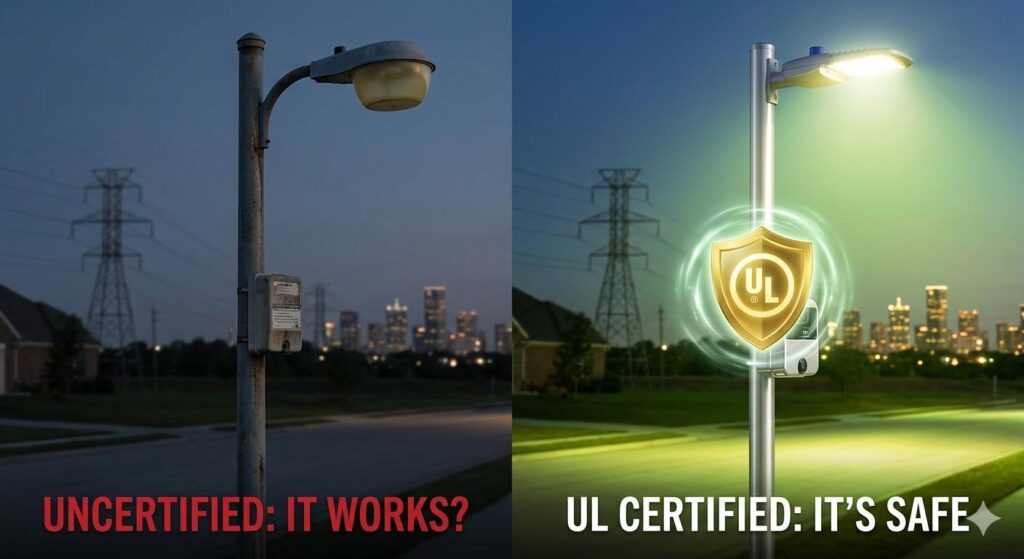
What Are UL and cUL Certifications?
UL stands for アンダーライターズ・ラボラトリーズ, the US standard-bearer for independent electrical safety certification, and cUL extends that same framework to the Canadian market under Canadian Safety Association requirements.
Together, these are the most recognized safety certification organizations in the United States, ensuring that products comply with:
- Electrical safety standards
- Fire safety requirements
- Material reliability
- Environmental performance standards
A UL listing means the product was tested against those specific criteria by an independent laboratory and passed. And the cUL works within the same UL framework but is evaluated against CSA (Canadian Standards Association) requirements.
Carrying both means one product covers both sides of the border under a single certification chain; useful for buyers or distributors who operate across both markets and don’t want to manage separate compliance files for each.
Why Do North American Projects Actually Require This?
Most buyers who have tried to source uncertified photocontrols for a serious North American project already know that it won’t be clear the distribution channel, nor will a reputable inspector sign off on it.
Here are some values that they unlock:
| UL/cUL Value | 利点 |
| Safety compliance | Reduces electrical hazards |
| Project qualification | Meets municipal and commercial tender requirements |
| Insurance acceptance | Improves liability compliance |
| 製品の信頼性 | Enhances customer confidence |
| Market access | Supports US & Canada distribution |
| Fire safety assurance | Reduces fire risk |
What Does UL Actually Test in a Photocontrol?
UL testing goes well beyond checking whether the unit switches on and off. It evaluates the safety of the following:
Electrical unit components
The relay switching circuit is tested for:
- Overcurrent safety
- Behaviour under abnormal load conditions
- Switching stability across the rated range.
Capacitors have to meet voltage endurance and temperature resistance thresholds. For products claiming LED compatibility, the inrush current handling of the LED driver load is specifically verified.
Wires and cables
Internal wiring is checked for:
- Insulation integrity
- Temperature resistance
- Outdoor durability
Flame retardancy is also a specific test here; the wiring has to resist propagating fire under fault conditions. For a photocell mounted on a public roadway fixture, a wiring fire that spreads through the housing is a direct public safety event, and UL’s testing is designed to verify that the product’s wiring won’t allow that to happen.
Enclosures and live parts
The housing has to demonstrate adequate electrical isolation between live internal components and any externally accessible surface.
Insulation protection and safe construction are verified to confirm there is no realistic path for someone touching the unit to contact an energised part. Product labelling is also checked for accuracy and permanence.
The following photocontrol-related components are commonly associated with UL safety evaluation
| 成分 | UL Evaluation Focus |
| Relay components | Electrical switching safety |
| Capacitors | Voltage and temperature reliability |
| Housing materials | Flame resistance and insulation |
| Internal wiring | Insulation integrity and durability |
| Power terminals | Electrical contact safety |
| Outdoor enclosure | 環境保護 |
| Socket interface | Safe electrical connection |
How Do Long-Join’s Products Reflect UL Safety Design?
Long-Join models are all produced with safety and compliance considered. The JL-205C, JL-207C, 、 そして JL-403C all carry UL or UL/cUL listings in their respective application ranges.
Looking at the JL-207C specifically, several of its design choices directly address the criteria UL evaluates:
- The UV-resistant polypropylene housing maintains its electrical insulation properties
- The reinforced base material supports thermal resistance and mechanical durability
- The waterproof sealing structure keeps moisture away from the internal components
Long-Join also manufactures under ISO 9001:2015 certification. The practical implication is that the unit tested for UL listing and the unit that arrives on a project site are built to the same specification. UL conducts ongoing production surveillance to verify this, which is part of what keeps a listing current.
Why North American Buyers Prioritise UL Certification
Procurement buyers in the US and Canada are increasingly specific about what they require:
- Certified components
- Traceable safety standards
- Compliance-ready products
This matters most in municipal roadway projects, utility lighting, commercial lighting tenders, and OEM manufacturing, where an uncertified product creates project risk, warranty exposure, maintenance liability, and inspection problems that far outweigh any unit cost savings.
Before purchasing dusk-to-dawn sensors for North American projects, verify the following:
| Evaluation Item | Recommended Requirement |
| UL/cUL certification | Required |
| LED compatibility | Required |
| Waterproof protection | IP65 recommended |
| 紫外線耐性 | 推奨 |
| Flame-retardant materials | Important |
| Long switching lifespan | Required |
Getting Photocells with UL Certification
The point of UL certification is to give buyers, inspectors, insurers, and project specifiers an independently verified answer to whether a product remains safe to operate under the conditions it will actually face.
For outdoor photocontrols in North America, the answer has to come from a recognised testing body, not from the manufacturer. Long-Join’s certified range available on Chi-Swear provides that answer, backed by UL773 or UL773A listing, ISO 9001:2015 production consistency, and the design features that UL testing specifically verifies.
Frequently Asked Questions on UL and cUL Certifications
Q1: What is the difference between UL and cUL certification?
UL covers US safety standards, and cUL covers Canadian ones. They are both issued under the UL framework but evaluated against different regulatory requirements.
Q2: Why do North American roadway lighting projects require UL-certified photocontrols?
Because tenders say so, inspectors require it, and distributors stock accordingly. UL listing is the threshold qualification for the North American outdoor lighting market; without it, a product is excluded from public infrastructure projects, won’t clear inspection in most jurisdictions, and won’t make it onto the shelves of major electrical distributors.
Q3: Which photocontrol components are evaluated during UL testing?
They include:
- Relay circuit
- Capacitors
- Internal wiring
- Housing materials
- Power terminals
- Enclosure
- Socket interface
Testing covers normal and fault operating conditions, flame resistance, insulation integrity, and environmental durability.
Q4: How does UL certification improve outdoor lighting safety?
It moves safety verification from the manufacturer’s own claims to independent testing against defined standards. UL also conducts ongoing production surveillance to confirm that listed products continue to meet those standards across full production runs, not just the initial test sample.
Q5: Why are flame-retardant wires and insulated enclosures important in dusk-to-dawn sensors?
A photocell that develops an internal fault under load generates heat. Without flame-retardant wiring and properly insulated housing, that heat can ignite surrounding materials and spread through the fixture.

 English
 Spanish
 Russian
 Arabic
 Italian
 Japanese
 Portuguese
1件のフィードバック
This is my first time visit at here and i am actually impressed to read everthing at
alone place.