
Outline
- Introduction
- What Are the Core Functional Requirements for Modern Outdoor Lighting Systems?
- What Light Photocell Sensor Categories Does Long-Join Offer and Where Are They Best Applied?
- How Should Different Lighting Types Be Matched with the Right Light Sensor Control Solutions?
- What Are the Key Technological Advantages of Long-Join Street Light Controller Solutions?
- What Do Typical Application Cases Reveal About Future Outdoor Lighting Trends?
- How Does Long-Join Enable Optimized Photocell Switch Selection for Diverse Outdoor Lighting Needs?
- The Bottom Line
Automation is not the only efficient outdoor lighting. It must survive harsh weather. It must save energy. It must adapt to different environments.
Lighting controls play a critical role in making this possible. They decide when lights operate and how efficiently they perform. But not every photocontrol fits every lighting scenario.
This article explains how to match Long-Join photo sensor solutions with different outdoor lighting applications. The goal is simple. Better performance, higher efficiency, and smarter lighting systems.
What Are the Core Functional Requirements for Modern Outdoor Lighting Systems?
| Installation Environment | Key Environmental Stress | Recommended Enclosure Feature | Practical Benefit |
| Coastal Roads | Salt spray, humidity | Corrosion-resistant housing | Prevents sensor drift |
| Industrial Zones | Dust, vibration | High IP + shock resistance | Stable operation |
| Urban Streets | Light pollution | Accurate ambient sensing | Avoids false switching |
| Parks & Green Areas | Moisture, insects | Sealed optical window | Longer service life |
Environmental resistance
Outdoor lighting must withstand the harsh environmental stresses. Durable luminaires require high ingress protection, scaled as IP ratings. Typically, IP65 to IP66 or higher is good to stop dust and water from entering and damaging internal parts.
For high-exposure areas, higher IP may be needed. Impact resistance, which is measured as IK, protects against physical damage in public spaces.
Temperature tolerance and long service life
These two aspects are not optional. Outdoor street light controller must run in extreme heat of +50°C or more and cold of up to -40°C without performance loss.
Long lifespans, usually above 50,000 hours, ensure less maintenance and lower lifecycle cost.
Smart Automation
Smart features like intelligent dimming and automation optimize energy use. They allow lights to dim during less active periods and integrate with centralized control systems for scheduling and monitoring. These functions support energy saving and emission reduction goals.
Proper matching between luminaires and automatic light sensor devices
Matching photocontrols with luminaires is crucial. The wrong photo control can misread ambient light and trigger lights at the wrong times. Proper matching ensures reliable dusk-to-dawn or adaptive dimming behavior.
Influence of installation environments
The installation environment shapes the choice of control. Streets, parks, and squares have different light levels, traffic, and safety needs, affecting sensor sensitivity and control logic. Pole height and spacing change the way light is distributed.
Taller poles with wider spacing need controllers tuned for broader detection ranges and consistent dimming to avoid dark spots or glare.
What Light Photocell Sensor Categories Does Long-Join Offer and Where Are They Best Applied?
Long-Join provides photo switch sensor options that suit a range of outdoor lighting needs. These products vary in installation style and control function, making them suitable for basic dusk-to-dawn switching to more precise power control. Each category has distinct strengths.
| Photocontrol Type | Installation Skill Level | Typical Project Size | Upgrade Flexibility |
| Wired Photocontrol | Low | Small / Medium | Limited |
| Direct Connection | Medium | Targeted systems | Moderate |
| Twist-Lock | Low | Medium / Large | High |
| Zhaga Controller | Medium | Smart city scale | Very high |
Below, we focus on the Wired Photocontrol Series and Direct Connection Controllers.
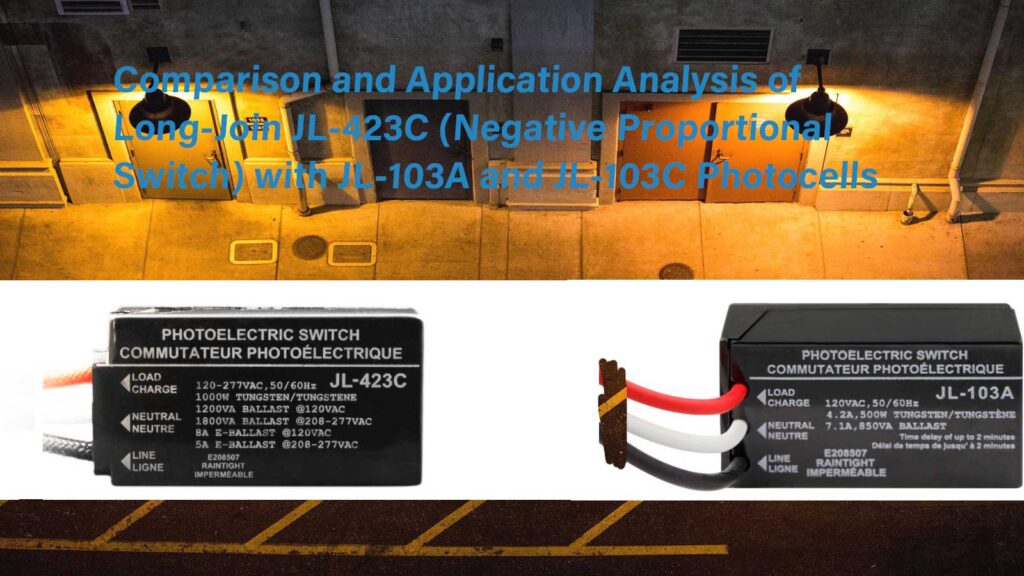
Wired Photocell Lighting Sensor Series (103A, 403C, 118A, 423C)

Long-Join’s wired photocontrol are traditional wire-in sensors. They connect directly to the fixture’s supply wiring. These are simple and reliable for automatic on/off control based on ambient light.
Functional characteristics
- Basic photocell sensing with switching automation.
- Compatible with standard AC mains voltages like 120–277 VAC.
- Built-in time delay reduces false triggers.
Why are they suitable
- Excellent for basic light sensing and timing control.
- No complex setup or network configuration required.
Benefits
- Quick to install and respond.
- Low cost and dependable.
Best for
- Outdoor floodlights, streetlights, wall packs, and single-lamp fixtures.
- Standalone, non-networked lighting where automated switching is needed.
Direct Connection Controllers (JL-411R-12D, JL-411R-24V)

Direct connection controllers from Long-Join use low-voltage DC photocontrols for precise light management. They are designed for systems powered by 12 VDC or 24 VDC.
Advantages of direct connection
- The sensor is tied directly to the power line, enabling a stable signal and accurate on/off decisions.
- Separated sensor design allows positioning where light sensing is most effective.
Dimming and regulation
- These dusk-to-dawn photocell sensors support high-precision control in low-voltage systems.
- Ideal when mains-voltage photocells aren’t suitable.
Best applications
- Low-voltage outdoor luminaires.
- Billboard lighting and traffic warning lights that require reliable automatic control.
Why they excel
- Reduced electrical noise and improved sensing accuracy.
- Better matching with DC-powered fixtures for efficiency.
- Compact, flexible installation in varied outdoor settings.
How Should Different Lighting Types Be Matched with the Right Light Sensor Control Solutions?
Choosing the right lighting control ensures outdoor lights perform reliably. Different lighting types require varied control logic.
Matching controllers to fixtures impacts energy use, reliability, and maintenance.
| Control Strategy | Typical Application | Energy Saving Impact | Control Precision |
| On/Off Only | Basic streets | Low | Basic |
| Scheduled Dimming | Urban roads | Medium | Controlled |
| Sensor-Based Dimming | Smart streets | High | Adaptive |
| Data-Driven Control | Smart cities | Very high | Predictive |
For Ordinary Street and Floodlights

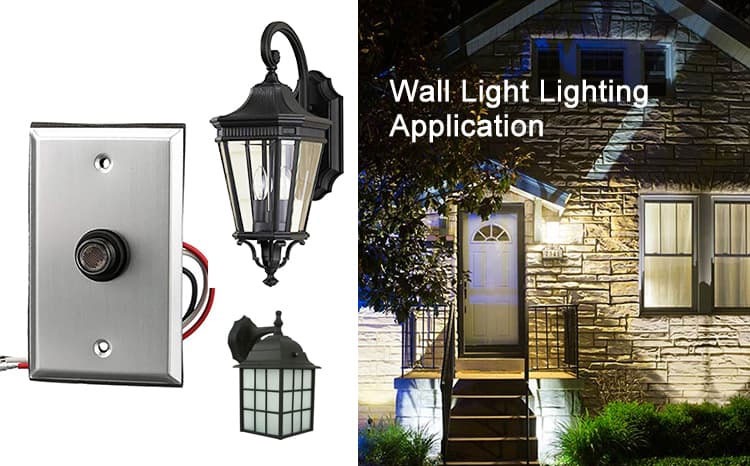
Wired outdoor light sensor switches provide dependable automatic switching for these lighting needs. They are cheaper and require minimal setup. These controllers respond quickly to ambient light and avoid unnecessary complexity.
When dimming is needed, direct connection controllers with precise power-line input offer improved control. They support predictable dimming behavior and stable light levels around low-voltage systems.
Together, these solutions strike a balance between cost, reliability, and basic functionality for high-mast and floodlight installations without smart networking needs.
Streetlights and Urban Lighting Benefit from Twist-Lock Controllers
Twist-lock controllers supply flexible dimming like 0–10V, allowing lights to adjust based on local requirements. 0–10V dimming lets you program smooth brightness changes and part-night dimming schemes for efficiency.
Modular expansion matters in urban projects because lighting often evolves over time. Twist-lock systems support various receptacles and multi-pin interfaces, making it easier to upgrade controllers without rewiring fixtures.
These controllers adapt to different scenarios — pathways, parks, or roads — and keep system designs consistent and serviceable.
Smart Streetlights with Environmental Sensing Needs
For advanced smart lighting, Zhaga photocontrol controllers are ideal. They use the Zhaga Book 18 standard for plug-and-play sensing modules. These units can combine light sensing with motion or environmental data.
Precise light adjustment
Integrated sensors measure ambient light accurately and adjust output in real time.
● Remote monitoring & management
Zhaga interfaces support digital communication and remote control adoption, enabling centralized energy optimization and real-time diagnostics.
This makes them perfect for modern cities, where light systems must respond efficiently to population and traffic patterns.
What Are the Key Technological Advantages of Long-Join Street Light Controller Solutions?
Long-Join photocontrols cover a broad range of lighting control needs—from basic dusk/dawn switching to advanced smart management. Their products adapt from simple automatic on/off to real-time intelligent control.
High-precision sensors detect ambient light accurately, preventing false triggers and unnecessary switching.
Scalability matters. Modern lighting systems must grow from standalone units to centrally managed networks.
Long-Join controllers support modular upgrades and integration with remote or IoT systems. This allows cities to expand without redesigning control infrastructure.
Proper system matching improves light stability and energy efficiency.
When an LED street light photocell is chosen to suit both the luminaire and the environment, it maintains optimal brightness without waste. Accurate sensing reduces over-illumination and avoids flicker.
Long-Join photocontrols also support sustainable and intelligent outdoor lighting:
- Smart dimming and scheduling cut power use.
- Integrated sensors adapt lighting to real conditions.
- Remote monitoring reduces maintenance and lowers the carbon footprint.
Together, these features deliver reliable performance and future-ready lighting control systems.
What Do Typical Application Cases Reveal About Future Outdoor Lighting Trends?
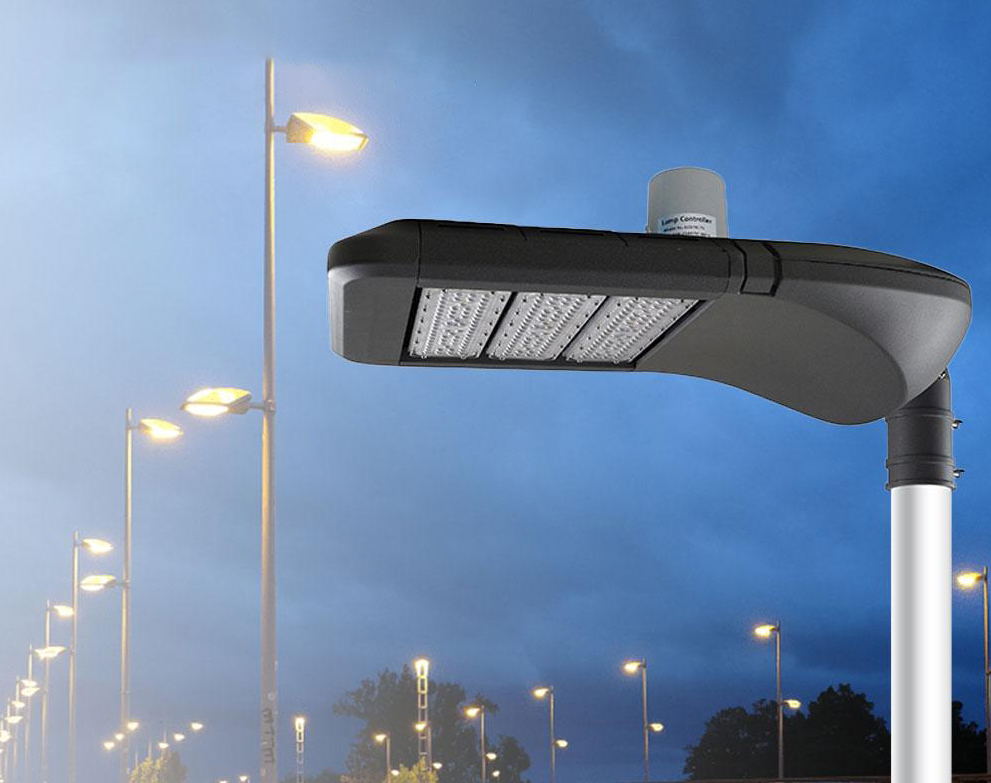
Real-world projects show where outdoor lighting is headed. Smart city cases prove that lighting can do more than just turn on at dusk. Simple retrofits continue to have value.
Both paths reveal specific trends for performance, cost-efficiency, and scalability.
Smart City Demonstration Projects Showcase Zhaga Street Light Sensor Advantages
Smart city lighting is moving toward data networked systems that do more than illuminate roads. Controllers with sensing and communication capabilities collect real-time data on ambient light and multiple other parameters, like traffic and weather.
This is then fed to the central systems for adaptive control. This improves:
- Operational intelligence
- Reduces energy waste
- Supports broader urban services
Cities using smart controllers report:
- Remote fault detection
- Adaptive dimming
- Integration with environmental sensors for better safety and resource planning
Zhaga-compliant solutions make upgrades easier and support plug-and-play sensor modules, which align with ongoing smart city expansion.
Wired Photocontrols Effective for Basic Streetlight Retrofit Projects
For legacy lighting upgrades, wired photocontrols deliver fast and low-cost results. They can be installed directly into existing fixtures without major rewiring. This dramatically reduces project time and labor.
These solutions are ideal for large fleets where smart capabilities are not immediately needed, but automatic dusk-to-dawn control is. Standard sockets like ANSI/NEMA speed deployment and make scaling across thousands of lights straightforward.
For cities prioritizing budget and simplicity, wired light control photocells retrofits perform reliably with minimal infrastructure changes.
How Does Long-Join Enable Optimized Photocell Switch Selection for Diverse Outdoor Lighting Needs?
Long-Join’s wide product diversity lets you match controllers to both basic and advanced lighting systems. Their portfolio includes simple wire-in units, twist-lock modules, Zhaga standard controllers, and smart nodes with communication protocols. This range supports projects from standalone streetlights to fully networked smart grids.
Choosing the right photocontrol means more than just matching voltage or IP rating. You must evaluate:
- Installation environment (urban, coastal, high-dust)
- Lamp pole structure (height, spacing, orientation)
- Functional requirements (on/off only vs intelligent dimming + remote control)
Considering these together helps avoid performance issues like false triggers or uneven lighting. Correct photocontrol selection enhances system intelligence and operational efficiency by:
- Ensuring accurate light sensing based on true ambient conditions.
- Reducing energy consumption with smart dimming logic and scheduling.
- Supporting centralized or cloud-based management for quick adjustments.
Lowering maintenance through remote diagnostics and automated fault alerts. Further, the table below justifies why proper selection matters, especially for decision-makers.
| Selection Approach | Lowest-Cost Choice | Application-Matched | Smart-Ready Design |
| Initial Cost | Low | Balanced | Higher |
| Operational Cost | High | Low | Very low |
| System Intelligence | Minimal | Moderate | High |
| Upgrade Risk | High | Low | Minimal |
The Bottom Line
Modern outdoor lighting demands accurate control and scalability. Choosing the right photocontrol ensures stable energy savings and extended system efficiency. For projects using Long-Join photocontrols, Chi-Swear stands out as a reliable and experienced supplier. Their product support and application knowledge make selection easier and implementation smoother.

 English
  Spanish
  Russian
  Arabic
  Italian
  Japanese
  Portuguese