- Overzicht
- Invoering
- Wat zijn de belangrijkste soorten? Fotosensoren Used in Outdoor Lighting?
- What Makes Twist-Lock Foto-elektrische sensoren the Standard Choice for Municipal Projects?
- Why Are Wire-In Photocells the Go-To Option for Cost-Sensitive Projects?
- How Do Zhaga Fotoschakelaars (Book 18) Enable Smart City Lighting?
- How Do These Three Lichtfotocelsensor Types Compare at a Glance?
- Why Choose Long-Join Fotocellen for Guaranteed Compatibility and Performance?
- De kern van de zaak
De juiste keuze maken verlichtingsregeling directly impacts your lighting project. With multiple types of photocells available, the choices could be confusing. Differences go beyond just price. They affect compatibility and performance.
This guide helps you understand:
- How each type works
- Where it fits best, and
- How to make a confident choice for your project
Wat zijn de belangrijkste soorten? Fotosensoren Used in Outdoor Lighting?
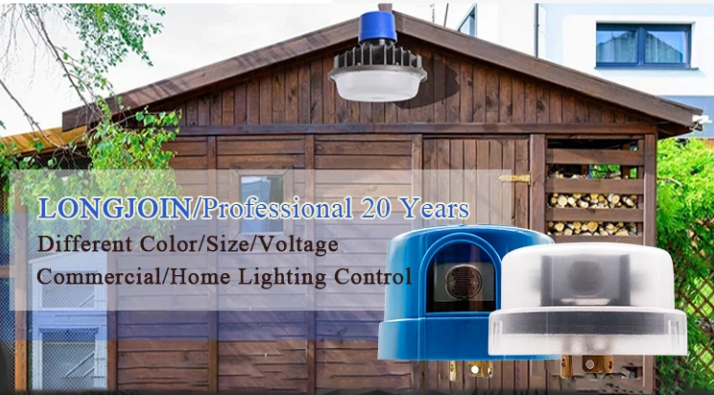
Fotocontrollers sit at the heart of dusk-to-dawn lighting. These devices detect ambient light and automatically switch luminaires. Three primary types dominate the outdoor lighting market:
- Twist-Lock units that use NEMA receptacles for easy installation.
- Bedrading fotocelschakelaars that are wired directly into the luminaire’s circuit without a socket interface.
- Zhaga Boek 18 compatible fotocel-lichtsensoren are designed for smart lighting systems and modular receptacles.
Understanding each type’s compatibility and mechanical interface is essential to avoid mismatches and ensure your lighting project meets both current requirements and future flexibility.
Wat maakt Draaisluiting Foto-elektrische sensoren the Standard Choice for Municipal Projects?
They follow the ANSI C136.10 standard for mounting. They connect via a NEMA-style socket configured as:
- 3-pin (simple on/off)
- 5-pin (adds dimming)
- 7-pin (adds remote control and IoT interface
Installation is easy. Twist the unit into the socket and you’re done. This interchangeability across brands reduces maintenance complexity. These units are widely deployed in street lights, highways, parking lots, and industrial outdoor lighting schemes because they fit standard receptacles.
Voordelen
Because they adhere to ANSI C136.10, Twist-Lock schemeringsfotocellen offer uniform compatibility: any compliant unit fits the existing socket. Maintenance crews can replace units in seconds without rewiring.
With 5 and 7-pin versions, you can upgrade to dimming without changing the receptacle. The durability and broad manufacturer support make them cost-effective for large assets.
Best Applications
Twist-Lock is ideal for municipal lighting programs, utility companies, and EPC contractors focused on operational efficiency. When you’re managing hundreds or thousands of poles, the speed of replacement and the standard socket interface make this type a clear winner for large-scale outdoor lighting deployments.
Waarom zijn Inbouwbare fotocellen the Go-To Option for Cost-Sensitive Projects?

Bedrading lichtsensorschakelaars are built to be wired directly into the luminaire’s circuit. They have a compact form factor and lower component cost—ideal where budget matters. They’re commonly used in residential lights, garden fixtures, or small commercial outdoor lighting where socket-type receptacles aren’t practical.
Voordelen
- Lower overall cost compared to socketed models.
- Flexible installation in fixtures without the standard NEMA socket interface.
- Enables basic automation with minimal hardware.
Limitations
- Replacement typically requires rewiring.
- Functionality is limited. Most wire-in types support only simple on/off control, with no dimming or remote monitoring.
Best Applications
These are best suited for small budget or scale lighting projects. They are also good to go in bulk retail applications where advanced control features are not required. Here is a table outlining their wiring configuration and mounting style.
| Model Type | Wire Color Code | Mounting Style | Typical Load Capacity |
| Standard 3-wire | Red, Black, White | Panel mount | Up to 1000W |
| Inline 2-wire | Brown, Blue | Fixture-integrated | 500–800W |
| Heavy-duty | Red, Black, White | Conduit-mounted | 1500W |
How Do Zhaga Fotoschakelaars (Book 18) Enable Smart City Lighting?
It defines a plug-and-play interface between outdoor luminaires and communication modules. The standard uses a low-profile receptacle built into the luminaire and supports a 24 V DC power feed plus data lines. Modules for this interface support communications protocols such as DALI-2 / D4i, ZigBee, LoRa, NB‑IoT, and WiFi. (e.g., note features of a Book 18 photocell module).
Here is a table discussing these protocols in detail.
| Protocol | Transmission Type | Use Case | Power Requirement |
| DALI-2 | Bedraad | Dimming and diagnostics | < 2W |
| ZigBee | Draadloze | Adaptive control networks | < 3W |
| LoRa | Long-range wireless | Remote area lighting | < 2.5W |
| NB-IoT | Cellular-based | Smart city monitoring | < 2W |
Voordelen
- Enables smart-city readiness: lights can be monitored, dimmed, and managed remotely. For example, Book 18 modules support multistage dimming profiles based on ambient light or time.
- True interoperability: any certified sensor module fits any certified luminaire via the Book 18 interface, regardless of brand.
- Future-proof scalability: By using a modular socket approach, upgrades (e.g., new sensor modules) avoid full fixture replacement.
Limitations
- The initial cost is higher than basic socket or wire-in photocells because of added electronics and communication layers.
- In some North American markets, the Book 18 ecosystem is still less mature compared to legacy standards like ANSI/NEMA; adoption is slower.
- Requires luminaire design to incorporate the receptacle and proper communications wiring—retrofits on older fixtures may be complex.
Best Applications
Ideal for large-scale smart-city infrastructure, municipal outdoor lighting upgrades, European tenders with interoperability requirements, and EPC contractors planning for IoT integration and future expansion.
How Do These Three Lichtfotocelsensor Types Compare at a Glance?
Here’s a clear comparison table of the three photocell types based on key decision criteria:
| Type | Draaisluiting | Bedrading | Zhaga (Book 18) |
| Kosten | Medium | Laag | Medium-High |
| Installatie | Plug-and-play socket install | Hard-wired into the fixture | Plug-and-play low-profile socket |
| Verenigbaarheid | High: ANSI C136.10/41 NEMA 3-/5-/7-pin bases | Low: fixture must support direct wiring | High: brand-neutral standardized interface |
| Slimme functies | Yes (5-/7-pin support dimming/remote) | No: basic on/off only | Yes: IoT-ready, adaptive, remote, data capable |
| Ideale toepassingen | Municipal street lightingUtilitiesLarge-scale outdoor lighting | ResidentialGarden lightsCost-sensitive installs | Smart city lightingEuropean tendersFuture-oriented projects |
Concise interpretation and when each is the right fit:
- Choose Twist-Lock when you need a proven standardized solution with quick replacement and strong compatibility across manufacturers.
- Choose Wire-In when the budget is tight, you’re dealing with small fixtures, and advanced functionality is not required.
- Choose Zhaga (Book 18) when you are implementing smart lighting networks, need future-proof IoT capability, and interoperability across sensors and brands.
Why Choose Long-Join Fotocellen for Guaranteed Compatibility and Performance?
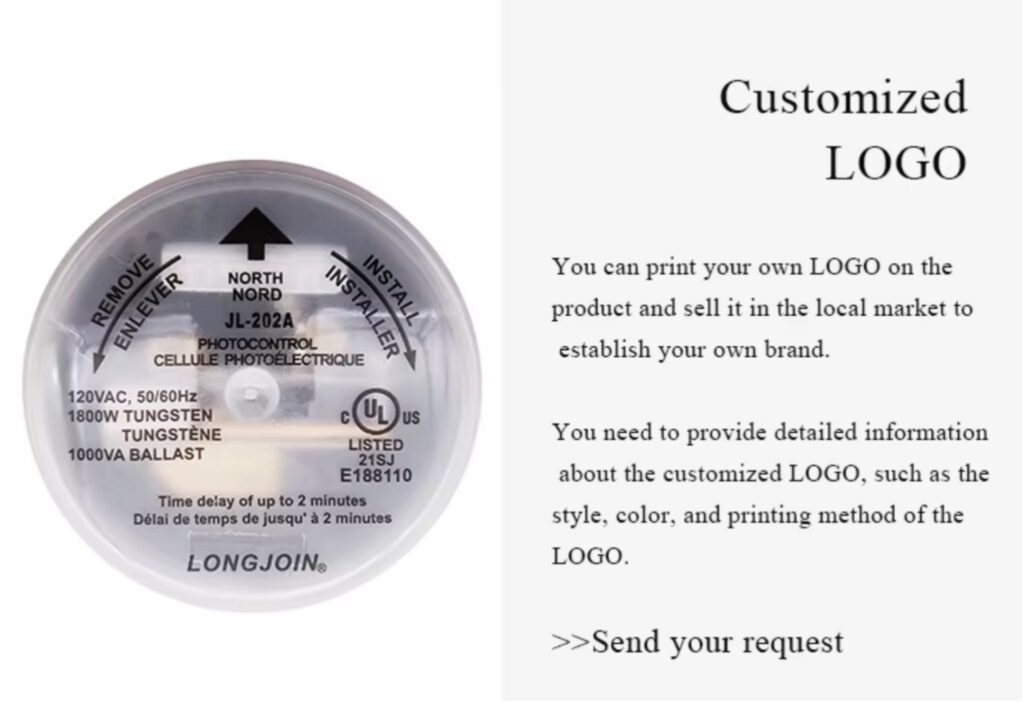
Shanghai Long-Join positions itself as a full-range supplier of photocells and sensor modules. The company publishes product lines that include ANSI/ NEMA twist-lock units, Zhaga Book-18 modules, and wire-in sensors.
● Certifications & standards
Long-Join lists UL, CE, En RoHS compliance and designs products to meet ANSI C136.10 / C136.41 and Zhaga Book-18 interfaces. These claims appear on their product and company pages.
● Surge protection & zero-cross switching
Many Long-Join controllers use zero-cross switching to reduce inrush stresses. Their product pages and datasheets also reference a built-in surge arrestor for transient protection. tip:photocontroller built in Surge protection up to 10kA/20kV.
● Weatherproof housings
Outdoor units are described as rain-tight and designed for LED luminaires. IP/ sealing features and outdoor-grade materials are noted across product listings.
● OEM / ODM customization
Long-Join offers OEM and ODM services. You can request a customization and selective protocol support (e.g., 0–10V, DALI, LoRa, NB-IoT).
● Partnerships & market footprint
The company cites supply relationships with major lighting brands and claims a substantial North American presence—historic product lines have served well-known lamp manufacturers and, historically, a large market share in some product segments.
De kern van de zaak
Smart lighting is reshaping cities with intelligent and connected control. Choosing the right photocell ensures stable and efficient operation for years. For those seeking trusted performance, Chi-Swear offers genuine Long-Join photocontrollers built to global standards.
Externe links
- https://www.nema.org/
- https://www.zhagastandard.org/?view=article&id=64:book-18&catid=10
- https://www.ansi.org/
- https://www.dali-alliance.org/dali2/comparison.html
- https://en.wikipedia.org/wiki/Zigbee
- https://en.wikipedia.org/wiki/LoRa
- https://en.wikipedia.org/wiki/Narrowband_IoT\
- https://www.ul.com/solutions
- https://single-market-economy.ec.europa.eu/single-market/goods/ce-marking_en
- https://en.wikipedia.org/wiki/RoHS