
Contorno
- Introdução
- O que são as normas NEMA? Fotocontroles and How Do They Work in Street Lighting Systems?
- Why Are Plug-and-Play Features Critical in Smart Streetlight Deployment?
- How Do Standardized Specifications Like ANSI C136.41 Improve Compatibility?
- How Do NEMA Receptacles Support Modern Dimming and Control Protocols?
- Why Do Cities Trust the Market Maturity of NEMA Receptacles?
- How Do NEMA and Zhaga Receptacles Compare in Smart Lighting Applications?
- What Are the Key Differences Between Zhaga and NEMA (5-Pin vs 7-Pin) Receptacles?
- Qual Tomada de fotocontrole Is Better for Future Smart City Projects?
- Conclusão
Lighting is no longer just about illumination. Cities now demand control and efficiency with live monitoring. This shift has made the connection interface more important than ever.
So, why do most cities still rely on the NEMA sensor de iluminação fotocélula?
The answer lies in simplicity and proven reliability. NEMA systems solve real operational challenges, whether it’s about quick installation or wide compatibility.
Understanding this choice helps explain how modern street lighting networks stay scalable and cost-effective.

O que são as normas NEMA? Fotocontroles and How Do They Work in Street Lighting Systems?
Struggling to understand how smart streetlights connect so easily? It comes down to the NEMA receptacle. It is a standardized socket mounted on top of the luminaire. It uses a twist-lock interface to connect controllers securely. This benefits by ensuring stable electrical contact in outdoor conditions like vibration and moisture.
The receptacle works as the interface between the luminaire and the controller. It supplies power and enables control signals without internal rewiring. This allows quick installation and fast replacement in the field. Downtime is reduced, and maintenance becomes simple.
There are two common configurations used in cities:
5-pin
- Supports basic ON/OFF and 0–10V dimming
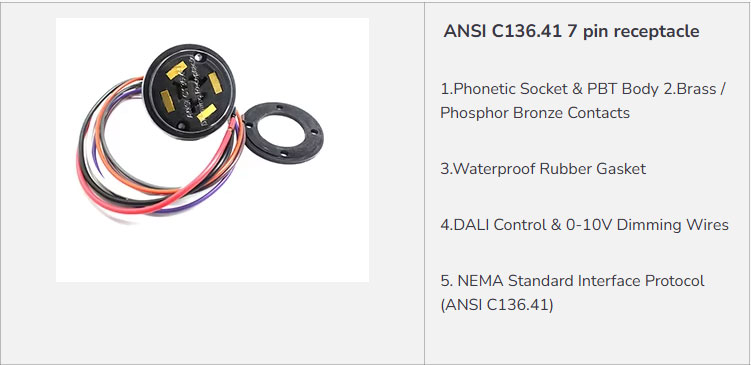
7 pinos
- Adds extra contacts for DALI and advanced control
This flexibility allows cities to scale from basic lighting to fully smart systems.
Why Are Plug-and-Play Features Critical in Smart Streetlight Deployment?
Facing delays in streetlight installation? Complex wiring is often the problem. NEMA plug-and-play design removes that friction. Sensores fotoelétricos can be mounted or replaced in seconds using a twist-lock system. No rewiring. No specialized tools.
This directly improves field operations:
- Faster installation across large city networks
- Quick fault replacement with minimal downtime
- Reduced labor and training requirements
Maintenance teams save time on every service cycle. Operational costs drop over the project lifecycle. That is why cities prefer systems that work instantly and reliably.
How Do Standardized Specifications Like ANSI C136.41 Improve Compatibility?
Inventory from multiple suppliers could mix the devices. Lack of standards creates that risk. ANSI C136.41 solves it by defining pin configurations and electrical interfaces for NEMA tomadas.
This standard ensures consistency across deployments:
- Uniform socket design across manufacturers
- Guaranteed fit for controllers and photocells
- Support for both power and control signals
Cities can source components from multiple vendors without compatibility issues. This avoids vendor lock-in and supports scalable upgrades. Standardization keeps projects flexible and easy to manage.

How Do NEMA Receptacles Support Modern Dimming and Control Protocols?
Need precise control over streetlight brightness? That is where NEMA receptacles deliver real value. The 7-pin configuration receptáculo de fotocontrole enables both power and control signaling. This allows integration with widely used dimming protocols.
0–10V
- Simple analog dimming. Reliable and widely deployed
DALI
- Digital control. Supports addressing, monitoring, and automation
These protocols enable adaptive lighting. Brightness adjusts based on traffic, time, or environment. Energy savings improve significantly without manual control. The receptacle also allows seamless connection with smart nodes, making it compatible with centralized city management systems.
Why Do Cities Trust the Market Maturity of NEMA Receptacles?
Extended reliability of products is a valid concern. Cities avoid this risk by choosing proven systems. In business since 1979s NEMA receptacles’ performance is validated across millions of installations worldwide.
This maturity brings real advantages:
- Stable design with minimal failure rates
- Wide availability of compatible controllers and photocells
- Strong ecosystem across global manufacturers
Utilities trust what works at scale. NEMA systems offer consistency, supply chain stability, and tested field performance. That makes them a safe and scalable choice for smart street lighting projects.
How Do NEMA and Zhaga Receptacles Compare in Smart Lighting Applications?
Confused between NEMA and Zhaga for smart lighting? Both solve different problems. Zhaga sockets follow Book 18 standards. They are compact and designed for modern IoT nodes. This improves design flexibility and aesthetics.
NEMA receptacles focus on robustness and standardization. They are larger and typically top-mounted. They support higher power handling and proven outdoor durability.
- Zhaga excels in: compact smart nodes, sensors, and IoT integration
- NEMA excels in: roadway lighting, retrofits, and large-scale deployments
Cities often choose based on project scale and control requirements.
| Advantage Category | NEMA | Zhaga |
| Retrofit Simplicity | Excelente | Limitado |
| Smart Data Support | Weak | Forte |
| Lifetime Reliability | Bom | Better (DC‑based design) |
| Aesthetics | Bulkier | Smaller, sleek |
| Controller Complexity | Alto | Baixo |
What Are the Key Differences Between Zhaga and NEMA (5-Pin vs 7-Pin) Receptacles?
| Comparison Item | Soquete Zhaga | NEMA (5-Pin) | NEMA (7-Pin) |
| Padrão | Livro 18 de Zhaga | ANSI C136 | 10 ANSI C136.41 |
| Tamanho | Compactar | Larger | Larger |
| Montagem | Flexível | Top-mounted | Top-mounted |
| Protocols | DALI-2, partial 0–10V | 0–10V | 0–10V + DALI |
| Smart Support | Native IoT | Limitado | Avançado |
Qual Tomada de fotocontrole Is Better for Future Smart City Projects?

The compatibility of any standard depends on the use case. Both NEMA and Zhaga are evolving to meet different needs.
NEMA remains the preferred choice for large-scale street lighting. It fits well in retrofit projects and existing infrastructure. Cities rely on it for reliability and wide compatibility. It works best where proven performance and quick deployment matter most.
Zhaga interruptores de sensor de luz externa are gaining traction in new smart city designs. Their compact size supports modern luminaires and integrated sensors. It is ideal for IoT-driven applications and connected urban systems.
- NEMA: best for roads, highways, and upgrades
- Zhaga: best for smart nodes and adaptive lighting
Both standards will coexist. Future systems will combine reliability with smart flexibility.
| Região | Dominant Standard | Tendência |
| América do Norte | NEMA | Slow shift to Zhaga |
| Europa | Zhaga (Livro 18) | Strong adoption |
| Middle East/Asia | Mixed deployments | Increasing Zhaga use |
| Australia / NZ | Primarily NEMA | Gradual modernization |
Conclusão
NEMA receptacles remain the trusted choice for most cities due to their reliability and ease of maintenance. Zhaga sockets are emerging as a compact and smart solution for modern lighting projects. For reliable Long-Join photocontrollers, Chi-Swear offers proven products and strong industry support, making them a dependable partner for any smart streetlighting project.



 Portuguese
  English
  Spanish
  Russian
  Arabic
  Italian
  Japanese