
OUTLINE
- Introdução
- How Does Each Technology Save Energy?
- How Do They Compare Across Key Application Factors?
- What Are the Cost Implications of Each Approach?
- What Are the Recommended Control Configurations?
- Photo Control vs Motion Sensor
- Frequently Asked Questions on Photo Controls and Motion Sensors
The energy efficiency debate between photo controls and motion sensors misses the point when framed as a head-to-head competition. Both save energy.
Both devices save energy in different ways, at different times of day, in different environments.
The real question is which one matches the specific lighting application. This article compares their energy-saving performance and suitability for different applications, helping users make informed choices
How Does Each Technology Save Energy?
Photocontrols can limit lighting during sufficient daylight. Occupancy controls can reduce output when an area is unoccupied, subject to the project lighting requirements. Savings depend on the operating schedule, settings and baseline.
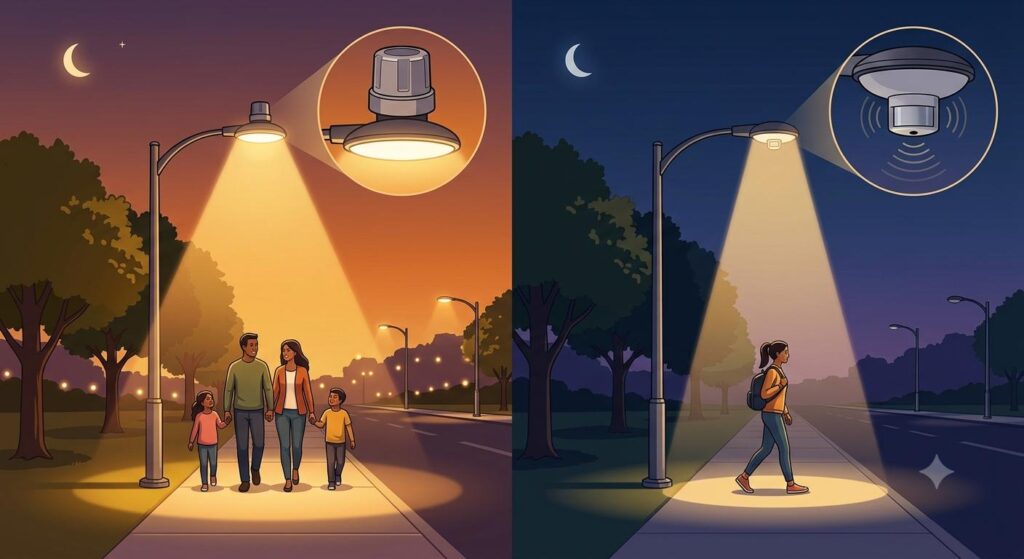
A photocontrol switches the light off when ambient lux rises above the dawn threshold. Every hour of daylight that a fixed-timer system runs unnecessarily is energy the photocontrol prevents from being consumed.
A motion sensor holds the light at reduced output or off during unoccupied nighttime periods and switches to full brightness when presence is detected. For example, in a low-traffic car park between 1 am and 5 am, the energy consumed by full-brightness lighting that nobody is benefiting from is what the motion sensor eliminates.
How Do They Compare Across Key Application Factors?
Nine practical factors determine which technology is more suitable for a given application.
| Discussion Points | Photo Controls | Sensores de movimento | Explanation |
| Adaptability to LED Lighting Reflection | Check sensor positioning and light feedback in the installed fixture. | Response depends on the sensing technology and detection environment. | Evaluate the actual light and occupancy inputs; neither control type is universally superior. |
| More Suitable for Urban or Rural | Choose daylight switching where it matches the lighting plan. | Choose occupancy response where reduced output is permitted by the lighting plan. | Different regional usage needs dictate control solution choice |
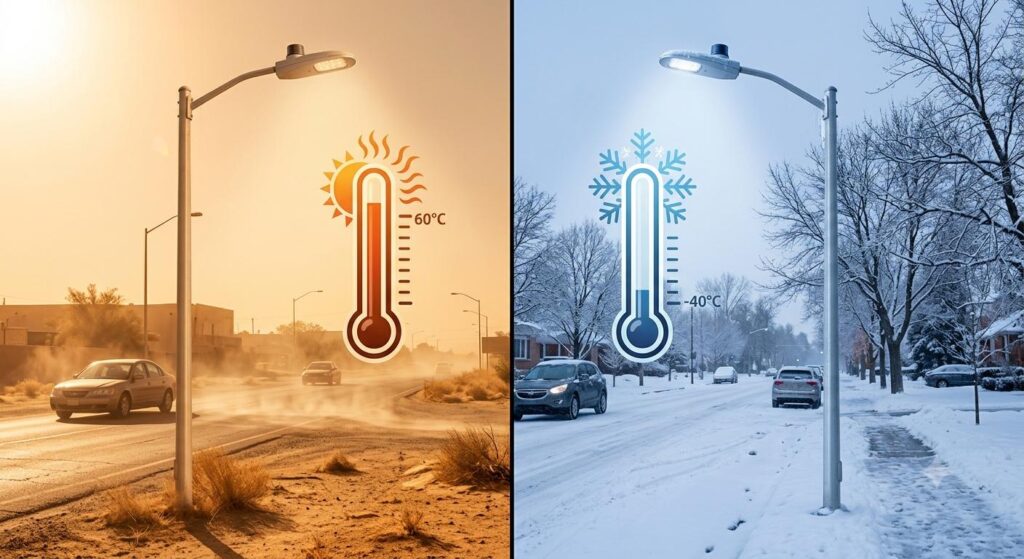
| Suitability for Harsh Weather | Confirm the model temperature, ingress protection and installation requirements. | Confirm the model temperature, ingress protection and installation requirements. | Climate affects device stability |
| Suitability for Parking Lots | Compare the required overnight lighting level with the proposed schedule. | Validate detection coverage, hold time and minimum lighting level. | Assess the actual occupancy pattern and lighting requirement. |
| Suitability for Commercial Building Facades | Use the required facade lighting schedule and operating level. | Use the required facade lighting schedule and operating level. | Commercial lighting demands continuous and steady lighting |
| Suitability for Solar-powered Lights | Verify the solar-system supply and controller/driver interface. | Verify the solar-system supply and controller/driver interface. | Solar lighting requires stable power management |
| Suitability for High Humidity Environments | Confirm the exact assembly and documented humidity or ingress conditions. | Confirm the exact assembly and documented humidity or ingress conditions. | High humidity challenges electronic components |
| Increase in Driver Wear and Tear | Assess switching, dimming, inrush and driver endurance documentation. | Assess switching, dimming, inrush and driver endurance documentation. | Do not infer service life without comparable model and load data. |
| Sensitivity at High Pole Height | Confirm mounting, sensor exposure and the required lighting function. | Confirm the actual model detection height, coverage and target movement. | Choose the operating level and schedule from the project lighting plan. |
What Are the Cost Implications of Each Approach?
Compare installed cost, maintenance access, standby power, operating hours and measured energy use for the exact alternatives. Neither control type has a universal cost advantage.
| Cost Element | Photo Controls | Sensores de movimento |
| Economia de energia | Saves daytime electricity | Estimate savings against a measured baseline and validated occupancy profile. |
| Investimento inicial | Compare installed equipment, commissioning and maintenance costs. | Compare installed equipment, commissioning and maintenance costs. |
| Custo de manutenção | Use documented field performance and the planned maintenance procedure. | Use documented field performance and the planned maintenance procedure. |
| Impact on Driver Service Life | Assess switching, dimming, inrush and driver endurance documentation. | Assess switching, dimming, inrush and driver endurance documentation. |
Evaluate driver switching endurance, inrush, operating hours, temperature and the actual control sequence using manufacturer documentation. Dimming without power cycling and switching the supply are different behaviours; do not infer replacement frequency from the sensor type alone.
Estimate lifecycle cost using the actual energy tariff, operating profile, equipment price, service access and documented replacement assumptions. A projected saving is not a measured result.
What Are the Recommended Control Configurations?
Select photocontrol-only, occupancy-only or combined control against the application requirements. Validate the proposed schedule and lighting levels before comparing energy performance.
Pure photo control
Photocontrol-only operation may suit projects requiring dusk-to-dawn switching. Review the photocontrol selection guide and the exact model supply, load, delay and installation requirements. Solar-system suitability and ingress protection require model-specific confirmation; do not infer them from the product family.
Pure motion sensor control
Occupancy control may reduce energy use during unoccupied periods where the lighting plan permits reduced output or switching off. Confirm detection coverage, mounting height, hold time, driver interface and the required minimum lighting level for the selected model.
Hybrid mode
Combined daylight and occupancy control may address different operating periods. Confirm the driver interface, thresholds, hold times and control priorities; a combined approach is not automatically the best solution for every site.
For the JL-723A1H or another combined controller, confirm the documented sensing functions, power, driver interface and adjustable settings. A Zhaga mounting format alone does not establish system compatibility.
Photo Control vs Motion Sensor
Choose the control function that matches the lighting requirement. Compare a measured baseline with the proposed operating hours and dimming levels, including standby use and maintenance. Document the model and installation conditions instead of assuming universal savings or durability from the control type.
Assess combined control only where the chosen driver and controller support the required functions. Verify behaviour and integration on a sample rather than assuming one unit replaces every other control component.
Frequently Asked Questions on Photo Controls and Motion Sensors
Q1: Can photo controls and motion sensors be combined for the best energy-saving effect?
Yes, compatible daylight and occupancy functions can be combined where the design supports them. Confirm the driver, interfaces, settings and required lighting levels, then validate the proposed operation against the project baseline.
Q2: Does LED lamp reflection affect photo control accuracy, and how is it handled?
Artificial light and reflections may affect the lux seen by a photocontrol. Follow the exact model orientation and positioning instructions, keep the sensor clear of its own fixture output and confirm spectral response and delay settings. An IR filter or a NORTH direction is not a universal remedy.
Q3: In what environments do motion sensors commonly produce false triggers?
Potential false triggers depend on the sensing technology, field of view, mounting and site conditions. Check the model detection range and height, temperature and ingress protection. Investigate the observed trigger source; no single 8–12 metre limit applies to every motion sensor.
Q4: What energy-saving risks are associated with photo control Fail-ON mode?
Fail behaviour is model- and fault-specific. Confirm what Fail-ON or Fail-OFF means for the selected controller and the failure modes it covers. Choose the required response through the project safety and lighting review, and monitor unexpected daytime operation rather than treating a fail-mode label as a universal diagnostic guarantee.
Q5: How big is the maintenance cost difference between photo controls and motion sensors?
Maintenance cost depends on the model, installation, access, failure records, spare strategy and control system. Compare documented field performance and maintenance requirements under equivalent conditions; do not assign a failure rate solely from the control type.
Links externos
Project and selection resources
Photocontrol Selection · NEMA Receptacles & Accessories · Zhaga Controllers & Sockets · Smart Lighting Integration
América latina · América do Norte · Europa · Perguntas frequentes

 English
 Spanish
 Russian
 Arabic
 Italian
 Japanese
 Portuguese
Uma resposta