OUTLINE
- Introdução
- Effects of 60°C High Temperature on Internal Components of Photocontrols
- How Do the JL-207C and JL-103A Compare Across All Five Areas?
- Photocells for High Temperature Regions
- Frequently Asked Questions on Photocells and High Temperature
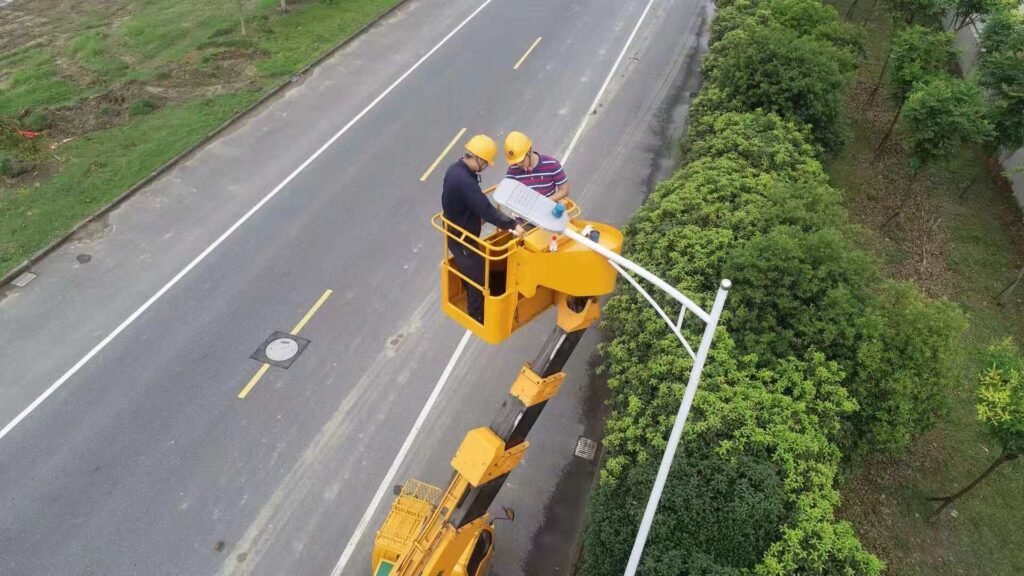
Most outdoor photocells spend their entire service lives in positions with no shade, no ventilation, and no protection from direct solar radiation. In the Middle East, South Asia, and tropical regions, surface temperatures on pole-mounted equipment routinely exceed 60°C during summer months.
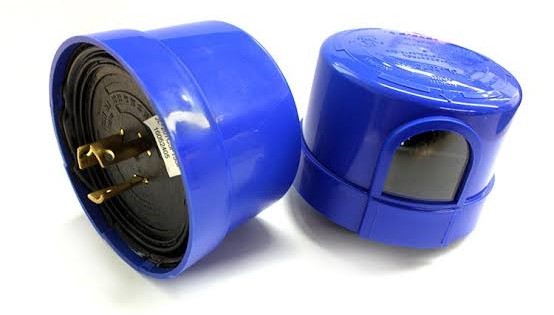
That thermal load doesn’t just affect the housing. It works its way into every internal component, and each one responds differently. Photocells such as Long-Join’s JL-207C and JL-103A are both designed with outdoor temperature tolerance as a core requirement.
Understanding how each internal component responds to sustained high-temperature exposure explains why design decisions at the component level matter for long-term reliability.

Effects of 60°C High Temperature on Internal Components of Photocontrols
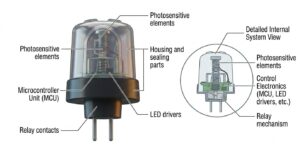
The long-term exposure of photocells to high temperature could lead to adverse effects on different Internal elements in the device, such as:
- Photosensitive elements
- Microcontroller Unit (MCU)
- Relay contacts
- Housing and sealing parts
- drivers de LED
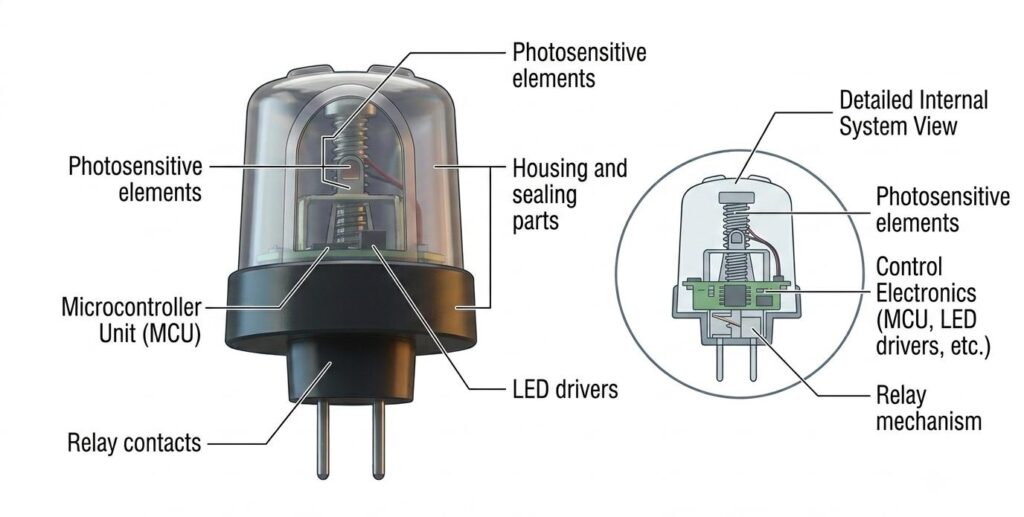
In my experience, Long-Join photocontrol’s high-temperature-resistant internal component design is built with several advantages to overcome these adverse effects. Let’s take a look at each effect and how the JL-207C e JL-103A models work to curb them.
What Happens to Photosensitive Elements at High Temperature?
Photosensitive elements, whether photodiodes ou fototransistores, experience parameter drift as temperature rises, shifting the lux threshold at which switching occurs and reducing sensing accuracy.
As junction temperature increases in a semiconductor sensor, the dark current increases and the sensitivity characteristics shift. A photocell calibrated to switch at 15 Lux at 25°C may switch at a noticeably different threshold at 60°C if no compensation is applied.
The JL-207C uses a high-temperature photodiode with built-in compensation to offset this drift. The JL-103A uses a standard phototransistor with a damping drift design that reduces but does not fully eliminate the effect.
What Happens to the MCU at High Temperature?
O MCU (Microcontroller Unit) is the logic brain of a smart or electronic photocontrol, and sustained high-temperature exposure causes leakage current increases that produce control errors, false triggers, and delayed response.
Standard commercial-grade MCUs are typically rated to 70°C or 85°C. In a sealed outdoor housing under direct sun, the internal temperature can exceed these limits. Logic errors at elevated temperatures cause the relay to switch at the wrong moment or fail to switch at all.
The JL-207C uses an industrial-grade MCU with a temperature protection rating appropriate for sustained outdoor use. The JL-103A uses a standard industrial control MCU suited to its operating temperature range.
What Happens to Relay Contacts at High Temperature?
Relay contacts face thermal expansion and contraction stress on every switching cycle in a high-temperature environment, which accelerates contact surface degradation and shortens relay service life.
The combination of electrical arcing at each switching event and the mechanical stress from thermal cycling is more damaging at 60°C than at 25°C. This creates the likelihood of contacts fusing in a closed position, also known as contact welding.
Both the JL-207C and JL-103A use silver alloy contacts, which have better resistance to oxidation and welding than standard copper contacts. The JL-207C’s relay carries a longer cycle life rating due to the more robust contact design used in its higher-specification configuration.
What Happens to the Housing and Seals at High Temperature?
UV exposure and sustained heat cause housing materials and sealing compounds to age. This reduces the integrity of the seal and opens paths for moisture that damage internal components.
Over time, the sealing glue and gasket materials lose elasticity under heat exposure. Once the seal degrades, moisture enters during rain events or from condensation, reaching the relay contacts and Printed Circuit Board (PCB).
The JL-207C uses a PolyCarbonate (PC) and Acrylonitrile Butadiene Styrene (ABS) double-layer housing construction with ultrasonic welding, which creates a permanent mechanical bond at the housing joint rather than relying solely on adhesive or compression gasket seals. The JL-103A uses a single-layer PC housing with standard sealing, which is adequate for moderate environments but offers less long-term protection under extreme UV and heat conditions.
What Happens to LED Driver Compatibility at High Temperature?
drivers de LED are more prone to transient surge damage at high operating temperatures, and without adequate filtering in the photocell’s switching circuit, MCU failures become more likely in high-temperature surge environments.
Heat reduces the surge tolerance of LED driver components. When a photocell switching event generates a transient on a hot circuit, the driver’s ability to absorb that transient without damage is lower than at normal temperature.
The JL-207C includes filter design elements in its switching circuit that reduce the transient seen by the connected LED driver. This is particularly relevant in regions with frequent lightning or grid instability, where surge events are a regular occurrence alongside high operating temperatures.
How Do the JL-207C and JL-103A Compare Across All Five Areas?
| Component Type | Typical Effect | JL-207C Design Features | JL-103A Design Features |
| Photosensitive Element | Parameter drift, sensitivity degradation | High-temp photodiode with effective compensation | Standard phototransistor with damping drift design |
| MCU | Control errors due to leakage and heat failure | Industrial-grade MCU with temperature protection | Standard industrial control MCU |
| Relay Contacts | Contact welding and poor contact affecting bidirectional switching | Silver alloy material, lifespan of tens of thousands of cycles | Silver alloy but slightly shorter lifespan |
| Housing and Seals | UV heating, aging, and sealing failure causing moisture risk | PC+PC double-layer housing, ultrasonic welding, UV chemically stable | Single-layer PC, standard sealing |
| LED Driver | Lack of filter design, prone to surge damage | With filter design |
Full specifications for both models are available on Chi-Swear along with compatible features information.
Photocells for High Temperature Regions
Sustained 60°C operating temperature affects every internal component in a photocontrol, from sensor drift and MCU logic errors through to relay contact degradation and housing seal failure. Long-Join’s photocell model designs work to avoid these effects. The JL-103A covers moderate environments competently, but for extreme high-temperature installations, the JL-207C’s component-level design decisions make it the more reliable long-term specification.
Frequently Asked Questions on Photocells and High Temperature
Q1: What are the most direct high-temperature effects on photosensitive elements?
Sensitivity decreases, and the switching threshold drifts, causing the photocell to switch at the wrong lux level. The JL-207C’s temperature compensation addresses this directly.
Q2: What problems can high temperature cause to relay contacts?
Contact welding in the closed position and increased surface oxidation that raises contact resistance. Both become more likely when thermal stress is added to the normal switching arc damage.
Q3: How is MCU stability ensured in a high-temperature environment?
Through industrial-grade high-temperature components with appropriate junction temperature ratings, and thermal design that limits heat accumulation around the MCU under sustained outdoor exposure.
Q4: What requirements apply to photocontrol housing materials?
High-temperature resistance, UV stability, and waterproof sealing integrity maintained across years of thermal cycling. Ultrasonic welding at housing joints provides more durable sealing than adhesive or compression gaskets.
Q5: Which model is better for extreme high-temperature conditions?
The JL-207C. Its double-layer enclosure with ultrasonic welding, high-temperature photodiode, industrial-grade MCU, and LED driver filter design gives it significantly better performance under sustained 60°C conditions than the JL-103A.