
Outline
- Introduction
- What Are the Key Characteristics of Traditional Photocell Switches?
- What Defines IoT-Enabled Smart Photocells?
- How Do Traditional and IoT-Enabled Photocells Compare Across Key Dimensions?
- Which Type of Photocell Is Better for Modern Lighting Projects?
- What Are the Installation and Integration Differences?
- ` Traditional Photocells Installation
- How Do Maintenance and Lifecycle Costs Compare?
- What Is the Future Trend of Photocell Technology?
- Which Solution Should You Choose?
- The Bottom Line
Automation is not the only need that makes lighting controls critical. Cities now demand smarter and more efficient systems.
This shift has brought IoT-enabled controllers into focus. But traditional photocells are still widely used.
They have some key differences. Understanding this helps you choose the right solution for modern lighting projects.
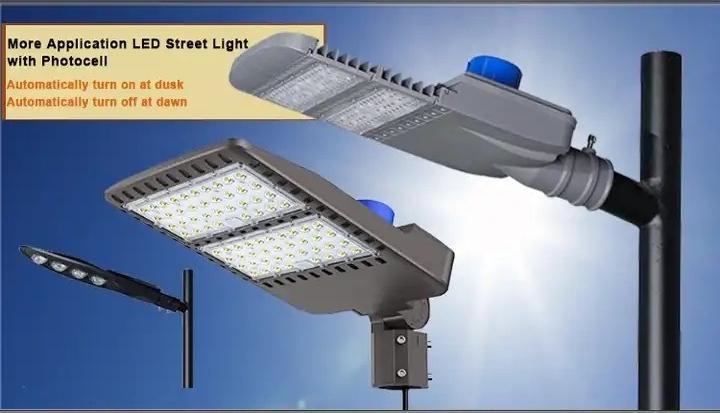
What Are the Key Characteristics of Traditional Photocell Switches?
These photosensors are standardized and widely adopted. Common models include:
- JL-205C
- JL-207C
- JL-243C (supports 0–10V dimming)
- JL-253C (supports DALI dimming)
These models follow NEMA-based designs. They are plug-and-play. Easy to replace. Widely available across global markets.
Functioning Of Traditional Photocells
Traditional light sensor control works as an automatic switch. They detect ambient light and respond instantly. When light drops below a set threshold, the circuit closes. This turns the lamp on. When daylight increases, it opens the circuit and turns it off.
- Based on light-sensitive elements like CdS sensors
- Resistance changes with light intensity
- Simple relay triggers ON/OFF action
- Limited dimming in advanced variants
The design is simple. No communication module. No external control needed.
Common Applications
These outdoor light sensor switches are built for standalone operation. No network required. They are commonly used in:
- Conventional street lighting systems
- Parking lots and highways
- Basic outdoor and security lighting
Each unit operates independently. It reacts only to local light conditions. This makes it reliable but limited in control flexibility.
Technical Specifications Overview
| Parameter | Typical Range / Feature |
| Operating Voltage | 120–277V AC |
| Load Capacity | 1000W Tungsten / 1800VA Ballast |
| Response Time | 30–120 seconds delay |
| Switching Threshold | 10–20 lux ON / 30–60 lux OFF |
| Mounting Type | NEMA 3-pin twist-lock |
| IP Rating | IP65 / IP66 |
What Defines IoT-Enabled Smart Photocells?
These photocontrol switches are built for connectivity. They combine sensing with communication modules. Common models include:
- JL-246CG (ZigBee communication)
- JL-245CN (NB-IoT connectivity)
- JL-723A1H (PIR + light sensing)
- JL-721NP (optic sensing + NB-IoT real-time control)
These models support network integration. They are designed for scalable deployments.
Working Of IoT-Enabled Photocontrol Receptacle
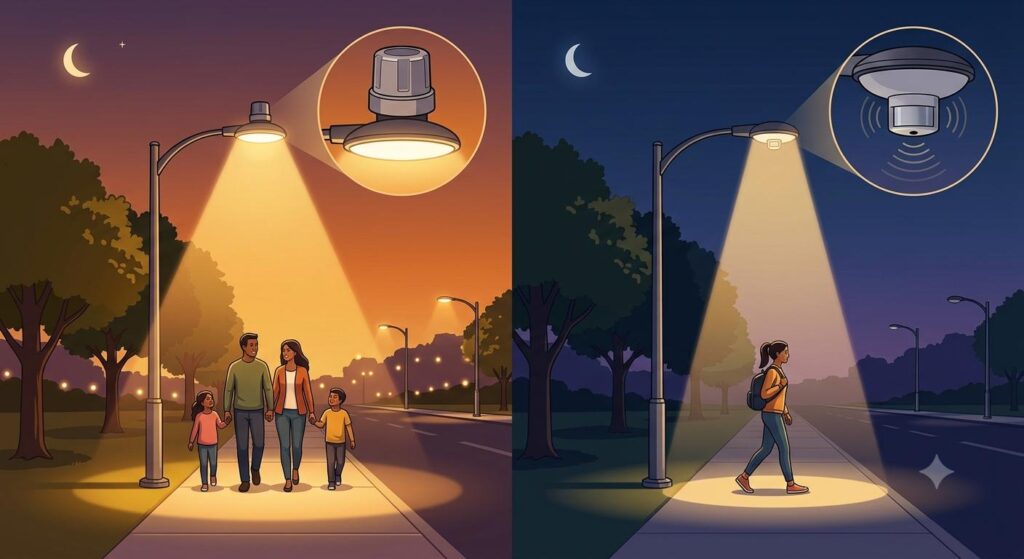
These controllers go beyond simple switching. They collect data. They communicate with central systems. Control becomes dynamic, not fixed.
- Wireless protocols
- Real-time remote monitoring and fault detection
- Multi-sensor input: light, motion, scheduling
- Adaptive dimming based on traffic or environment
Each node shares data continuously. Decisions can be automated or centrally managed.
Application Scenarios for Smart Photocells
IoT photocells fit complex systems. They reduce manual intervention. They improve efficiency at scale. Typical use cases include:
- Smart city lighting infrastructure
- Highway and urban lighting networks
- Industrial parks and campuses
They are ideal where remote O&M is critical. Data-driven control ensures optimized energy use and faster maintenance response.
Communication Technologies Comparison
| Protocol | Range | Power Consumption | Best Use Case |
| ZigBee | Short (10–100m) | Low | Local mesh networks |
| NB-IoT | Wide (cellular) | Very Low | City-wide deployments |
| LoRaWAN | Long (2–15 km) | Ultra-low | Rural/remote areas |
| Bluetooth | Very Short | Low | Device-level control |
| 4G/5G | Wide | High | Real-time high data transfer |
How Do Traditional and IoT-Enabled Photocells Compare Across Key Dimensions?
Choosing between these two is not simple. The difference is not just features. It is about control, scale, and efficiency. The table below shows a clear comparison.
| Dimension | Traditional Photocells | IoT-Enabled Smart Photocells |
| Typical Models | JL-205C, JL-207C, JL-243C, JL-253C | JL-246CG, JL-245CN, JL-723A1H, JL-721NP |
| Control Mode | Light sensing or basic dimming | Multi-sensor + remote control |
| Dimming Support | Partial (0–10V) | 0–10V, DALI, adaptive dimming |
| Connectivity | Wired | ZigBee, NB-IoT, LoRaWAN, 4G/5G |
| Maintenance | Manual inspection | Remote diagnostics |
| Energy Saving | Basic | Dynamic and optimized |
| Application | Standalone lighting | Networked smart systems |
Which Type of Photocell Is Better for Modern Lighting Projects?
Choosing the right type depends on project scale and control needs. Not every project needs IoT. But not every project can rely on basic control either.
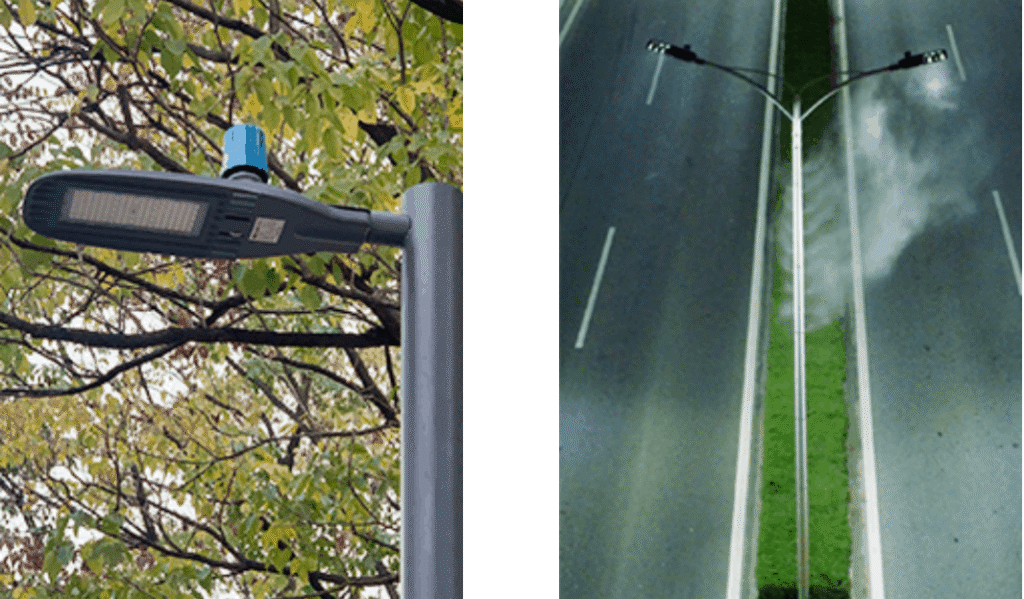
Applications Where Traditional Photoelectric Sensors Are Sufficient
They work best in simple setups. No network. No remote access needed.
- Small street lighting projects
- Rural areas
- Budget-sensitive installations
They offer stable switching. Minimal setup. Low upfront cost.
Applications Where IoT-Enabled Solutions Are Necessary
They are essential when control must be centralized. Data matters here. They reduce manual work. Improve uptime.
- Smart city deployments
- High-density urban roads
- Projects needing remote diagnostics
Cost vs Functionality Consideration
| Factor | Traditional | IoT-Enabled |
| Initial Cost | Low | Higher |
| Control Level | Basic | Advanced |
| ROI | Limited | Long-term savings |
Scalability and Future Readiness
Traditional systems are fixed. Hard to expand. IoT systems scale easily. New nodes can be added without rewiring. They are future-ready by design.
What Are the Installation and Integration Differences?
Installation complexity varies significantly. It impacts project timelines and labor costs. The difference is practical, not theoretical.
Traditional Photocells Installation
These are plug-and-play devices. No configuration required.
- Direct mounting on luminaire (NEMA base)
- Simple wiring connection
- No software setup
They are quick to deploy. Ideal for fast rollouts.
IoT-Enabled Photocells Installation
These require system-level integration. Hardware is only one part.
- Device installation + network configuration
- SIM pairing or gateway setup (NB-IoT/ZigBee)
- Platform integration and commissioning
Deployment takes longer. But control becomes centralized and scalable.
How Do Maintenance and Lifecycle Costs Compare?
Traditional Lighting Control Maintenance
Maintenance is manual. Fault detection is reactive.
- On-site inspection required
- Failures detected after outages
- Higher labor dependency
Costs seem low initially. But it increases over time.
IoT-Enabled Photocells Maintenance
Maintenance becomes predictive. Data drives decisions.
- Remote fault alerts and diagnostics
- Real-time performance monitoring
- Reduced field visits
What Is the Future Trend of Photocell Technology?

The industry is shifting fast. Control is moving from local to connected systems. Cities want visibility. Operators want data.
- Smart controllers are replacing standalone units
- Integration with smart city platforms is increasing
- Sensors and AI-based control are expanding
Lighting is becoming a data node. Not just an asset. Future systems will focus on predictive maintenance and energy optimization.
Which Solution Should You Choose?
The difference is clear. Traditional outdoor light sensor switches offer simplicity. IoT controllers deliver intelligence. One is reactive. The other is proactive.
Choose based on project needs. Use traditional for small, static setups. Use IoT for scalable and high-performance systems.
The industry is moving toward smart control. Adopting IoT now ensures extended efficiency and operational flexibility.
The Bottom Line
Traditional photocells are simple and reliable. IoT-enabled controllers deliver smarter control and scalable management. For stable performance and proven quality, Chi-Swear offers reliable Long-Join photocontrollers. A practical choice for projects moving toward smarter lighting solutions.


 English
  Spanish
  Russian
  Arabic
  Italian
  Japanese
  Portuguese