Gliederung
- Einführung
- Why Have Single-Lichtsensorschalter Control Become the Global Standard?
- How Does “One Photocell per Light” Improve System Reliability?
- Why Are Individual Lichtsensorschalter für den Außenbereich More Cost-Effective in the Long Run?
- How Does Plug-and-Play Deployment Simplify Street Lighting Projects?
- Why Is Single-Light Architecture the Best Path Toward Smart City Integration?
- What Are the Hidden Costs of Centralized Lichtsteuerung?
- How Does Long-Join Electronics Support Smarter Lighting Choices?
- What Really Defines the “True Cost” in Street Lighting Projects?
- Schlussworte

Street lighting is at the heart of modern urban infrastructure. But how should cities control it — with one central Lichtsteuerung or one per light? At first, centralized control seems cheaper. Yet, the risks and hidden costs tell another story.
Reliability and flexibility are more critical in smart city planning than upfront savings. That’s why the single-light Fotosensor approach is gaining ground worldwide. This guide explains why it’s the smarter, long-term choice for engineers, planners, and manufacturers.
Why Have Single-Lichtsensorschalter Control Become the Global Standard?
In North America, the individual Fotoschaltersensor dominates new street lighting installations. Many jurisdictions report that over 80% of new LED street light retrofits use one-photocell-per-light architecture for enhanced reliability and modular maintenance.
The three primary reasons for this are:
Zuverlässigkeit
Each fixture has its own Lichtsensor. A single failure darkens only one light—not an entire row. Localized control cuts outage risks. It strengthens system resilience. That reliability is vital in high-traffic zones. It is just as critical in remote areas where repairs take longer.
Anpassungsfähigkeit
Individual control unlocks plug-and-play flexibility. Engineers can add IoT upgrades with ease. Controllers stay untouched. The modular setup keeps projects future-ready. It aligns with smart-city standards. It connects smoothly with remote management systems.
Zukunftssicherung
LED fixtures with smart fotoelektrische Sensoren deliver predictable lifespans and easier troubleshooting. Seattle reports up to 60% lower energy use, “greater reliability and lower maintenance costs,” and “three to four times greater field life” with modern LED + control setups.
How Does “One Photocell per Light” Improve System Reliability?
Cities face serious consequences when a central photocell fails — the entire street can go dark. That’s a single point of failure. By contrast, distributed control gives each light its own fotoelektrischer Sensor. One failure means just one dark fixture — not a blackout.
Here’s how distributed photocell control boosts reliability:
- Localized independence. Each fixture works on its own. One Lichtschrankenschalter failing doesn’t affect its neighbors. Streets stay lit, even when components fail.
- Faster fault detection. Individual units are easier to test. Technicians can find and fix the bad photocell fast—reducing downtime.
- Verbesserte Sicherheit. Smart photocells respond in real time. They turn on lights when natural light drops abruptly—like during storms or dense fog—preventing gaps in visibility.
Why Are Individual Lichtsensorschalter für den Außenbereich More Cost-Effective in the Long Run?
For a grid-tied municipal lighting fixture, the approximate annual cost is between $250 and $400. The complex troubleshooting and cable repairs are not part of it. So that quickly towers over initial savings.
By contrast, fixtures with individual Straßenbeleuchtungssteuerungen simplify maintenance:
- Simplified fault isolation. No need to trace entire circuits. Replace only the failed unit.
- Reduced labor costs. Fewer truck rolls. Technicians fix one fixture—not the whole street.
- Hardware savings. No trenches or rewiring when faults happen. Avoid pricey underground work.
On a larger scale, cities save even more. Smart, photocell-enabled systems can cut energy use by up to 30% compared to timer-based controls—especially handy for fleets like 50,000 fixtures.
Other studies show that a full smart, sensor-based street lighting setup (using adaptive control) can yield up to 48% energy savings versus conventional systems.
How Does Plug-and-Play Deployment Simplify Street Lighting Projects?

Standard NEMA/ANSI sockets make upgrades fast. Engineers simply twist in a controller—no rewiring needed. This means:
● Plug-and-play retrofit
You insert a NEMA smart controller into the existing ANSI C136.41 socket. It snaps right in. No cabinet modifications, no wiring changes.
● Rapid deployment at scale
Teams upgrade one fixture at a time. Same process, every street. It scales effortlessly across hundreds or thousands of lights.
● Standardized connectivity
3-, 5-, and 7-pin NEMA sockets support photocells, dimming, DALI, and IoT modules. Future-proof functionality with zero infrastructure rework. JL-207 and JL-243 series twist-lock photocells.
With plug-and-play, street lighting moves from heavy installs to simple swaps. Projects finish faster. Costs drop. Smart city goals get unlocked—with minimal effort.
Why Is Single-Light Architecture the Best Path Toward Smart City Integration?
Smart cities need flexible lighting. Per-fixture control delivers that in spades. Here’s how:
Wireless upgrade simplicity
Lichtsteuerungen can be swapped in at each pole. Use ZigBee, LoRa, or NB-IoT without rewiring. The light becomes “smart” with a simple controller install. No infrastructure change needed.
Here is a table outlining various communication protocols in terms of range, data rate, and cost.
| Technology | Typischer Bereich | Datenrate | Cost Level | Bester Anwendungsfall |
| ZigBee | 10–100 m | ~250 kbps | Niedrig | Local mesh control |
| LoRa | 2–5 km urban / 15 km rural | ~50 kbps | Medium | Citywide coverage |
| NB-IoT | 1–10 km | ~250 kbps | Mittel-Hoch | Utility integration |
Smart features enabled
These controllers support adaptive dimming and remote commands. They respond to real-time data. Manage brightness based on traffic, time, or weather. You save energy and reduce emissions.
Integration mit IoT
Nanocontrollers talk to city systems using gateways or cellular networks. Use mesh, LPWAN, or licensed bands. You connect lighting to the larger smart grid.
Scalability and future proofing
Single-light modules scale easily. Each light is independent yet connected. New IoT protocols or sensors plug in as tech evolves. You stay ahead.
Data-driven city operations
Individual fixtures provide the status of energy use and fault alerts. Cities can monitor, analyze, and optimize lighting performance in real time. This makes maintenance proactive and not reactive.
What Are the Hidden Costs of Centralized Lichtsteuerung?
Centralized systems may look cheap at first, but they bring many hidden expenses.
1. Costly Wiring and Installation
Grid-tied installations often demand trenching and utility coordination. These costs can run into tens of thousands per site, especially in dense or remote areas.
Post-install repairs often require disruptive excavation and roadwork. That raises both direct and indirect costs.
2. High Ongoing Maintenance and Labor
For grid-connected fixtures, the maintenance costs are high. Each issue, like wiring faults and photocell malfunctions, needs proper setups for recovery. Traditional systems also suffer theft, vandalism, and aging infrastructure—all adding labor and replacement costs.
3. Widespread Outage Risks
A single point of failure in centralized control can plunge entire districts into darkness. Even minor failures in control cabinets or wiring often lead to blackout zones, raising public safety risks.
4. Inflexible and Limited Upgrade Options
Centralized systems make per-fixture customization nearly impossible. Retrofitting smart controls often requires extensive changes in wiring or controllers. Scaling or integrating newer IoT technologies is costly and cumbersome.
Further, here is a table elaborating the cost breakdown of centralized vs. distributed systems.
| Kostenfaktor | Centralized System | Distributed (Photocell) System |
| Wiring & Installation | High (extensive cabling) | Low (minimal wiring) |
| Wartung | Higher (whole circuit outage) | Lower (individual unit failure) |
| Flexibilität beim Upgrade | Beschränkt | Scalable, modular |
| Long-Term Cost | Sehr hoch | Mäßig |
How Does Long-Join Electronics Support Smarter Lighting Choices?
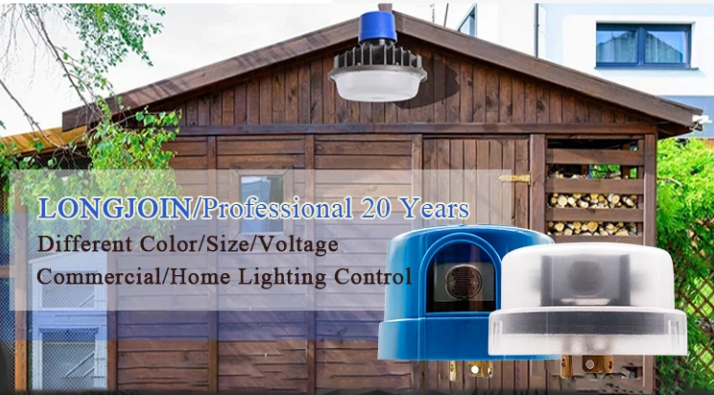
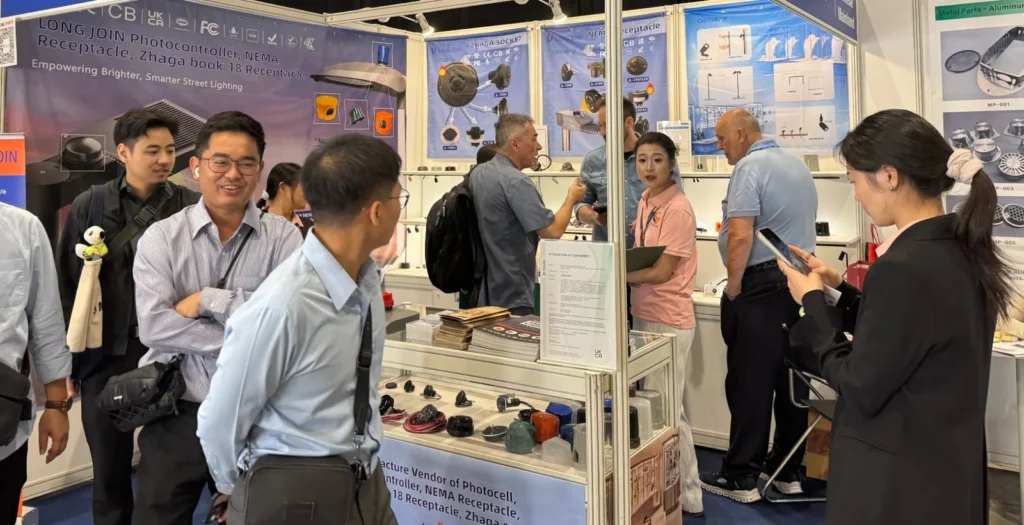
Long-Join brings over 20 years of Lichtsensor innovation. Founded in 1996, the company has become one of China’s leading manufacturers in the field. They produce around 8.5 million light-control components every year.
● Broad Product Portfolio and Flexibility
They offer thermal, electronic, and smart Fotosteuerung types. Customized firmware, housing, and packaging are available via OEM/ODM service.
● Global Certifications and Standards
Here is a table of certifications & compliance standards that Long-Join products meet.
| Certification / Standard | Region | Zweck |
| ANSI C136.10 / C136.41 | Nordamerika | Photocontrol receptacle & dimming standards |
| UL & cUL Listing | US / Canada | Safety certification |
| CE Markierung | Europa | Compliance with EU safety & performance |
| RoHS & REACH | Global | Environmental and hazardous material compliance |
● Collaboration with Industry Leaders
They supply top brands, including:
- Bedeuten
- GE Lighting
- Eaton Cooper
- Ideal Industries
- Opple
- Leedarson, and others.
What Really Defines the “True Cost” in Street Lighting Projects?
True cost isn’t just what you pay to buy a light. It’s how much it costs over its full lifetime.
LEDs cost more initially than traditional fixtures, yet they last 10–15 years—up to four times longer—and offer predictable lifespans based on electronic components lasting ~50,000 hours. That longevity directly cuts maintenance and replacement expenses.
Distributed Dämmerungs- bis Morgengrauen-Fotozelle Systeme let you isolate failures quickly—only one fixture goes out, not the entire street. That means fewer service calls—saving municipalities both money and headaches.
Smart, adaptive systems lower energy bills by up to ~35%, extend lamp life, and reduce how often maintenance crews need to visit. Here is a table showing short-term vs. long-term costs for traditional vs. smart street lighting.
| Faktor | Traditionelle Beleuchtung | Smart Lighting (with photocells) |
| Initial Fixture Price | Niedrig | Mittel-Hoch |
| Energy Cost (10 yrs) | Hoch | Niedrig |
| Wartungshäufigkeit | Häufig | Reduziert |
| Upgrade Readiness | Poor | Stark |
| Total Lifetime Cost | Sehr hoch | Untere |
Schlussworte
Street lighting is moving toward smarter, distributed control. Single-light photocells offer reliability, flexibility, and long-term savings. For cities and OEMs seeking proven solutions, Chi-Schwören supplies LongJoin smart photocells with global certifications and trusted quality.
Externe Links
- https://www.seattle.gov/city-light/in-the-community/safety-and-reliability/streetlight-maintenance
- https://www.researchgate.net/publication/339309759_An_Energy-efficient_Smart_Street_Lighting_System_with_Adaptive_Control_based_on_Environment
- https://www.nema.org/standards/technical/ansi-accreditation
- https://en.wikipedia.org/wiki/Zigbee
- https://lora-alliance.org/
- https://en.wikipedia.org/wiki/Narrowband_IoT
- https://www.ul.com/solutions
- https://single-market-economy.ec.europa.eu/single-market/goods/ce-marking_en
- https://en.wikipedia.org/wiki/RoHS