Contour
- Introduction
- How Does the Installation Environment Influence Your Contrôleur de lumière Selection?
- How Do You Match the Light Controller to the Electrical Specifications of Your System?
- What Key Control Features Should You Look for in a Interrupteur à capteur de lumière To Ensure Anti‑Lightning and Anti‑Interference Capabilities?
- What Should You Consider When Selecting a Smart, Remote-Control Capable Light Controller?
- Why Is Certification and Standards Compliance Critical in Light Controller Selection?
- Mots de la fin

Choosing the right outdoor lighting controller can be tricky, especially when customer requirements are vague or undefined. Without clear specs, how do you decide what model to recommend? Getting it wrong can lead to poor performance or early failure. But getting it right means safer roads, better energy efficiency, and fewer maintenance calls.
Shanghai Longjoin Electronics Co., Ltd. has been solving this exact problem for years. In this guide, we’ll walk you through Longjoin’s practical, professional approach to making smart, informed choices—even when the details are missing.
How Does the Installation Environment Influence Your Contrôleur de lumière Selection?
Before recommending an cellule photoélectrique pour éclairage extérieur, know where and under what conditions it’ll be used. The environment shapes durability and longevity.
Installation Location
Street lighting demands controllers built for relentless exposure to extreme temperatures. Here is how you can choose sensors accordingly to your location:
- In coastal or flood-prone areas, use devices rated IP65–IP66 or higher. IP67 is even better for protection against temporary water immersion.
- In high-impact zones—such as highways or playgrounds—choose capteurs photoélectriques with strong impact resistance. Look for IK07–IK10 ratings. These ensure the device can withstand hits, strikes, or flying debris.
- For garden or park lighting, lower protection ratings may be enough. IP54–IP65 typically works well here. This offers a good balance between protection and design while keeping system costs under control.
Conditions environnementales
De plein air contrôleurs d'éclairage public must match the site climate. Cold areas require tolerance down to –40 °C, hot regions up to +40 °C, following specs like those in Calgary’s LED guidelines. Further, high moisture regions like flood-prone spots must ensure full dust and immersion protection.
Further, here is a table showing recommended light photocell specs based on installation scenarios.
| Installation Scenario | Suggested IP Rating | Suggested IK Rating | Résistance aux UV | Preferred Housing Material |
| Éclairage public urbain | IP65–IP67 | IK08+ | Haut | UV-stabilized Polycarbonate |
| Routes côtières | IP66+ | IK10 | Très élevé | Marine-grade Aluminum |
| Garden & Landscape Areas | IP54–IP65 | IK07 | Moyen | Decorative PC/ABS Blend |
| Éclairage routier | IP66+ | IK08–IK10 | Haut | Die-cast Aluminum Alloy |
How Do You Match the Light Controller to the Electrical Specifications of Your System?
Matching electrical specs ensures the capteurs photoélectriques work safely and reliably with your lighting system. Here’s how you do this:
Tension de fonctionnement
Start by checking your system’s operating voltage. Prises de contrôle photoélectrique are available in standard ranges like:
- 120 V
- 220–240 V
- 277–480 V.
If the controller’s input voltage doesn’t match the system, it may fail or get damaged. Also, sensors with voltage tolerance, such as ±10%, are recommended to handle voltage swings.
Note: For low-voltage setups like landscape lighting, use photocells that support 12–24 V DC or AC.
Load Type and Power
Know the type and power of the lighting load. LEDs behave differently from high-pressure sodium lamps at startup and during operation.
Pick a light sensor switch rated at least 20% higher than the total load. This prevents overloads, especially during inrush current. Also, check the wattage and load type listed on the controller. Make sure it matches your lamp specs. The table below outlines the voltage compatibility matrix by region.
| Région | Common Supply Voltage | Compatible Controller Voltage | Fréquence |
| Amérique du Nord | 120 V / 277 V | 105–305 V | 60 Hz |
| Europe | 220–240 V | 180–305 V | 50 Hz |
| Moyen-Orient | 230 V | 200–305 V | 50 Hz |
| Asie-Pacifique | 220–240 V | 180–305 V | 50/60 Hz |
What Key Control Features Should You Look for in a Interrupteur à capteur de lumière To Ensure Anti‑Lightning and Anti‑Interference Capabilities?
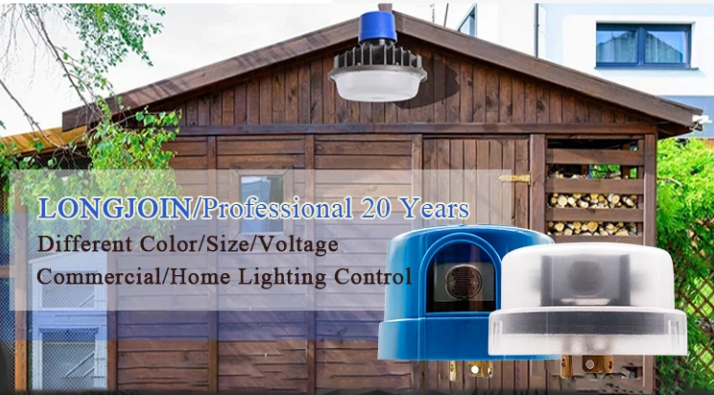
Protecting contrôleurs photo from electrical surges is critical. It ensures long-term stability and safety in outdoor installations.
Niveau de protection contre les surtensions
In lightning-prone areas, opt for controllers with robust surge protection. Industry standards like ANSI C136.2‑2018 recommend:
- Typical (6 kV/3 kA) for standard area lighting
- Enhanced (10 kV/5 kA) for parking lots or tunnels
- Extreme (20 kV/10 kA) for stadiums or airports
For example, Shanghai Longjoin’s JL‑207/JL‑217 series includes surge-damping features ideal for smart street lighting. These products also come with IP66 sealing, suitable for wet, exposed locations.
Electromagnetic Interference Resistance
EMI from LED drivers or nearby devices can trigger false switching. To avoid this, choose controllers designed with proper shielding.
Look for grounded, shielded housings and built-in line filters. These help reduce radio frequency interference (RFI). Ferrite beads or EMI filters are also useful. They block high-frequency noise in harsh environments.
Trusted manufacturers include these protections in their interrupteurs à cellule photoélectrique. This boosts reliability, especially in areas with wireless signals or heavy industrial noise.
What Should You Consider When Selecting a Smart, Remote-Control Capable Light Controller?
Smart control is now essential in modern lighting. It adds remote access, improves efficiency, and extends system life.
Protocole de communication
For remote monitoring, choose controllers with reliable IoT protocols.
- ZigBee is a low-power mesh system. It works well in large networks with close-range needs.
- LoRaWAN offers long-range coverage. It’s ideal for wide outdoor zones. It supports dimming, alarms, and data collection through gateways.
- NB-IoT uses existing cellular networks. It provides strong coverage and low energy use—great for rural or remote areas.
Longjoin’s JL‑245C supports ZigBee, LoRa, and NB‑IoT. It also connects via LTE or Wi‑Fi gateways. This flexibility makes it suitable for both local and cloud-based setups.
Compatibilité
Capteurs à interrupteur photoélectrique must work together for smart lighting to be effective. Check for support of standards like Zhaga Book‑18 or ANSI C136.41/NEMA. Also, ensure CMS compatibility with TALQ certification to avoid vendor lock-in.
Longjoin’s JL-7 series supports multiple dimming types: 0‑10 V, DALI, and D4i. It fits Zhaga sockets and has IP66 protection. These features make it easy to use with third-party platforms. Always verify protocol and socket compatibility before installation.
Why Is Certification and Standards Compliance Critical in Light Controller Selection?

Certifications show a controller’s safety, quality, and plug-and-play compatibility. Meeting global standards ensures reliability and easy integration.
International Certification
Opt for controllers bearing international standards. This indicates compliance with stringent safety, EMC, and performance tests. For example, UL-certified photocells undergo ignition-resistance and cycle testing for >6,000 operations under full load.
CE certification assures conformity with European requirements, particularly electromagnetic compatibility .
Longjoin controllers hold UL, CE, RoHS, and FCC marks, backing global market acceptance. Here is a table further indicating the certifications reference guide for light controllers.
| Certification | Région | Domaine d'intervention | Required For |
| UL | Amérique du Nord | Safety & Electrical Specs | Municipal Bidding Projects |
| CE | Europe | EMC, Safety, RoHS | General EU Compliance |
| FCC | USA | Radio Frequency Emissions | Smart/IoT Controllers |
| ANSI C136.10 | Mondial | Socket & Receptacle Fit | Interoperable Design |
Conformité aux normes
Ensure the controller meets ANSI C136.10, which defines electrical and dimensional specs for twist-lock photocontrols and receptacles, allowing fixture interchangeability. Controllers compliant with ANSI C136.41 support external dimming control, enabling smart integration.
For receptacles, choose units like TE Lumawise that are ANSI C136.10 certified with IP66 sealing and UL listing to ensure robust fit and performance.
Mots de la fin
Choosing the right outdoor lighting controller without clear specs can be challenging. But with a structured approach, it becomes a confident decision. For dependable LongJoin photocells, Chi-Swear offers expert support and genuine products you can trust.
Liens externes
- https://en.wikipedia.org/wiki/IP_code
- https://www.polycase.com/techtalk/learningcenter/ik-ratings
- https://www.calgary.ca/content/dam/www/pda/pd/documents/centre-city/centre-city-policies/centre-city-illumination-guidelines.pdf
- https://en.wikipedia.org/wiki/Electromagnetic_interference
- https://en.wikipedia.org/wiki/Zigbee
- https://en.wikipedia.org/wiki/LoRa
- https://en.wikipedia.org/wiki/Narrowband_IoT
- https://www.zhagastandard.org/books/overview/smart-interface-between-outdoor-luminaires-and-sensing-communication-modules-18.html
- https://en.wikipedia.org/wiki/0-10_V_lighting_control
- https://www.dali-alliance.org/
- https://www.ul.com/solutions
- https://single-market-economy.ec.europa.eu/single-market/goods/ce-marking_en
- https://en.wikipedia.org/wiki/FCC_mark