OUTLINE
- 導入
- What Is a Dusk-to-Dawn Sensor?
- What Should You Check Before Buying a Dusk-to-Dawn Sensor?
- How Do Long-Join Photocontrols Compare to Generic Alternatives?
- What Mistakes Do Buyers Most Often Make?
- Why Are Twist-Lock Photocontrols Becoming the Standard?
- What’s the Future of Dusk-to-Dawn Sensors?
- Choosing the Right Dusk-to-Dawn Sensor
- Frequently Asked Questions
Picking a sensor for an outdoor LED project isn’t as straightforward as people think. Some units are reasonably priced and look fine to do the job on the spec sheet, then all of a sudden, the lights start flickering, or worse, stay on through the day.
Such failures happen more often than they should, and almost always for the same reason: the buyer compared prices without comparing the specs that actually matter.
In 2026, outdoor LED lighting is more popular than ever, mounted in parking lots, highways, residential streets, commercial buildings, and smart city infrastructure. And the demand for reliable dusk-to-dawn sensors has grown with it.
This guide cuts through the catalogue noise and explains what to actually check before specifying a photocontrol for an outdoor LED project.
What Is a Dusk-to-Dawn Sensor?
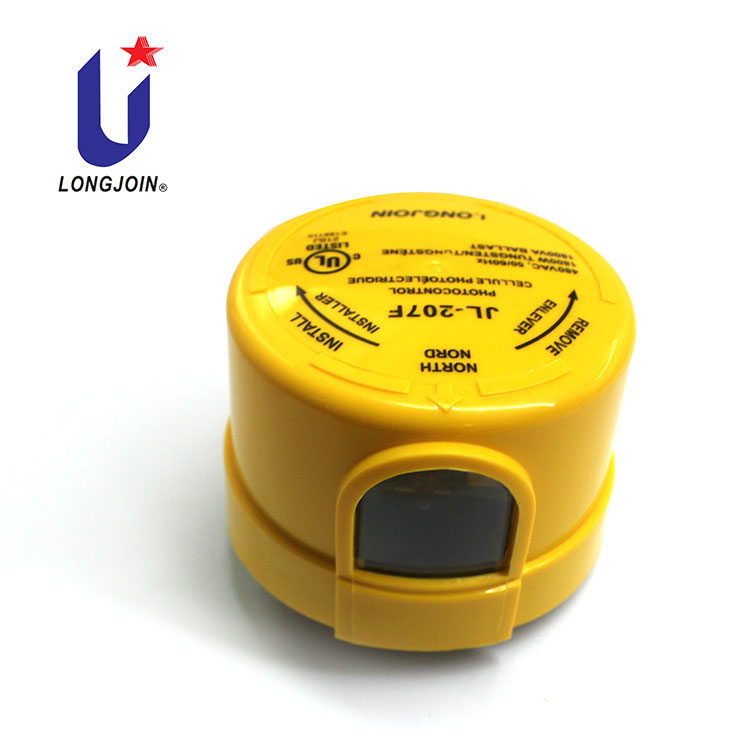
A dusk-to-dawn sensor, also called a photocell or photocontrol, is what controls the outdoor lights switch. As the name implies, it automatically switches on the lights at dusk and off at dawn.
They do this by detecting ambient light levels through a photosensitive component, without the need to manually flip a switch.
Some common applications for dusk-to-dawn sensors include:
- 街路照明
- 駐車場照明
- Security flood lights
- Garden lighting
- Billboard lighting
- Smart city systems.
What Should You Check Before Buying a Dusk-to-Dawn Sensor?
If you are looking to procure dusk-to-dawn sensors for any outdoor light fixtures, firstly, take your mind off the price, and consider these five factors.
Waterproof and dustproof protection
Outdoor fixtures face exposure to rain, dust, humidity, UV exposure, and seasonal temperature swings. A photocell without adequate sealing will allow moisture, which could lead to internal corrosion and false switching.
IP65 is the minimum acceptable rating for any fully exposed outdoor installation. A photocell like the Long-Join’s JL-207C series uses a waterproof sealing structure with UV-resistant housing rated to IP65 and IP67, depending on the variant specified. You can read more about this in my article covering the minimum waterproof rating requirements when testing photocell compatibility.
LED compatibility
Traditional photocells designed for HIDランプ can behave unpredictably on LED loads. This is because LED drivers use lower wattage, produce different inrush current profiles, and can cause leakage current issues that make a poorly matched photocell flicker or cycle on and off repeatedly.
Long-Join’s electronic photocontrols are optimised for LED fixtures such as street lights, wall packs, flood lights, and smart lighting fixtures, without any issues.
電圧互換性
Different projects run on different supply voltages, and specifying the wrong model creates compatibility problems that only surface after installation. The table below maps common applications to the appropriate Long-Join models:
| 応用 | Common Voltage | 推奨モデル |
| Residential lighting | 120V | JL-205C |
| Commercial lighting | 208-277V | JL-207C |
| Solar lighting | 12V/24V DC | JL-207-48D |
| Municipal roadway lighting | 120-277V | JL-411 series |
Service life and reliability
Low-quality sensors fail from contact wear, UV ageing, poor sealing, and corrosion. A professional-grade photocontrol needs long switching cycle life, stable electronic performance, and corrosion-resistant contacts. The JL-207C series is rated at over 10,000 switching cycles on the standard relay, with the HP variant exceeding 50,000 cycles.
Certification compliance
For North American and Latin American projects, certifications are a procurement requirement, not a formality. Common requirements include UL, CE, RoHS, and FCC for specialised applications. Long-Join products carry UL and CE listings and are widely deployed in roadway lighting, parking lots, industrial facilities, and smart city projects.
How Do Long-Join Photocontrols Compare to Generic Alternatives?
Professional-grade photocontrols differ from low-cost alternatives across every specification that determines outdoor reliability.
| 要素 | Generic Sensor | Long-Join Photocontrol |
| Waterproof rating | IP44-IP54 | IP65 |
| 紫外線耐性 | Basic plastic housing | UV-resistant engineered housing |
| LED compatibility | Unstable | Optimised for LED loads |
| 耐用年数 | 10,000-15,000 cycles | 10,000+ to 50,000+ cycles |
| 認証 | 限定 | UL, CE, RoHS |
| インストール | Fixed wire only | Twist-lock and wire-in options |
| Smart upgrade capability | なし | Supports smart lighting ecosystem |
What Mistakes Do Buyers Most Often Make?
Based on experience, there are four procurement mistakes that show up repeatedly across outdoor lighting projects, and each one is avoidable with basic due diligence.
1. Assuming All Dusk-to-Dawn Sensors Are the Same
They are not. Sensing technology, sealing structure, relay quality, and housing material vary significantly between products, and these differences determine service life in real outdoor conditions. Here is a photocell and fixture compatibility guide to help you begin.
2. Being Satisfied With IP44 for outdoor street lighting
Do not be. In humid regions, lower IP等級, such as the IP44, lead to moisture ingress, corrosion, and false switching within one to two wet seasons. IP65 is generally recommended for professional outdoor applications.
3. Thinking LED lights work with any photocell
They don’t. Older photocells can cause flickering, repeated on/off cycling, and relay sticking when paired with LED drivers they were not designed to handle.
4. Treating Unit Price As the Measure of Value.
Lower prices don’t mean better value in the long run. A cheaper sensor that fails after 18 months and requires a maintenance visit at height costs far more than a professional-grade unit that runs for a decade without intervention.
Why Are Twist-Lock Photocontrols Becoming the Standard?
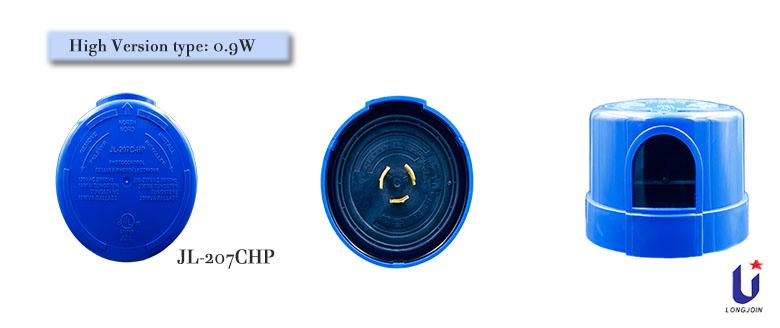
NEMA twist-lock photocontrols are increasingly the default specification for municipal and commercial projects because they allow faster installation, easier maintenance, standardised replacement, and straightforward upgrading to smart lighting systems.
There is a wide array of twist-lock photocontrols selection on Chi-Swear; these include Long-Join models such as the JL-205C, JL-207C, and JL-215C.
Some common use-cases include:
- US roadway lighting
- スマートシティプロジェクト
- Commercial outdoor lighting.
For projects requiring smart lighting integration, the JL-240XA 7-pin NEMA receptacle base enables 0-10V and DALI dimming control alongside standard photocontrol switching.
What’s the Future of Dusk-to-Dawn Sensors?
The outdoor lighting industry is moving toward smart photocontrols with features such as:
- IoT integration
- リモート監視
- Adaptive lighting capability.
Future photocontrols will increasingly support wireless communication, energy management platforms, and data collection. Long-Join’s JL-245CN NB-IoT smart photocell is already deployed in municipal networks across multiple markets, providing real-time fault reporting and remote parameter adjustment without site visits.
The full Chi-Swear photocontrol range covers standard, high-specification, and smart-ready models across all common voltage and application requirements.
Choosing the Right Dusk-to-Dawn Sensor
Getting the right dusk-to-dawn sensor may be the difference between your light fixture working quietly in the background for years and you having to deal with failures like flickering lights, frequent maintenance visits, and high replacement costs.
In 2026, the checklist is straightforward: IP65 protection, LED compatibility, correct voltage range, certified relay life, and the right installation format for the fixture. These are factors all considered in Long-Join’s photocell range.
Frequently Asked Questions
Q1: What is the best IP rating for outdoor dusk-to-dawn sensors?
IP65 is where most professional outdoor projects start. It covers complete dust protection and water jets from any direction, which handles wind-driven rain, road spray, and coastal humidity.
For anything near the coast, in a wash-down environment, or prone to heavy condensation, move up to IP67, which adds protection against temporary immersion.
Q2: Why do some photocells flicker when used with LED lights?
Most of the time, it comes down to a mismatch between the photocell relay and the LED driver’s load profile. LED drivers have different inrush characteristics than the HID ballasts that older photocells were built around.
Q3: What is the difference between twist-lock and hard-wired photocontrols?
Twist-lock units plug into a NEMA receptacle on the fixture and lock with a quarter-turn rotation. No rewiring, no tools, done in seconds. Hard-wired models go through a knockout hole and need the wires disconnected before replacing them.
Q4: How long should a professional outdoor photocontrol last?
Two switches per day is the normal rate, on at dusk and off at dawn. A relay rated at 10,000 cycles covers roughly 13 years at that rate. The JL-207C HP variant goes past 50,000 cycles, which is well beyond any realistic service period.
Q5: Which dusk to dawn sensor is best for smart city lighting projects?
The JL-245CN is the straightforward answer for NB-IoT-connected projects. It links directly to a cloud platform through the nearest mobile tower, no local gateway needed, and gives you real-time fault detection, remote parameter adjustment, and scheduled dimming from day one.