
Contorno
- Introdução
- How Are Outdoor Dual-Head Security Lights Classified Based on Sensor Configuration?
- What Is the Long-Join JL-412 Light Sensor, and What Are Its Core Features?
- When Is the JL-412 Fotocontrolador Suitable for Dual-Head Security Lights?
- Why is JL-412 Usually Not Required for Lights with Motion + Sensores fotocélula?
- What Are the Best Selection Recommendations for Different Security Lighting Needs?
- What Are Typical Application Scenarios for These Lighting Configurations?
- Palavras finais
Outdoor dual-head security lights are widely used in residential yards and commercial spaces. Their wide lighting coverage makes them a practical solution for safety and nighttime visibility.
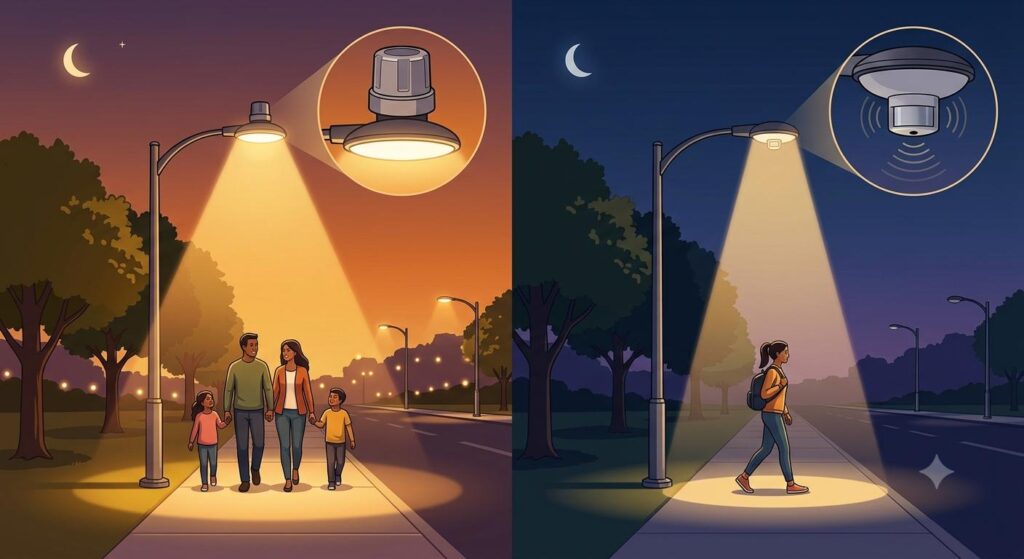
Most of these lights operate with two common control configurations. Some rely on a single fotossensor for switching automation, while others combine it with a motion sensor to activate lighting based on movement.
Whatever the case, choosing the right control affects energy efficiency and maintenance requirements.
In this context, the Long-Join JL-412 fotocontrolador has become a reliable option for certain dual-head security light designs. Understanding when this photocontrol is necessary—and when it is not—helps optimize both lighting performance and system cost.
How Are Outdoor Dual-Head Security Lights Classified Based on Sensor Configuration?
They are mainly classified by the type of sensing control integrated into the fixture. The sensor system determines when the light turns on and how long it stays active.
In practice, two configurations dominate the market as discussed below:
Lights That Use Only Interruptor fotocélula com sensor de luz
These lights operate using a simple controle de iluminação. The lighting is controlled based on the availability of natural light levels.
The operating logic is simple. The photocell completes the electrical circuit in the evenings to turn the light on. At dawn, rising light levels break the circuit to turn the lights off.
Key characteristics include:
- Automatic switching
- Simple electronic structure
- Low maintenance and long service life
- Reliable switching even with seasonal daylight changes
In this configuration, the light stays on throughout the night. This suits areas requiring continuous illumination, such as:
- Residential yards
- Building entrances
- Property perimeters
- Small parking areas
Lights That Are Equipped with Both Motion Sensors and Photocells
These lights combine two detection mechanisms to improve efficiency and responsiveness.
First, the photocell determines day and night conditions. Second, the motion sensor detects movement within a defined coverage zone. Most fixtures use PIR sensors. They identify changes in infrared energy caused by people and vehicles entering the detection area.
This design provides several practical benefits:
- Lights activate only when movement occurs
- Energy consumption drops significantly during idle periods
- Sudden illumination helps deter intruders and improve visibility
Typical installation environments include:
- Garages and driveways
- Pathways and alleyways
- Warehouse entrances
- Security-sensitive building areas
Compared with photocell-only lights, these fixtures deliver dynamic lighting and a stronger security response.
Sensor Technology Comparison
| Recurso | Photocell-Only Security Lights | Motion + Photocell Security Lights |
| Control Principle | Detecção de luz ambiente | Motion detection + light sensing |
| Activation Condition | Automatically at dusk | Only when motion is detected at night |
| Consumo de energia | Higher (continuous lighting) | Lower (lighting on demand) |
| System Complexity | Simple | More complex sensor module |
| Typical Installation | Yards, building perimeters | Garages, driveways, pathways |
What Is the Long-Join JL-412 Light Sensor, and What Are Its Core Features?
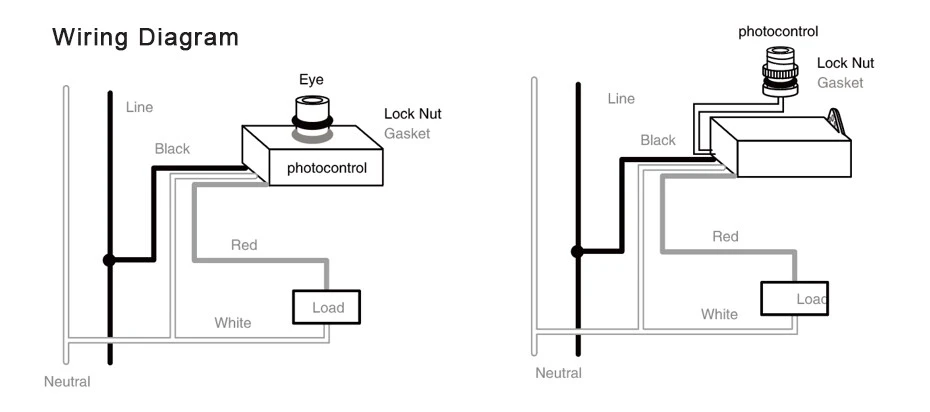
Esse light photcell switch belongs to a compact series of wire-in photocell controllers. It detects ambient light to automate switching at dusk and dawn.
This simple logic makes it suitable for all types of security lights.
The controller is commonly used in 120V lighting circuits. Its small form factor allows easy integration directly into light fixtures without requiring a separate external photocontrol unit.
Core Technical Characteristics
Key design features include:
● Rated voltage
Typically compatible with 120–277 VAC lighting systems
● Automatic switching level
Around 10–30 lux ON and 30–80 luxo OFF
● Low power consumption
Minimal standby load for continuous operation
● Outdoor protection
Housing rated around IP65 for moisture and dust resistance
These features allow the controller to operate reliably in exterior lighting environments.
Aplicações típicas
JL-412 is widely integrated into small outdoor fixtures, including:
- Dual-head security floodlights
- Porch and entrance lights
- Garden and pathway luminaires
- Decorative landscape lighting
Because of its compact electronics and stable switching logic, the JL-412 provides a cost-effective dusk-to-dawn control solution for many residential outdoor lighting products.
When Is the JL-412 Fotocontrolador Suitable for Dual-Head Security Lights?
Esse interruptor do fotossensor is best suited for security lights that depend only on ambient light sensing. In this setup, the photocell monitors surrounding brightness and automates switching at dusk and dawn. No additional sensors or control modules are required.
This simple architecture works well for fixtures designed for continuous nighttime illumination. Typical examples include yard floodlights and porch lights.
Several design factors make the JL-412 suitable for these lights:
- Stable dusk-to-dawn switching based on preset lux thresholds
- A short time delay of around 3 to 10 seconds. This helps avoid false switching between the lightning and the headlights
- Wide input voltage compatibility (120–277 VAC) for common lighting circuits
- Compact button-type design that fits directly inside small fixtures
Because the controller handles the entire switching function, the lighting system remains simple and reliable. Here is its typical Installation structure.
| Componente | Function in the Lighting System |
| JL-412 Photocell | Detects ambient light level |
| Circuito de controle | Switches the lamp ON/OFF automatically |
| Dual-Head Fixture | Provides wide illumination coverage |
| Power Supply (120V) | Standard residential lighting voltage |
Why is JL-412 Usually Not Required for Lights with Motion + Sensores fotocélula?
Dual-head security lights with motion detection usually come with an integrated control module of a photocell and the motion sensor inside the fixture.
The former component of this configuration checks ambient light conditions while the latter handles the lighting trigger.
Most fixtures use PIR sensors. This detects changes in heat patterns caused by people and vehicles moving through the detection area. The light turns on and off based on motion detection.
Using an external photocontroller like JL-412 would duplicate the same function already built into the fixture. Key reasons manufacturers avoid external photocells include:
- Integrated control logic already manages dusk detection
- Motion sensor activation is handled internally
- An additional photocell could cause switching conflicts
- Extra components increase wiring complexity and cost
Control Architecture Comparison
| Lighting Configuration | Control System | Need for JL-412 |
| Photocell-only security light | External photocell performs dusk-to-dawn switching | Sim |
| Motion + photocell security light | The integrated sensor module manages both functions | Não |
What Are the Best Selection Recommendations for Different Security Lighting Needs?
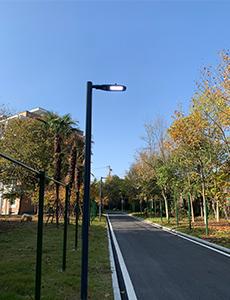
Choosing the right control method depends on how the security light is expected to operate at night. Some locations require continuous illumination. Others only need light when activity occurs. The sensor configuration should match the lighting purpose and installation environment.
Recommendation for Photocell-Only Dual-Head Lights
For automatic dusk-to-dawn switching, the JL-412 sensor fotoelétrico is a practical solution. It monitors ambient light and switches the fixture accordingly.
This configuration works well in locations that require stable nighttime lighting, such as:
- Residential yards and entrances
- perímetros de construção
- Small parking areas
- Iluminação de caminho
Recommendation for Motion-Activated Security Lights
When a fixture includes motion detection, the built-in sensor system should remain the primary controller. Most designs already combine photocell and PIR motion sensing inside one module.
As principais vantagens incluem:
- Lighting activates only when movement occurs
- Lower electricity consumption during idle periods
- Simplified wiring and installation
Key Factors to Consider When Selecting a Control Method
| Fator de seleção | Photocell-Only Lighting | Motion + Photocell Lighting |
| Installation environment | Open yards, entrances, perimeter walls | Garages, driveways, pathways |
| Energy-saving priority | Moderado | Alto |
| Lighting operation pattern | Continuous night illumination | Activity-triggered lighting |
| Control complexity | Simple | Integrated smart sensing |
What Are Typical Application Scenarios for These Lighting Configurations?
Residential Yard Lighting
A consistent nighttime visibility is critical in residential applications. So photocell-only control is a practical solution. The fixture automatically switches lights at dusk and dawn. This ensures stable overnight illumination.
A controller like JL-412 receptáculo de fotocontrole ensures reliable switching operations and reduces manual switching for homeowners.
Commercial Parking Lots and Driveways
Lighting based on demand is a good fit for such applications. Parking lots and driveways benefit from motion sensor + photocell lighting systems. The photocell enables operation only after dark. The motion sensor activates the light when vehicles or people enter the detection area.
This setup improves security responsiveness while reducing unnecessary energy use during idle periods.
Building Perimeter and Entrance Lighting
Perimeter and entrance areas require a balance between visibility and energy efficiency. Photocell-controlled lights provide steady overnight illumination along walls and boundaries.
Motion-activated fixtures work well near doors and access points. This combination improves security coverage while optimizing power consumption.
Palavras finais
Choosing the right control system depends on the lighting objective. Simple photocell lights provide stable automated illumination, while motion-sensor lights offer demand-based security lighting. For fixtures that rely on photocell control, the JL-412 provides simple and reliable automation. Chi-Swear remains a trusted supplier of Long-Join photocontrollers, offering stable components for outdoor lighting manufacturers and project installers.

 Portuguese
  English
  Spanish
  Russian
  Arabic
  Italian
  Japanese