
OUTLINE
- Introdução
- Signs of Aging or Poor Contact in NEMA Receptacles
- Long-Join NEMA Receptacle Aging Identification Matrix
- Avoid Receptacle Issues
- Frequently Asked Questions on Aging NEMA Receptacles
A NEMA receptacle sits on top of a street light pole and does nothing visibly dramatic for years. No moving parts, no indicator lights, no audible signals.
However, when it starts to fail, the symptoms show up in the fixture in the form of flickering lights, intermittent outages, lights stuck on, and the receptacle itself is often the last thing a maintenance team checks.
Knowing what aging looks like on the receptacle, and what to look for without any tools, saves a diagnostic step and often prevents a more expensive failure down the line.

Signs of Aging or Poor Contact in NEMA Receptacles
These eight signs can help identify aging or poor contact in Tomadas NEMA by visual inspection and manual handling alone.
1. Pin Oxidation
Dark discolouration, blackening, or green spots on the receptacle pins indicate oxidation caused by air, moisture, and salt spray. How severe the level of oxidation is directly determines whether cleaning is sufficient or replacement is needed.
- Mild surface oxidation presents as a dull grey or slightly darkened finish on the brass pins.
- Moderate oxidation shows as distinct black patches or a green verdigris layer where copper salts have formed.
- Severe oxidation feels rough to the touch and may show pitting.
Light oxidation can be cleaned with an appropriate contact cleaner. Anything showing green corrosion or pitting has compromised the contact surface sufficiently that replacement is the safer call.
2. Receptacle Plastic Aging
Prolonged outdoor UV exposure causes the receptacle’s plastic housing to yellow, become brittle, and eventually crack. Once cracking appears, the structural integrity and sealing performance are both compromised.
A yellowed housing that still feels solid under light pressure is in early-stage UV degradation. One that feels brittle or shows surface micro-cracks has lost a significant portion of its impact resistance. A cracked housing is an ingress path for moisture and needs replacing, regardless of whether the pins and contacts still appear functional.
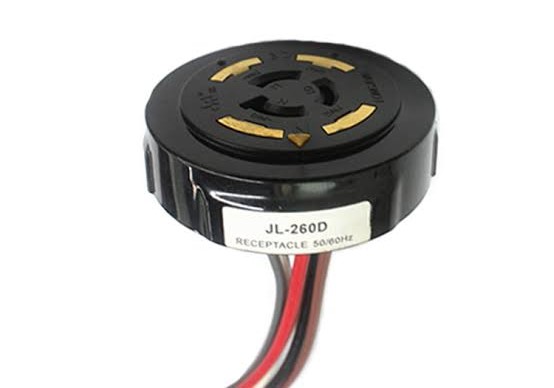
UV-resistant materials, as used in Long-Join’s receptacle range, significantly extend the point at which this degradation becomes a problem.
3. Loose Contact Clips
Fatigue or deformation of the spring clips inside the receptacle reduces the clamping force on the photocell’s twist-lock pins, which is felt as looseness or play when inserting and removing a photocell by hand.
A correctly functioning twist-lock receptacle should require noticeable rotational force to lock and unlock a photocell. If a photocell can be inserted, rotated, and removed with very little resistance, the spring clips have lost their tension.
A reduced clamping force increases contact resistance at the pin interface, which generates heat and accelerates further degradation. Re-forming the clips is sometimes possible, but replacement of the receptacle is the more reliable fix.
4. Water Accumulation or Moisture at the Base
Water pooling inside the receptacle after rain indicates that the waterproof seal has failed, and the moisture that has entered will accelerate pin corrosion and copper oxidation at every joint.
Check the base of the receptacle for visible water or dried mineral deposits that indicate past water accumulation. Even a small amount of pooled water in contact with the pins creates an electrolytic environment that accelerates corrosion significantly.
Moisture that evaporates but leaves mineral residue behind also increases contact resistance over time. To fix ths:
- Inspect the sealing ring
- Replace it if it shows hardening or cracking
- Confirm the housing joint seal is intact.
5. Bent or Misaligned Pins
Bent pins, usually caused by applying excessive or off-angle force when installing or removing a photocell, prevent complete insertion and create a point contact rather than a full surface contact at the pin interface.

A bent pin is usually visible by eye. The photocell will feel like it’s not seating fully into the receptacle, and the trava giratória rotation may feel rough or incomplete. Partial insertion means only a fraction of the designed contact area is actually making electrical contact, which increases resistance and heat at that point.
Minor bends can sometimes be carefully corrected, but replacing the receptacle removes the risk of a contact failure from a compromised pin.
6. Loose Connection Between Receptacle and Fixture
A receptacle that wobbles on the fixture top due to loose mounting screws creates intermittent electrical contact as the photocell moves in response to wind, thermal expansion, and vibration.
Grasp the receptacle and apply light pressure in different directions. Any movement indicates loose mounting hardware. The symptom in the fixture is typically flickering that follows wind events or temperature changes.
Tightening the mounting screws is a straightforward fix, but the threads should be checked for stripping before assuming the repair will hold.
7. Signs of Aging on Sealing Rings
A hardened, cracked, or flattened sealing ring no longer fills the gap between the photocell base and the receptacle seat, which creates a path for rain to reach the internal contacts.
The sealing ring can be inspected by removing the photocell and examining the ring either on the photocell base or in the receptacle seat. A healthy ring feels slightly compressible and maintains a round cross-section. A degraded ring feels hard and may show flat spots where compression set has occurred, or visible cracks from UV exposure.
Replace the ring at the first sign of hardening or cracking. Sealing ring replacement is far cheaper than addressing the contact corrosion that follows water ingress.
8. Signs of Internal Burning
Black scorch marks inside the receptacle housing or a persistent burnt smell indicate overheating from poor contact resistance or surge backflow through the connected LED driver, both of which symptoms are not normal.
Burnt marks indicate that the contact resistance at that point has been high enough to generate damaging heat. This can result from advanced pin oxidation, a failing spring clip with reduced clamping force, or a surge event that sent excessive current back through the receptacle.
Stop using the receptacle immediately if burn marks or a burning smell are present. Inspect the connected LED driver for surge damage at the same time, as a single surge event that damages the receptacle often damages the driver too.
Long-Join NEMA Receptacle Aging Identification Matrix
Here is a summary of how a photocell manufacturer like Long-Join identifies aging or poor contact in NEMA receptacles.
| Aging Symptom | Typical Appearance | Causa | Recommended Action |
| Pin Oxidation | Pins blackened or green spots | Air, moisture, salt spray | Clean light oxidation regularly; replace if severe |
| Plastic Aging | Yellowish, brittle, cracked | Prolonged outdoor sun exposure | Replace enclosure; reinforce UV protection |
| Clip Looseness | Photocell plug loose contact | Fatigue or deformation | Re-form clips or replace receptacle |
| Moisture or Water at Base | Water pooling inside receptacle | Sealing failure | Inspect seals; replace O-ring; improve drainage |
| Bent or Misaligned Pins | Photocell fails to fully insert | Excessive insertion force | Use proper force; correct or replace pins |
| Loose Fixture-Receptacle Joint | Flickering, unstable lighting | Loose screws | Tighten all screws; secure mechanical fixings |
| Sealing Ring Aging | Hardened, cracked, water leaks | Natural aging or weather impact | Replace seals, improve protective measures |
| Internal Burn Marks | Black scorch spots, burning smell | Poor contact or surge damage | Inspect contacts; add surge protection; replace as needed |
With this information, Long-Join produces some of the top twist-lock receptacle models in the business, that adapt well to adverse environmental exposure. You can browse these models on Chi-Swear’s receptacle catalog for details on specifications and order.
Avoid Receptacle Issues
NEMA receptacle aging follows predictable patterns, and all eight signs can each indicate a specific failure path with a specific recommended action without any tools. Regular visual inspection of pole-mounted receptacles, particularly after seasonal weather changes, catches these issues before they produce fixture failures, maintenance emergencies, or safety hazards.
Frequently Asked Questions on Aging NEMA Receptacles
Q1: If black or green spots appear on the pins, is replacement necessary?
Mild oxidation can be cleaned with contact cleaner and is not an immediate replacement trigger. Green corrosion or visible pitting indicates the contact surface is compromised and replacement is the safer choice to avoid progressive contact failure.
Q2: Does yellowing of the plastic affect performance?
Yes. Yellowing indicates UV degradation that reduces structural strength and sealing integrity. A brittle or cracked housing allows moisture ingress, which accelerates internal corrosion. Replacement is recommended when cracking appears.
Q3: How should loose photocell insertion be handled?
Tighten the mounting screws immediately and check the spring clips for fatigue or deformation. If the looseness is in the clips rather than the mounting hardware, receptacle replacement is the correct fix.
Q4: How can you tell if the sealing ring is aging?
Remove the photocell and inspect the ring for hardening, flat spots from compression set, or visible cracks. Water accumulation inside the receptacle after rain is another reliable indicator of sealing ring failure.
Q5: Are burnt odors and burn marks normal?
No. Stop using the receptacle immediately. Burn marks indicate damaging heat from high contact resistance or surge damage. Inspect and replace the receptacle and check the connected LED driver for related surge damage before restoring power.



 English
 Spanish
 Russian
 Arabic
 Italian
 Japanese
 Portuguese