
Outline
- Introduction
- What Are the Key Lighting Technology Features of Low-Voltage and High-Voltage Photocell Switches?
- How Do Low and High-Voltage Photocontrol Receptacles Compare in Energy Efficiency and Safety?
- How Should Users Select the Right Photo Switch Sensor Based on Application Scenarios?
- How Should Long-Join Photocontrol Systems Be Selected for Different Climate Conditions?
- How Do Long-Join Photocontrol Systems Ensure Corrosion Protection in Humid Environments?
- Final Words
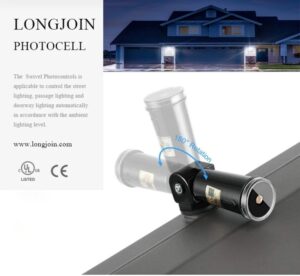
Choosing the right photocell system is not always simple. Outdoor lighting environments vary in scale and safety demands. Long-Join offers both low-voltage and high-voltage photocell sensors to address these differences.
Each system serves a specific purpose. They cater from small residential lighting to large municipal projects.
This article compares the two options to help you make a practical and informed decision. The focus is on performance and energy efficiency.

What Are the Key Lighting Technology Features of Low-Voltage and High-Voltage Photocell Switches?
Outdoor photocell lighting sensors vary widely in how they sense light and manage power. Long-Join’s portfolio includes both low-voltage and high-voltage solutions. Each has distinct advantages tailored to specific lighting needs.
This section explains their core features and why one may suit your project better than the other.
Low-Voltage Light Sensors Support Safe and Flexible Lighting
These outdoor photocell light sensors operate at reduced DC voltages, typically:
- 12 V
- 24 V
- 48 V
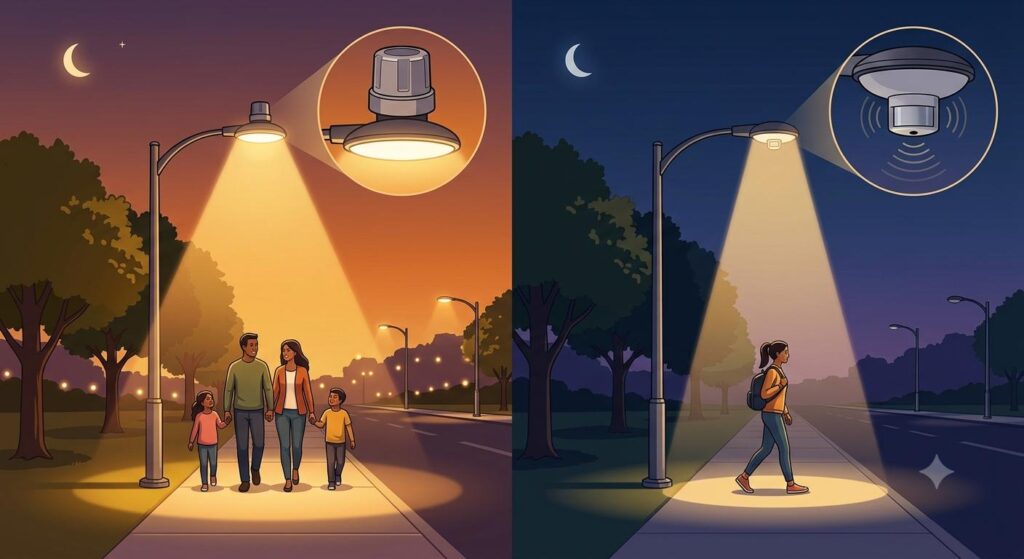
They use light sensor photocell switches that automate switching based on ambient light. These systems are inherently safer because lower voltage minimizes shock risk.
They are ideal where people may interact closely with the wiring. Installation is simpler with flexible wiring runs.
These photo sensors also integrate well with LED drivers and solar power systems. This reduces the need for heavy infrastructure. Maintenance and replacements are easier as components are often modular for quick swaps.
High-Voltage Light Sensor Switches Better Suited for Industrial and Scaled Outdoor Lighting
These lighting controls handle elevated voltages, i.e 120 V to 277 V and above. These units deliver reliable control over larger loads. This makes them suitable for streetlights and industrial spaces.
These photoelectric sensors can drive stronger luminaires directly. This:
- Reduces the need for external relays.
- Support more robust surge protection and temperature tolerance for continuous use.
While installation demands stricter safety standards and trained electricians, the outcome is stable outdoor lighting performance. The table below visualizes why high-voltage photocontrol systems are better suited for commercial use.
| Load Factor | Low-Voltage System | High-Voltage System |
| Typical Wattage Range | < 100 W | 100 W – 1000+ W |
| Load Type | LEDs, signal lamps | HID, LED streetlights |
| Switching Frequency | Moderate | High, continuous |
| Line Length Tolerance | Short | Long-distance |
| Circuit Complexity | Simple | Multi-branch |
How Do Low and High-Voltage Photocontrol Receptacles Compare in Energy Efficiency and Safety?

Both light photocells automate lighting based on ambient light. But they do this in very different electrical environments.
The energy efficiency and safety of each depend heavily on:
- How are they designed?
- Where are they installed?
This section breaks down these differences clearly and factually.
| Maintenance Factor | Low-Voltage | High-Voltage |
| Fault Isolation | Easy | Complex |
| Replacement Speed | Fast | Slower |
| Downtime Risk | Low | Medium–High |
| Safety During Servicing | High | Requires PPE |
| Long-Term Service Cost | Lower | Higher |
Low-Voltage Systems Offer Higher Safety and Easier Installation
These light photocell sensors run at reduced power potentials. This curtails shock risks and heat generation at minimum. This makes them safer for areas with frequent human contact.
Installation does not usually require a licensed electrician. This lowers labor cost and planning complexity.
These systems are also simpler to maintain and retrofit. This is because their wiring is lighter and less regulated. Their energy savings come from switching only when needed. This avoids waste from fixed schedules.
Key Safety Advantages
- Reduced shock risk
- Lower thermal stress
- Simple wiring
- DIY-friendly setup
High-Voltage Systems Achieve Superior Energy Efficiency
These light sensors deliver power directly to heavy loads like streetlights. These systems enable:
● Efficient load management
Lights switch on only when necessary. This cuts wasted energy from constant operation.
● High-capacity control
They handle larger circuits without additional relays. This improves overall efficiency in big installations.
● Integrated protections
Integrated surge and overvoltage safeguards help protect fixtures from electrical spikes.
Because they operate at mains, strict compliance with electrical safety codes is critical. Proper grounding and protection are essential to reduce hazard risks.
How Should Users Select the Right Photo Switch Sensor Based on Application Scenarios?
Selecting the right photocontrol is not guesswork. You must match the device to the lighting needs and environment. Long-Join offers both low-voltage and high-voltage options. Each serves different application scenarios.
This section explains practical principles and where each type fits best.
Selection Principles Should Be Considered When Choosing Between Low-Voltage and High-Voltage Photocontrols
Here are some important considerations in this regard:
- Check for voltage rating compatibility
- Ensure IP protection and weather resistance
- Sensitivity and operational delay features can multiply the outcomes.
- Surge protection and reliability are critical
Scenarios Where Low-Voltage Long-Join Photocontrol Systems are the Most Suitable Choice
Low-voltage light sensor control work best where safety and wiring flexibility matter most. They pair naturally with 12 V–48 V lighting systems. These setups include residential yards, paths, gardens, and small parks.
Their lower potential reduces shock risk and simplifies installation. They also integrate smoothly with solar and LED drivers where mains power is limited.
Typical Low-Voltage Use Cases:
- Landscape and garden lights
- Solar outdoor fixtures
- Small recreational and public areas
High-Voltage Long-Join Photocontrol Systems Could Be The Optimal Solution for Outdoor Lighting Projects
These photocell switches shine where high power and more extensive coverage are needed. They are ideal for street lighting and industrial yards.
These systems handle elevated voltages directly. Thus, support heavier load fixtures without extra converters. Although installation requires professional wiring and strict adherence to safety codes, the results are satisfactory.
Typical Use Cases:
- Municipal street lighting
- Commercial plazas and lot areas
- Industrial outdoor lighting
How Should Long-Join Photocontrol Systems Be Selected for Different Climate Conditions?

Choosing the right lighting control system isn’t just about voltage. The environment also has a big part. Temperature swings and electrical surges can shorten the life of controllers.
Long-Join designs products with features that match tough outdoor conditions. This section explains what matters and how to pick the right solution.
Temperature Adaptability and Surge Protection Are Critical
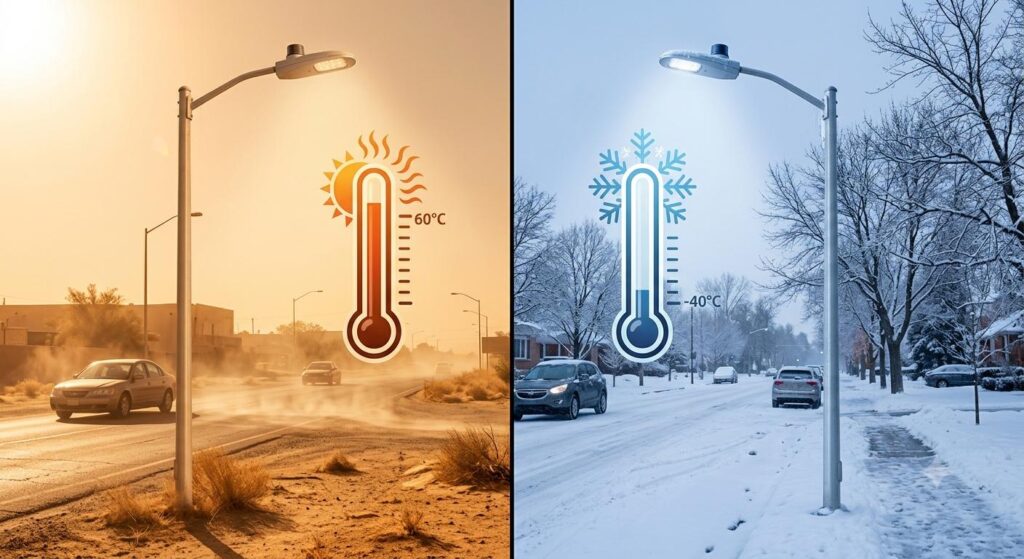
Outdoor light sensor switches face multiple challenges, including extreme temperatures and electrical spikes. Long-Join products often operate reliably from well below freezing up to scorching temperatures.
Here are some prominent features of Long-Join products.
- Many models work between –40 °C and +70 °C. Temperature tolerance prevents premature failures in places with seasonal extremes.
- Protection ratings like IP65 and higher guard against environmental degraders.
- Integrated surge protection shields electronics from power spikes. This reduces failures during storms or unstable grids.
- Use of UV-stabilized materials further helps resist heat and sun damage over time.
The below outlines various climate risks vs recommended photocontrol features.
| Climate Risk | Typical Region | Required Feature |
| High Humidity | Coastal zones | IP66 sealing |
| Extreme Heat | Desert regions | +70 °C rated components |
| Extreme Cold | High altitudes | –40 °C operation |
| Frequent Storms | Tropical zones | Surge & lightning protection |
| Dust Exposure | Industrial zones | Dust-tight housing |
Customization Options That Long-Join Offers to Address Special Climate and Environmental Challenges
Long-Join offers tailored solutions for extreme environments. Options include:
- Higher IP ratings — to prevent water and dust entry.
- Enhanced surge protection — for regions prone to frequent electrical spikes.
- UV-resistant enclosures — to withstand strong sun exposure.
- Temperature-compensated components — for consistent switching across wide ranges.
These customizations help Long-Join photocontrols stay reliable and durable in challenging climates.
How Do Long-Join Photocontrol Systems Ensure Corrosion Protection in Humid Environments?
Long-Join automatic light sensor must survive constant moisture and humidity in outdoor settings. Here is how Long-Join addresses these challenges.
Use of corrosion-resistant housings
Long-Join uses rugged housings made from plastics stabilized against UV and coated metals. These materials resist rust and material breakdown in humid and salty air.
IP65–IP66 rated enclosures block water jets and dust. This prevents corrosion at contact points and inside circuits.
Use Of Moisture-Proof Treatments
Internal boards often receive special coatings that repel water. These conformal coatings stop condensation from forming on sensitive circuitry.
Sealing of connections and gaps prevents short circuits and oxidation under humid conditions.
Compliance With International Waterproof Standards
Long-Join products are tested to meet IEC IP ratings such as IP65 and IP66. These standards prove resistance against dust and water ingress under defined conditions.
Certified ratings further give confidence that the unit will keep moisture out and operate reliably even in humid climates.
Final Words
Low-voltage and high-voltage Long-Join photocontrol systems each solve different lighting challenges. The right choice depends on application scale and environmental conditions. Chi-Swear supplies certified Long-Join photocontrollers with consistent quality and technical support. Their experience helps customers match the right solution to real project needs.

 English
  Spanish
  Russian
  Arabic
  Italian
  Japanese
  Portuguese