Índice
- Introducción
- What Is the JL-207C5-F23-HP-P-IP65?
- What Does ANSI C136.10-2010 Require for Surge Protection?
- How Does the JL-207C5-F23-HP-P-IP65 Meet ANSI Surge Requirements?
- Why Does UL773 Certification Support Surge Protection Claims?
- Palabras finales
Street light photocells spend their entire service lives connected to an outdoor power network. That network is exposed to lightning, grid switching transients, and the kind of voltage events that can arrive without warning and destroy unprotected electronics in microseconds.
Surge protection in a photocell is the difference between a unit that survives its rated service life and one that fails on the first significant storm.
This article covers what ANSI C136.10-2010 requires in terms of surge protection and how the JL-207C5-F23-HP-P-IP65 meets and exceeds those requirements.

What Is the JL-207C5-F23-HP-P-IP65?
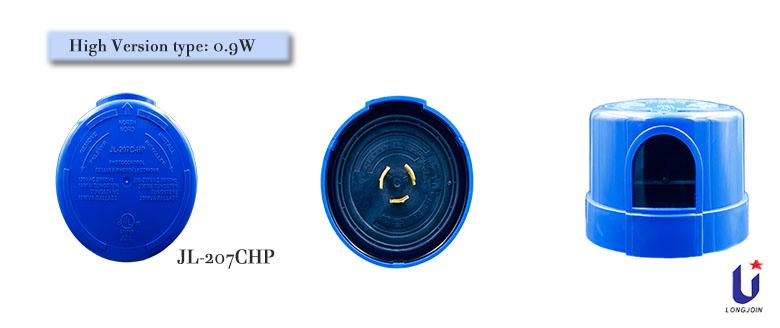
The JL-207C5-F23-HP-P-IP65 is a high-specification twist-lock photocontrol from Long-Join’s JL-207C series, built specifically for demanding street lighting and industrial outdoor applications.
Key product parameters:
- Rated load: 1,000W tungsten lamp
- Rated voltage: 120–277VAC
- Surge protection: MOV rated at 460 joules / 10,000 amps (F23 specification)
- IP rating: IP65 — dust-tight, protected against water jets from all angles
- Relay technology: Zero-crossing switching — reduces contact arcing and switching transients
- Fail mode: Fail-On
The unit has been tested under both UL773 y ANSI C136.10-2010, with a traceable third-party test report (S2017110122358023) from a CNAS-accredited laboratory operating to ISO/IEC 17025.
What Does ANSI C136.10-2010 Require for Surge Protection?
ANSI C136.10-2010 includes specific surge-immunity requirements that photocells must meet to pass certification, defining the minimum transient-voltage and current levels the device must withstand without damage or functional degradation.
Standard surge test parameters
- Test waveform: The standard references a combination wave generator producing a 1.2/50μs open-circuit voltage waveform and an 8/20μs short-circuit current waveform — the industry-standard representation of a lightning-induced transient on a power line
- Minimum withstand level: Photocells must demonstrate immunity to transient events of defined amplitude without sustaining damage or functional change
- Multi-level suppression: Effective surge protection requires coordination between the primary clamping component (MOV) and secondary protective elements — a single MOV without supporting circuit components is not considered adequate for high-reliability applications
- Repetitive surge capability: The photocell must survive not just a single surge event but repeated events, reflecting the reality that outdoor networks experience multiple transient events across a typical service period
What the tests verify
- The photocell must continue to switch correctly after surge testing — no relay welding, no control circuit damage, no sensor degradation
- The MOV must not fail short-circuit during testing — a shorted MOV connects the live supply directly to ground, tripping the circuit breaker and taking out the connected lighting circuit
- Housing integrity must be maintained — internal component failure from a surge event can produce heat and pressure that damage the enclosure
How Does the JL-207C5-F23-HP-P-IP65 Meet ANSI Surge Requirements?
The -F23- designation in the model code specifies a built-in MOV surge arrester rated at 460 joules energy absorption and 10,000 amps peak surge current — a specification that meets and in most parameters exceeds the minimum ANSI C136.10-2010 surge protection thresholds.
| Código MOV | Energy Rating | Peak Current |
| -12 | 110 joules | 3,500 amps |
| -15 | 235 joules | 5,000 amps |
| -23 | 460 joules | 10,000 amps |
| -25 | 546 joules | 13,000 amps |
The F23 MOV sits at the third tier of Long-Join’s MOV range. At 460 joules and 10,000 amps, it provides substantial headroom above the minimum ANSI requirements — which matters because real-world surge events don’t respect minimum specifications. A photocell operating at exactly the minimum rated surge capacity has no margin against events that slightly exceed the test parameters.
How the MOV works:
- Under normal operating conditions, the MOV presents high resistance and has no effect on circuit operation
- When a transient voltage spike exceeds the clamping voltage, it switches to low resistance and diverts the surge energy to ground, limiting the voltage seen by internal components
- The energy absorbed during clamping is dissipated as heat — the joule rating determines how much the MOV can absorb before sustaining damage itself
- After the transient passes, the MOV returns to high resistance, and normal operation resumes
The zero-crossing switching technology in this model works alongside the MOV by addressing internally generated transients at their source. Every time a relay opens or closes mid-cycle, it creates a switching transient — 730 times per year at two switches per day. Zero-crossing holds the switching action until the AC waveform crosses zero voltage, minimising contact arcing, reducing stress on the connected LED driver, and preserving MOV life for the external surge events it actually needs to absorb.
For installations in high-lightning or known grid-instability areas, the -25 MOV variant (546 joules / 13,000 amps) is available. Long-Join’s technical team can advise on MOV selection based on geographic lightning incidence data and grid characteristics.
Why Does UL773 Certification Support Surge Protection Claims?
UL773 certification includes surge and load testing that independently verifies the photocell’s performance under the electrical stress conditions that cause surge-related failures — making it a meaningful complement to ANSI C136.10 surge immunity testing.
UL773 covers:
- Maximum load switching tests that verify the relay handles the rated load without contact welding or degradation
- High current surge testing that applies startup inrush current conditions simulating real LED driver behaviour
- Lifecycle switching tests that verify performance is maintained across thousands of cycles — including the cumulative effect of switching transients on both the relay and the surge protection components
The JL-207C5-F23-HP-P-IP65 carries a UL773 listing for both the US and Canadian markets. Combined with ANSI C136.10-2010 compliance and the F23 MOV specification, this gives procurement teams a complete documentation chain covering surge performance, load performance, and lifecycle reliability from independent testing bodies.
You can conveniently find out all you need to know about Long-Join’s photocells that are ANSI C136.10-2010 compliant on Chi-Swear’s product page for full MOV configuration options and specification range.
Palabras finales
A photocell without adequate surge protection will eventually encounter a transient event that destroys it, and in a connected smart lighting network, that failure doesn’t stay local. The JL-207C5-F23-HP-P-IP65’s F23 MOV rating provides substantial headroom above minimum ANSI C136.10 requirements.
Zero-crossing technology reduces the internally generated switching transients that accumulate damage over thousands of daily switching cycles. And UL773 certification independently verifies that the relay and surge components perform as specified under real electrical stress conditions. For any outdoor lighting project where network reliability matters, these are the specifications that determine whether the photocell is still working five years from now.