OUTLINE
- Introdução
- How Do Zhaga and NEMA Interface Standards Compare?
- How Are They Used Independently and Together on Pole-Mounted Systems?
- How Do They Compare Across the Key Performance Indicators?
- What Are the Dominant Trends in Smart City Lighting?
- NEMA vs Zhaga Interface
- Frequently Asked Questions
Anyone specifying smart city lighting infrastructure right now is working with two competing interface standards that have different geographic strongholds, different design philosophies, and different answers to the same fundamental question:
NEMA has North America. Zhaga has Europe and parts of Asia. Neither has gone away, and increasingly, serious smart pole deployments are building infrastructure for both.
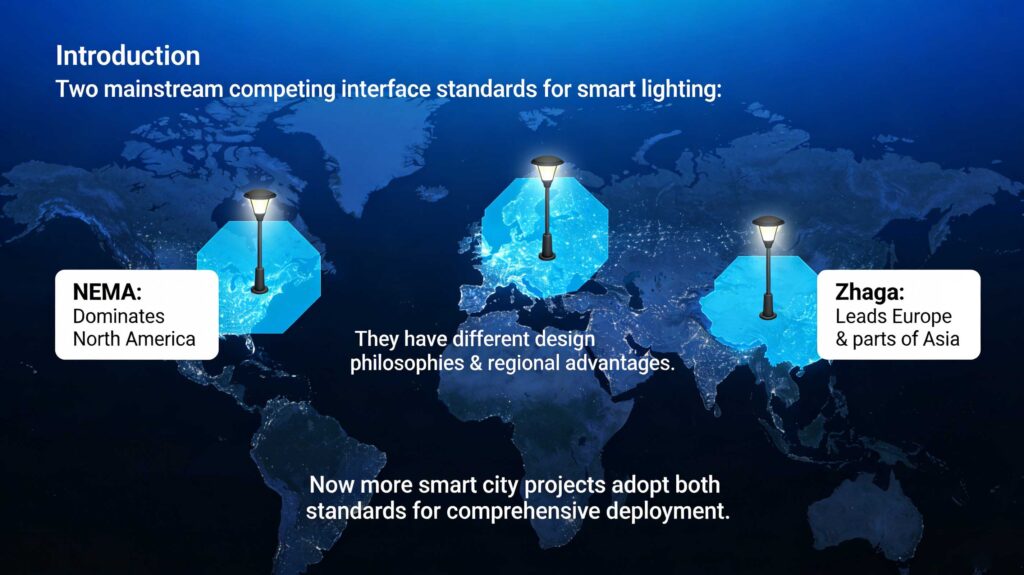
This article looks at what differentiates NEMA and Zhaga, where each performs best, and why the most thoughtful answer to “which one wins” is probably “both, depending on where you are and what you’re building.”

How Do Zhaga and NEMA Interface Standards Compare?
Straight to the most important question in everyone’s mind. NEMA and Zhaga solve the same connectivity problem with different design assumptions: NEMA prioritises compatibility with existing high-voltage AC infrastructure, while Zhaga prioritises compact modular integration for new intelligent systems.
Here is a summarized comparison of both interfaces:
| Recurso | Zhaga Interface (JL-700, JL-700W) | NEMA Interface (JL-200X, JL-240X) |
| Design Form | Small, compact opening with asymmetric holes; maintains IP66-IP67 waterproof rating after fixture installation | Standard aperture sizes of 30/35/45mm, multi-pin design, UL and ANSI C136 certified |
| Tensão de operação | Low voltage 12/24V (requires external AC-DC power converter) | 120-277VAC direct power supply |
| Dimming and Control Interfaces | Supports DALI-2 and Zhaga-D4i communication protocols | Basic 3-pin, 5-pin for 0-10V dimming, 7-pin includes DALI control |
| Application Regions and Device Types | Europe and Asia smart lighting, emphasising module integration and standardised smart communication | North America traditional and retrofit projects, suited for most street and industrial lighting systems |
How Are They Used Independently and Together on Pole-Mounted Systems?
The practical deployment reality depends on the project context.
Independent use
Zhaga suits new construction projects in Europe and Asia, where the luminaire was designed around the Zhaga interface from the start. The compact form factor, IP66/IP67 rating, and DALI-2 protocol support make it well matched to high-integration and low-voltage smart lighting modules.
NEMA suits retrofit projects in North America where the existing infrastructure already uses standard Tomadas NEMA and the priority is rapid compatibility with the installed base and legacy high-voltage rather than new modular architecture.
Hybrid use
Some smart poles incorporate systems compatible with both interfaces, implementing combined deployment of different standard modules with zoned smart control and reduced maintenance costs.
This hybrid approach is increasingly common in large-scale cidade inteligente tenders where the specification needs to accommodate a diverse installed base while building toward a unified management platform.
How Do They Compare Across the Key Performance Indicators?
| Key Indicator | Advantages of Zhaga System | Advantages of NEMA System | Notes and Preferred Use Cases |
| Waterproofing and Compact Structure | Easier to achieve IP66/IP67, space-saving | Standard structure size, robust for high-power fixtures | Zhaga is preferred for smart parks and new construction projects |
| Fonte de energia | Requires low-voltage power and conversions, increasing frontend design flexibility | Compatible with a wide AC range, simplifying installation | NEMA preferred for legacy backbone upgrades |
| Control Compatibility | Widely supports digital protocols, facilitating smart communications | Supports linear dimming and digital control, first to adapt the DALI standard | Differences due to the device ecosystem, compatibility solutions are necessary |
| Maintenance and Upgrade | Modular design simplifies replacement and reduces overall maintenance costs | Traditional socket widely used, lowering manpower and material costs | Flexible solutions needed for legacy system expansions |
| Multi-interface Operation | Difficult to integrate multiple systems; it depends on the manufacturer’s software/hardware integration | Easily integrates multiple control and power lines for complex streetlight management | Hybrid poles are a breakthrough in standard convergence |
What Are the Dominant Trends in Smart City Lighting?
Neither standard is winning outright. They’re converging on different segments of the same market, and the most sophisticated deployments are building infrastructure for both.

Zhaga promotes:
- Modularity
- Interoperabilidade
- Smart communication through open standards
It is especially well-suited to new facilities where the luminaire and sensor can be designed together from the start. The Zhaga-D4i certification ecosystem enables plug-and-play interoperability between sensors and luminaires from different manufacturers, which is a significant advantage for cities that don’t want to be locked into a single vendor’s hardware.
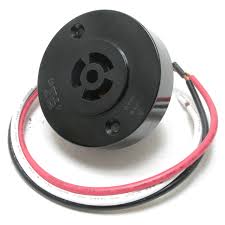
NEMA, with decades of market maturity in North America, retains a large share of traditional roadway and retrofit projects where compatibility with the existing installed base is the primary concern.
The 7-pin ANSI C136.41 standard has brought DALI and 0-10V dimming capabilities into the NEMA ecosystem, significantly narrowing the functional gap between the two standards. For North American municipalities upgrading existing infrastructure rather than starting from scratch, NEMA with 7-pin receptacles provides a practical path to intelligent lighting without replacing every fixture.
Long-Join’s product range reflects this market reality. The JL-700 e JL-700W Zhaga Book 18 series serve European and Asian smart lighting projects requiring compact IP67 sensor integration with DALI-2 protocol support.
O JL-200X 3-pin and JL-240X 7-pin NEMA series serve North American projects from basic switching through to full intelligent dimming and remote monitoring. The JL-250F adds surge protection for industrial and high-risk infrastructure applications.
Full specifications for Long-Join’s Zhaga and NEMA product ranges are available on Chi-Swear’s smart lighting receptacle product pages.
NEMA vs Zhaga Interface
The NEMA vs Zhaga question doesn’t have a single answer because the two standards are not competing for the same market in the same way. Zhaga is winning new smart construction in Europe and Asia. NEMA is holding its dominant position in North American retrofit and municipal work, with 7-pin infrastructure closing the functional gap. Long-Join’s product portfolio covers both standards with dedicated product lines, supporting whatever interface the project requires without forcing a choice between ecosystem loyalty and technical performance.
Frequently Asked Questions
Q1: Why does Zhaga use low-voltage 12/24V and require an external power converter?
Zhaga was designed around the principle of separating the high-voltage power supply from the low-voltage intelligent control module. The low-voltage interface makes the sensor and controller hardware safer to handle during installation and maintenance, and it enables standardised interoperability between devices from different manufacturers.
The AC-DC converter sits inside the luminaire driver, which is already part of the fixture design, so in practice, the additional component is absorbed into the luminaire rather than being an add-on at the receptacle.
Q2: What is the difference between a traditional 3-pin and a 7-pin NEMA socket?
The 3-pin NEMA socket carries live, neutral, and ground, which is only enough for a photocontrol to switch the fixture on and off. The 7-pin ANSI C136.41 socket adds four additional connections (two for 0-10V analogue dimming and two for DALI digital dimming and communication). This means a 7-pin socket can carry dimming commands from a management platform to the LED driver, and status information from the fixture back to the platform, all through the same twist-lock interface.
Q3: How do hybrid standard poles accommodate dual socket coexistence?
By integrating dual-socket installation and central control units, allowing flexible switching among different photocontrol units and sensors, and leveraging technological advantages.
Q4: Which interface standard is preferred for new smart city projects?
Zhaga is generally preferred for new smart city construction, particularly in Europe and Asia, because its modular design and open standard interoperability are better suited to future intelligent expansion.
Q5: How does Long-Join support different smart city interface standards?
Long-Join offers product lines covering both NEMA and Zhaga interfaces across their full specification ranges. The JL-700 Zhaga Book 18 series covers compact IP67 smart sensor integration for Zhaga-compatible luminaires. The JL-200X, JL-240X, and JL-240FXA series cover 3-pin and 7-pin NEMA applications from standard photocontrol switching through to full smart lighting infrastructure.