Last updated: 13 November 2026 · Long-Join technical marketing team, Shanghai
A streetlight photocell is usually the cheapest line item in a public-lighting budget — and one of the most expensive to get wrong. The part costs a few dollars; what it controls costs a city real money every night, and when it fails, the failure is public: a lamp burning at noon on the town’s main street, or a dark block that generates phone calls the same evening. This guide is written for municipal lighting managers and utility procurement teams who evaluate controls by what they cost across a decade, not across a purchase order.
Key takeaways for public-lighting buyers
- A control that fails ON wastes energy on every affected fixture nightly; a control that fails OFF generates complaints and perceived safety risk. Both failures cost more than the part.
- The dominant cost is the truck roll: one service visit typically costs a multiple of the control’s entire purchase price.
- Quality is visible in the datasheet: contact materials, sealing construction, fixed switching delay and threshold tolerances predict field life better than price does.
- Specify by standard interface (ANSI C136.10, ANSI C136.41, Zhaga Book-18) — it keeps replacement supply competitive for decades and enables staged smart-city upgrades without re-wiring.
- Or-equal clauses protect budgets when they are backed by a five-row technical cross-reference, not by brand familiarity alone.
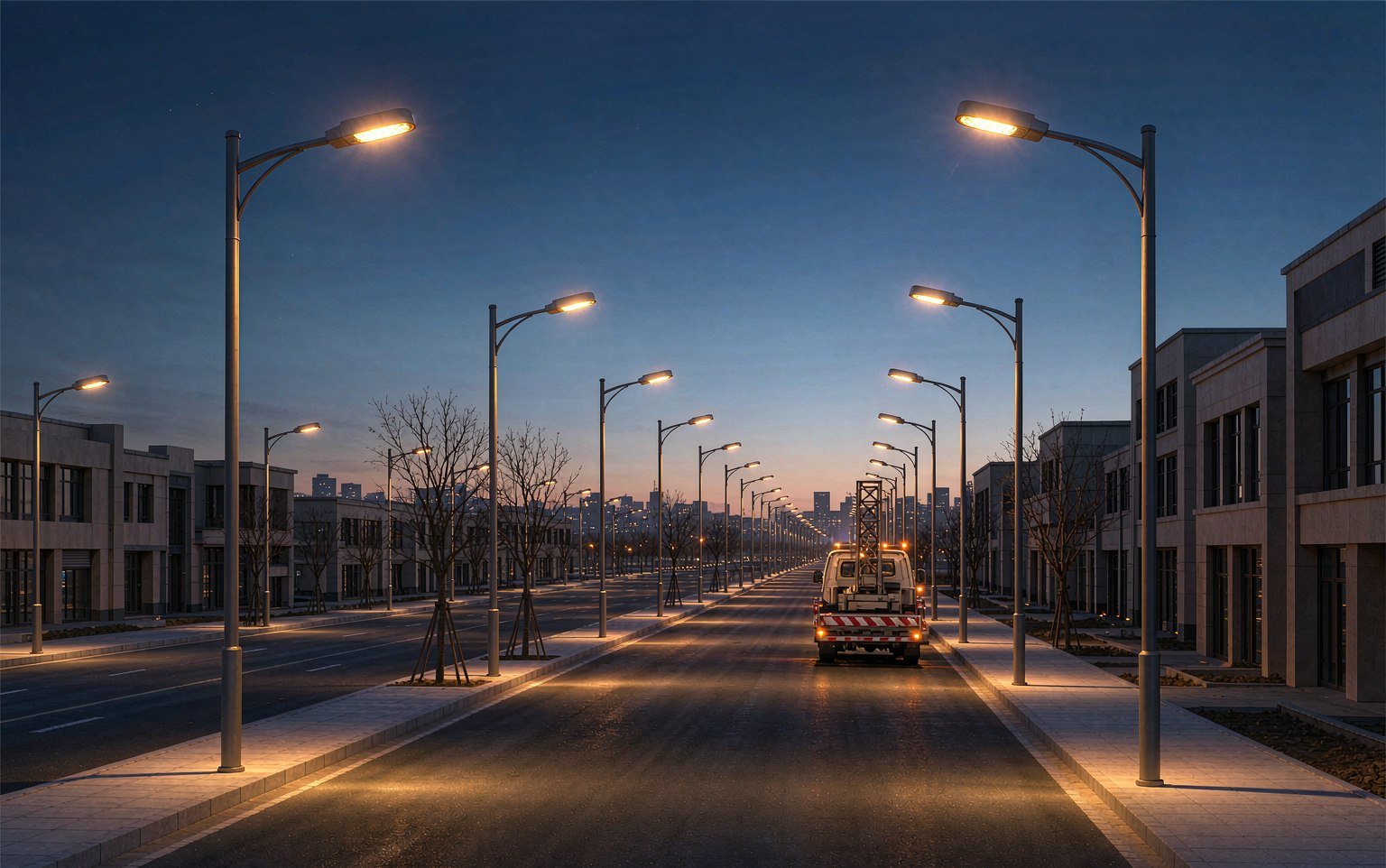
Failure mode 1: the control that fails ON
When a photocontrol welds or drifts into a permanently-on state, the lamp burns around the clock. The cost is quiet, continuous and cumulative:
Illustrative math (substitute your own tariff): a 100 W LED fixture burning an extra 11 hours per night consumes 11 h × 0.1 kW = 1.1 kWh/day. At a tariff of T per kWh, that fixture wastes 1.1 × 365 × T per year — per fixture. A single bad batch affecting a few hundred controls multiplies that across the fleet, and unlike a dark-street failure, nobody calls to report a lamp that is on.
Batches that fail ON also undercut any energy-savings reporting your program files: dusk-to-dawn control is itself an efficiency measure, and its savings vanish precisely when the control stops switching.
Failure mode 2: the control that fails OFF or cycles
The mirror failure is worse politically: dark streets read as neglect the same evening they happen. Cycling controls — lamps switching on and off repeatedly at dusk — are the most visible symptom of threshold or delay problems, because residents see it from their windows. This is why the delay specification matters: a fixed, defined switching delay (for example the 10-second delay used across the JL-241/242/243 series class of controls) is designed to ride through lightning flashes and passing headlights without the lamp responding. An uncontrolled or undersized delay produces exactly the flicker that fills complaint queues.
The truck-roll line item
Whatever your local crew rates are, the arithmetic is unforgiving: a service visit — crew, vehicle, fuel, administration — costs a multiple of the control’s purchase price before the replacement part is even installed. Two rules follow:
- Buy the failure rate, not the part. A control that costs 30% more but avoids one extra failure cycle across its service life is cheaper. The datasheet rows that predict this are contact materials (silver-alloy or brass contact systems rather than bare copper), sealing construction (gaskets, glued or welded joints, potted electronics), and stated switching-endurance testing.
- Standard interfaces turn failures into 30-minute jobs. Twist-lock controls (ANSI C136.10 / C136.41) and Zhaga Book-18 sockets are field-replaceable without re-wiring. A crew arrives, twists the old control out, locks the new one in, and the street is back — the replacement parts market stays competitive because every compliant manufacturer fits the same receptacle.

Specifying so budgets survive the decade
| Specification practice | Why it protects the program |
|---|---|
| Write the interface standard into the tender (ANSI C136.10, C136.41, Zhaga Book-18) | Keeps the replacement market competitive for the housing’s whole service life; no single-brand lock-in |
| Require the certification file number in bid annexes | Or-equal bids become verifiable by your own engineers in the certifier database |
| State thresholds, delay and tolerances numerically | Prevents the dusk-cycling and noon-lighting failures from ever being compliant deliveries |
| Require contact material declarations for current-carrying parts | The cheapest place to hide cost is contacts; the declaration makes it visible |
| Ask for datasheet revision history | A supplier that revisions documents is a supplier that engineering still watches |
The staged upgrade path — and why it starts with the receptacle
Public-lighting modernization rarely happens in one tender. The practical sequence most programs follow:
- Dusk-to-dawn baseline: standard-interface twist-lock controls on ANSI receptacles — the maintenance-competitive baseline described above.
- Programmable dimming: the same housing family in 5-pin (ANSI C136.41) adds dimming contacts; curfew dimming cuts energy without re-wiring.
- Node-ready luminaires: 7-pin receptacles add the low-voltage signal path for controller nodes — the standard interface smart-city projects are moving to.
- Field-upgradeable intelligence: Zhaga Book-18 sockets carry standardized sensor/controller modules — and support the connectivities (LoRa, NB-IoT, Zigbee classes of networks) that asset-management and fault-reporting platforms rely on.
The decision that matters is made once, at housing selection: if the luminaire family ships with standard receptacles, each following stage is a component swap. If it ships with a proprietary interface, every stage is a re-procurement.
Related reading on this site
- Why NEMA sockets and photocontrols recur in South American municipal streetlight bids
- NEMA vs Zhaga: which smart-lighting ecosystem fits your city
- Street-lighting installation and LED dimming: an illustrative energy calculation
Running a public-lighting tender or fleet study?
Ask for interface-standard pricing, material declarations and the certification file with your RFQ — we supply the annex rows directly.
Note: Energy figures above are illustrative formulas, not measured savings. Tariffs, fixture wattages, control failure rates and crew costs vary by jurisdiction; use your own values. Specification practices must follow your local procurement law.
References
- ANSI C136.10 — street-lighting photocontrol interfaces (3-pin twist-lock)
- ANSI C136.41 — roadway lighting photocontrol receptacles and accessories (5- and 7-pin)
- Zhaga Book 18 — LED driver-socket interface for outdoor lighting
- Long-Join photocontrol datasheets (PDF)
Specifying controls for a public-lighting program?
Send us three things — fleet size (or the tender’s fixture count), the interface standard in the specification (NEMA 3-pin, ANSI C136.41 5/7-pin, or Zhaga Book-18), and the operating voltage. We reply within 24 hours with unit pricing at tender quantity, datasheets for the exact variant, and the certification file number for your compliance annex.
For programs planning a phased smart-city upgrade, ask for the 3-pin to 7-pin or Zhaga migration path for your housing family.
PDF datasheets → · Twist-lock photocontrols → · 3-pin to 7-pin upgrade explained →