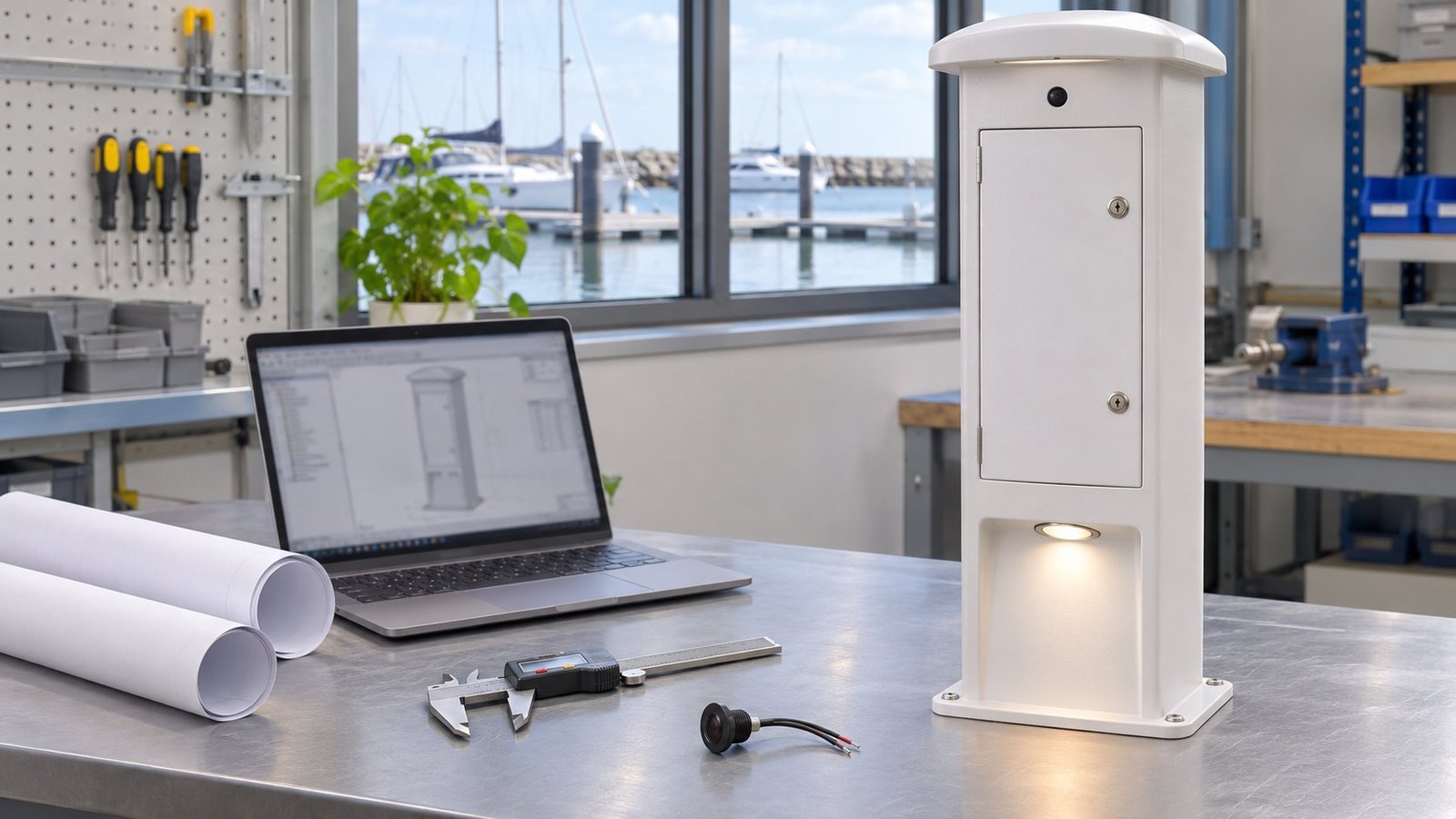
Before sourcing a photocell for a marina power pedestal, ask for a configuration-specific proposal. The useful deliverable is a traceable order code, drawing, electrical compatibility review, evidence scope and sample validation plan—not a general promise that the product is waterproof or suitable for every marine application.
1. Which complete model and mounting configuration are you quoting?
Ask the supplier to identify the full order code, mounting drawing and revision. State panel thickness, opening, depth, gasket arrangement, wire exit and service access. If you reference JL-103A, do not accept a JL-103 family description as confirmation of every option.
RFQ output: a marked drawing and a list of included and excluded parts. This helps avoid a sample that fits mechanically while production arrives with a different lead or sealing arrangement.
2. Is the electrical proposal matched to our LED driver?
Provide the operating supply and frequency, driver model, running current, inrush data and number of drivers switched together. Ask which ratings or validation support the proposed configuration. A generic tungsten or ballast rating should not be treated as confirmation of the intended LED load.
RFQ output: the applicable electrical specification and any agreed switching test. Clarify the required switching logic and failure behavior as part of the equipment design.
3. What environmental evidence applies to this exact assembly?
Describe the intended coastal exposure and request the relevant water-ingress, humidity, UV, temperature and corrosion evidence. Each report should identify samples, conditions, acceptance criteria and the tested configuration. Separate a material property from a finished-product test.
RFQ output: a document list with confirmed scope and open gaps. Do not assume a standard outdoor photocell is marine-grade-certified, or infer years of service from a salt-spray duration.
4. How will we prevent the lighting from influencing the sensor?
Share the proposed sensing position relative to the LED, diffuser and reflective surfaces. Ask how to evaluate shadows, reflections and adjacent lights in a prototype. Confirm the selected control’s documented thresholds and delay.
RFQ output: an agreed optical review and a realistic dusk/night/dawn test, using the assembled pedestal rather than only a component on a bench.

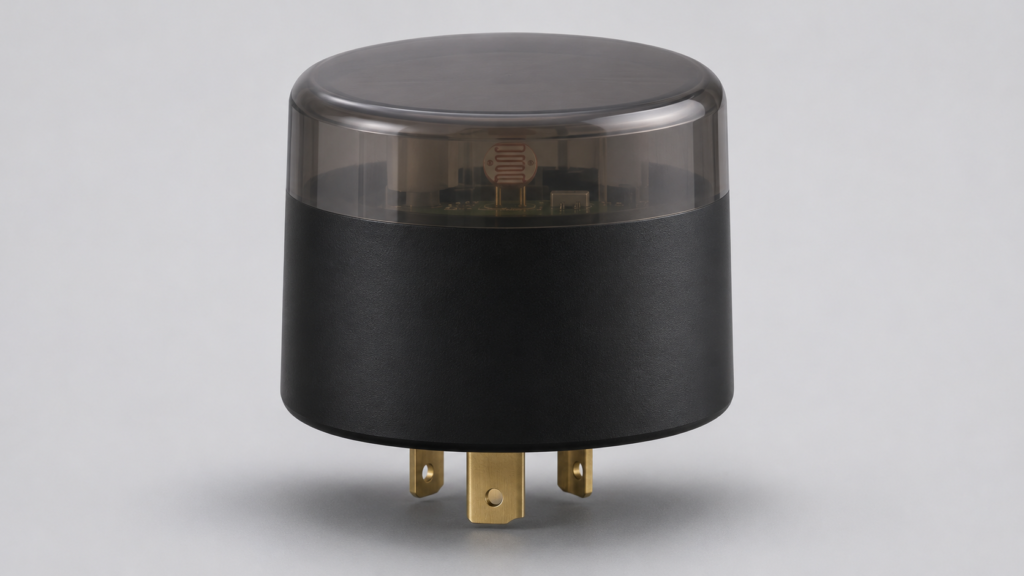
JL-403C
Direct wire-in electronic photocontrol candidate for an enclosure integration review. Confirm dimensions, LED-load capability and environmental requirements.
5. What will the sample approval actually prove?
Agree on the sample quantity and test plan before placing a volume order. Identify which checks address electrical operation, mounting, optical behavior and environmental exposure. Document failures and design changes rather than approving a sample only because the lamp switches on once.
RFQ output: an approval record that identifies the accepted sample, specification revision and remaining conditions. Discuss sample availability and commercial terms for the selected configuration.
6. How are production consistency and changes controlled?
Ask what inspection and traceability records can be agreed for the order, and how changes to materials, leads, gaskets, switching components or drawings will be reviewed. Request a quotation-specific quality plan where the project requires one.
RFQ output: documented inspection criteria, revision control, batch identification and a change-notification arrangement. These are procurement requirements to agree—not claims that every supplier already performs every test on every batch.
7. Which commercial and service conditions apply?
State destination country, initial order quantity, estimated annual quantity in pcs and target delivery schedule. Ask about MOQ, lead time, packaging, permitted customization, replacement identification and the documents included with the shipment.
RFQ output: a quotation tied to the approved order code, with sample terms and technical responsibilities clearly described. Avoid a volume price that is detached from the configuration you tested.
Copy this brief into your OEM inquiry
Company / website / country:
Application: marina power pedestal / dock lighting / RV pedestal / other
Supply and frequency:
LED driver, load and inrush data:
Mounting drawing and available space:
Required environmental and certification documents:
Sample quantity / annual quantity (pcs):
Target schedule and questions:
How CHI-SWEAR can start the review
Our catalogue offers button-type, swivel and direct wire-in photocontrol candidates within the LONG-JOIN product range. Send the brief above so the discussion starts with your pedestal design and evidence requirements. Current drawings, configuration availability and proposed validation must be confirmed before approving a marine application.
Should we ask for a universal replacement?
Ask for a documented compatibility review instead. Wiring, dimensions, supply, LED load and behavior all matter; appearance alone cannot approve an interchange.
Do listed standards prove our complete pedestal is approved?
No. A component document applies only within its stated scope. The equipment manufacturer must determine the documentation and approvals required for the complete product and destination market.
Request an OEM Photocell Solution
Tell CHI-SWEAR about your pedestal or luminaire, destination country, operating voltage, LED driver, mounting space and estimated annual quantity in pcs. Include the environmental tests your project requires. We will review candidate configurations and the documentation needed for a sample evaluation.
Start a marina OEM inquiryUse the existing contact form →Discuss sample availability, MOQ, customization scope and lead time for the exact configuration. These are quotation-specific, not fixed promises.
A photocontrol in this application controls a lighting circuit. It is not a shore-power charger, protective device or certification of the complete pedestal. Integration and testing must be reviewed by the equipment manufacturer and qualified electrical personnel.