
OUTLINE
- Introduction
- What Did Traditional Photocontrol Actually Do?
- How Did Smart Photocontrol Develop?
- What Role Does Motion Sensing Play?
- What Does AI Add to Photocontrol Systems?
- How Has Switch Contact Technology Evolved?
- The Future of Photocells
- Frequently Asked Questions on The Evolution of Photocontrol
Street lighting looked roughly the same for decades. A photocell sat on top of a pole, sensed when it got dark, switched the light on, and switched it off at dawn. That was the whole system.
This system worked, and for basic outdoor lighting, it still does. But the environments these systems operate in have changed, and the expectations placed on them have changed with it.
Cities now want to know which lights are on, which ones have faults, how much energy each circuit is consuming, and whether dimming can be adjusted remotely based on traffic conditions as late as 2 am. None of that is possible with a simple on/off photocell.
The integration of smart controllers, IoT protocols, motion sensing, and increasingly AI technology into lighting control systems is not a future concept; it is already deployed across municipal networks in multiple markets. The evolution has begun, and it is important to see where it is heading.
What Did Traditional Photocontrol Actually Do?
Traditional photocontrols performed one function: switching a light load on when ambient lux dropped below a threshold at dusk, and off when it rose above a threshold at dawn.
The structure was simple. A photosensitive element, a relay, and a housing. No communication capability, no data output, no remote adjustment. There was a time delay function that filtered out brief light events like lightning or passing headlights to prevent false switching. That was the extent of its intelligence.
Failure in these photocells on a municipal network is only discovered when someone notices the light is on during the day or off at night, and no way to adjust the switching threshold remotely if conditions change. For a small installation, these limitations are manageable. For a smart city managing thousands of street lights, they translate into high inspection labour costs and slow fault response times.
How Did Smart Photocontrol Develop?

The addition of IoT communication protocols to photocontrol systems transformed them from passive switching components into active network nodes that report status, receive commands, and participate in city-wide lighting management platforms.
Multiple protocols are in use across smart photocontrol deployments:
- NB-IoT — Low-power cellular connectivity, connects directly to the cloud via telecom infrastructure with no local gateway required. Long-Join’s JL-245CN uses this protocol.
- ZigBee — Mesh network protocol, suitable in urban precinct deployments where a local gateway coordinates a cluster of nodes.
- LoRa — Long-range, low-power protocol suited to wide-area deployments with low data frequency requirements.
- WiFi and Bluetooth — Shorter range options suited to controlled environments or commissioning tools.
With these protocols embedded, each photocontrol can report its switching status, energy consumption, fault conditions, and ambient lux readings back to a management platform in real time.
What Role Does Motion Sensing Play?
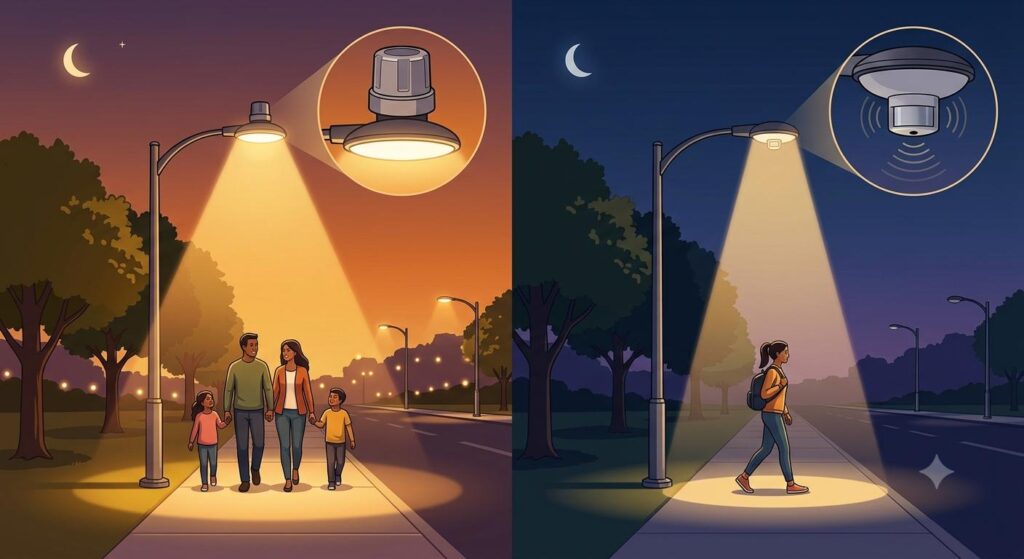
The integration of Passive Infrared (PIR), microwave, ultrasonic, and dual-technology sensors into lighting fixtures adds a secondary layer on top of dusk-to-dawn switching, enabling demand-based dimming that reduces energy consumption without compromising safety.
The dusk-to-dawn function decides whether the light should be on at all. Motion sensing decides how bright it should be. Put both in the same system and you get something genuinely useful: a fixture that comes on at dusk, drops to 30% through the quiet hours, and kicks back up to full brightness when a pedestrian or vehicle is detected. After a set period with nothing moving, it drops back down again.
The practical energy saving from this approach is significant in low-traffic periods between midnight and 5 am, when full brightness across a full street lighting network serves very few people. Long-Join’s Zhaga Book 18 series supports PIR and DALI 2.0 dimming integration within the compact Zhaga sensor format, making this combination straightforward to deploy on compatible luminaires.
What Does AI Add to Photocontrol Systems?
AI algorithms embedded in the Microcontroller Unit (MCU) allow a smart photocontrol to learn the lighting environment it operates in, distinguish between natural light changes and artificial interference, and adjust its control strategy over time without manual reconfiguration.
Seasonal variation, tree growth, nearby construction, and changes in surrounding infrastructure all alter the light environment in which a photocell operates. A system that can observe these changes and adapt its response over time maintains accuracy without requiring periodic manual recalibration.
AI also enables the system to distinguish between a genuine dawn condition and a temporary overcast sky that briefly raises lux levels above the off-threshold. Without that distinction, a photocell might switch off on a dark, stormy morning and leave a road unlit at 7 am. A learning system builds a model of what dawn actually looks like at a given location and time of year, and applies that model rather than responding purely to instantaneous lux readings.
How Has Switch Contact Technology Evolved?
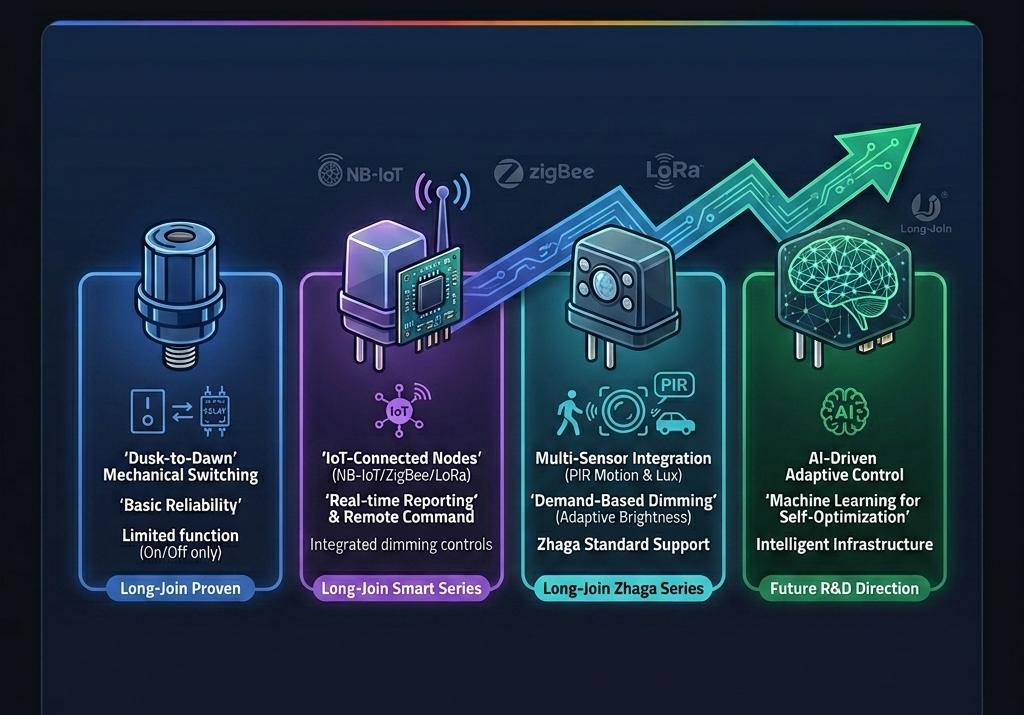
The progression from mechanical to electronic to smart contact technology directly tracks the evolution from basic reliability to long relay life to network-integrated control.
| Development Stage | Characteristics | Long-Join Products & Technology Highlights |
| Mechanical contact (Traditional) | Simple switching, durable, prone to wear, limited lifespan | JL-205C, JL-207C high-durability contact design |
| Electronic contact (Zero-cross Technology) | Reduces contact wear, improves switching lifespan, and stability | Some smart photocontrol products use electronic triggering, compatible with high LED loads |
| Smart contact (integrated sensors) | Combines light and motion sensors with MCU for dynamic response and remote control | LONGJOIN smart solutions support multi-sensor integration and AI algorithms |
| AI-enabled contact (Future Stage) | Machine learning and data analytics for self-optimization and adaptive control | Future R&D direction toward self-learning lighting systems |
Visit Chi-Swear’s smart photocell range for full specifications on Long-Join’s NB-IoT and Zhaga series smart photocontrol products.
The Future of Photocells
Photocontrol systems have moved from a single relay in a weatherproof housing to networked nodes with real-time fault reporting, and are now at the early stages of AI-driven adaptive control. Long-Join’s product range spans this full evolution, from the proven reliability of the JL-205C and JL-207C through to the NB-IoT connectivity of the JL-245CN and Zhaga-integrated smart sensor series. The trajectory is clear: lighting control systems are becoming intelligent infrastructure, and the photocontrol is at the centre of that shift.
Frequently Asked Questions on The Evolution of Photocontrol
Q1: What is the main difference between traditional and smart photocontrol?
All a traditional photocell does is switch on at dusk and off at dawn based on a fixed lux threshold. On the other hand, a smart photocontrol does the same switching function, while also reporting its status, receiving remote commands, logging energy data, and sending instant fault alerts to a management platform.
Q2: How does IoT technology enhance photocontrol applications?
Each IoT-connected photocontrol becomes a data point on a network map. The management platform knows in real time which fixtures are on, which have faults, and what each circuit is consuming.
Q3: How does motion-sensing technology benefit photocontrol systems?
Motion-sensing technology adds demand-based control on top of dusk-to-dawn switching. The light comes on at dusk regardless of motion, but dims during low-traffic periods and brightens when a pedestrian or vehicle is detected. This helps to reduce energy consumption significantly while maintaining safety levels when the road or pathway is actually in use.
Q4: What is the role of AI in photocontrol systems?
Current AI applications in photocontrol focus on adaptive threshold management and environmental pattern recognition. A system that has learned what dawn looks like at a specific location and time of year is less likely to switch off incorrectly on a dark winter morning or during heavy cloud cover.
Q5: What are Long-Join’s advantages in switch contact technology?
The JL-205C and JL-207C use high-durability relay contacts designed for sustained outdoor switching life. The HP relay variant in the JL-207C extends rated cycle life beyond 50,000 switching operations.


 English
  Spanish
  Russian
  Arabic
  Italian
  Japanese
  Portuguese