OUTLINE
- Introduction
- Why Does “Simple” Switching Get Complicated?
- Who Is Long-Join and Why Does Product Segmentation Matter?
- The JL-205C: Standard Reliable Workhorse
- The JL-207C: Enhanced Protection for Harsher Environments
- The JL-207F: High-Voltage Specialist
- Why Do Three Models Exist Instead of One?
- Common Photocell Procurement Mistakes to Avoid
- How Smart Buyers Structure Their Tenders
- In Summary
You’re sourcing photocells for a street lighting tender. You open the catalogue and immediately hit a wall. JL-205C. JL-207C. JL-207F. They look almost identical in photos, and the descriptions all say “dusk-to-dawn photocontrol.”
The price differences seem marginal at first glance. So your first instinct is completely reasonable: why are there three models when one should do?
For the procurement managers, lighting engineers, and the project specifiers who have asked that exact question several times, it’s important to understand Long-Join’s photocell options.
Why Does “Simple” Switching Get Complicated?
The core function of a dusk-to-dawn photocell is genuinely simple, but the environments these devices operate in are anything but, and that gap between simple function and complex environment is where model differentiation earns its place.
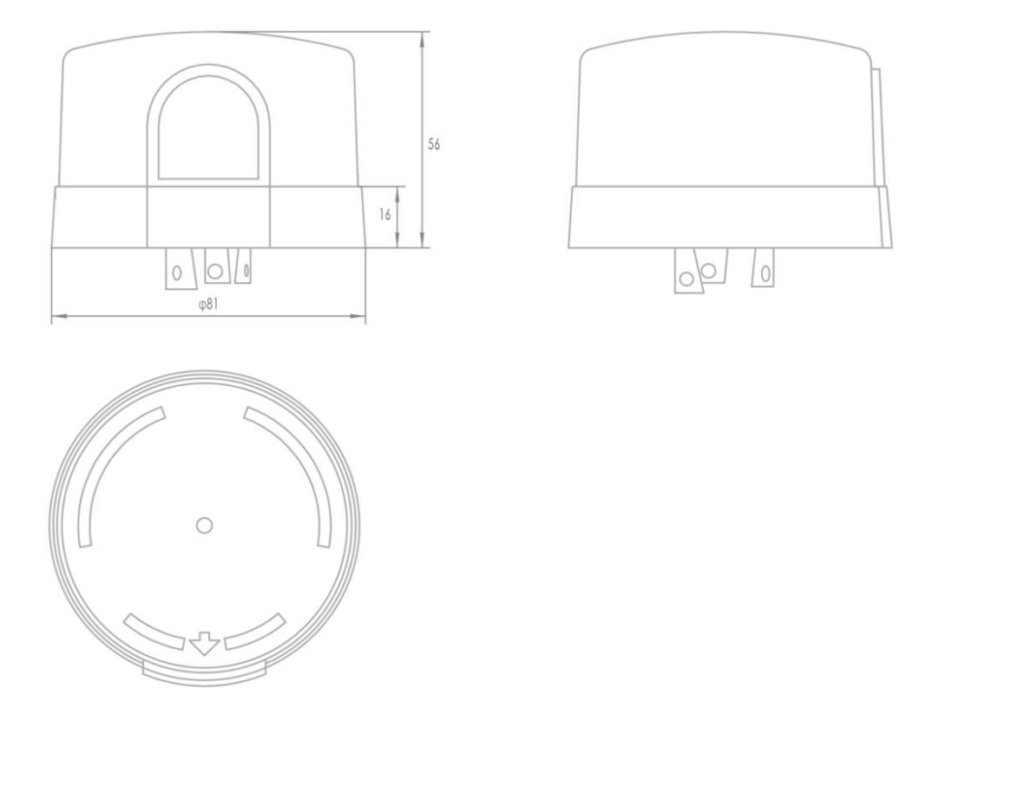
Think about what a photocell actually goes through. It sits on top of a street light pole, exposed to every weather event the local climate produces, connected to a power grid that isn’t perfectly stable, switching a load that may be LED or HID, in a location that might be a quiet residential street or a coastal industrial zone with salt air and frequent lightning. The basic switching function is the same. The conditions that surround it are not.
The hidden procurement variables that actually determine whether a photocell performs reliably over its service life are:
- Voltage compatibility — does the supply voltage match the photocell’s rated range, including transient spikes?
- Load type — LED drivers have different inrush characteristics than HID ballasts
- Surge protection level — how often will the grid see transients, and how severe will they be?
- Environmental rating — IP level, UV resistance, and housing durability
- Relay life cycles — how long before the switching mechanism needs replacement?
Long-Join’s three twist-lock models each answer a different combination of those variables. They’re not redundant. They’re segmented.
Who Is Long-Join and Why Does Product Segmentation Matter?
Long-Join has been manufacturing photocell controllers since 1993, shipping to over 90 countries, and its design philosophy is application-based segmentation; the idea that forcing one model to serve every condition produces a product that is either over-engineered for simple applications or dangerously under-specified for demanding ones.
A single “universal” photocell sounds appealing in a catalogue. In practice, it either costs more than it needs to for a residential street installation or cuts corners that matter in an industrial zone.
Long-Join’s approach involves building models with different capability levels for different risk environments, and this lets procurement teams match the specification to the actual application rather than paying for features that aren’t needed or missing ones that are.
The JL-205C: Standard Reliable Workhorse
The JL-205C is Long-Join’s entry-to-mid-level twist-lock photocontrol, designed for high-volume deployment in standard urban and suburban lighting environments where reliability and cost efficiency are the primary procurement criteria.

The JL-205C is the model that keeps city roads lit, manages parking lot lighting, and handles general outdoor networks across hundreds of thousands of installations globally. It’s not the most specified product in the range, and it doesn’t need to be.
Where does the JL-205C belong in procurement:
- Municipal street lighting
- Suburban parking lots and commercial area lighting
- General outdoor lighting networks
JL-205C Procurement Value
For standard urban environments with stable or near-stable grid supplies, it delivers reliable dusk-to-dawn performance at the best balance of price and durability available in the twist-lock format.
The JL-207C: Enhanced Protection for Harsher Environments
The JL-207C is the upgraded industrial-grade variant, built for environments where grid instability, surge exposure, and harsh physical conditions make the standard JL-205C’s specifications insufficient for the maintenance cost targets of the project.
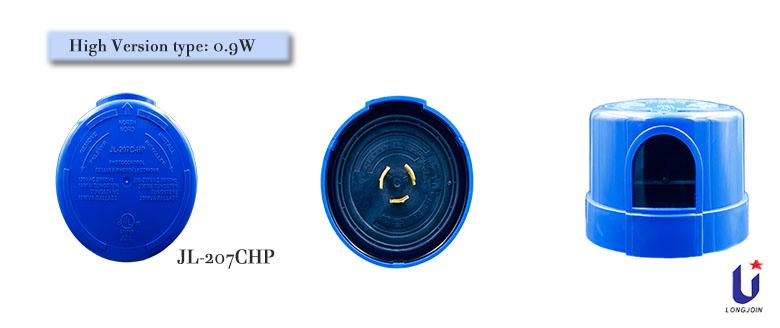
The differences from the JL-205C are deliberate and specific:
- IR-filtered phototransistor — blocks infrared-heavy sources that cause false switching in complex light environments; critical in industrial zones with mixed artificial light sources
- Zero-crossing switching technology — switches the relay only when the AC waveform crosses zero voltage, reducing contact arcing and extending relay life significantly
- Higher-specification MOV options — surge protection tiers up to 546J/10,000A (the -25 variant), compared to the JL-205C’s standard MOV
- HP (High-Power) relay option — 20-amp relay rated at over 50,000 cycles, versus the standard relay’s 10,000+ cycles
- Rated voltage: 120-277VAC with 347VAC variant (JL-207E) available
The JL-207C doesn’t just survive harsher conditions; it’s engineered to maintain its switching accuracy and relay integrity in them. The zero-crossing technology alone makes a meaningful difference in relay longevity in high-cycling or high-transient environments.
Where does the JL-207C belong in procurement:
- Coastal cities
- Industrial zones
- High lightning-risk regions
JL-205C Procurement Value
The unit price is higher than that of the JL-205C. The maintenance cost over five years in a harsh environment is lower. That’s the calculation that justifies the specification upgrade.
The JL-207F: High-Voltage Specialist
The JL-207F is Long-Join’s 480VAC twist-lock photocontrol, built for the specific infrastructure reality of where 277-480VAC three-phase supply is standard — a voltage range that neither the JL-205C nor the JL-207C can serve.
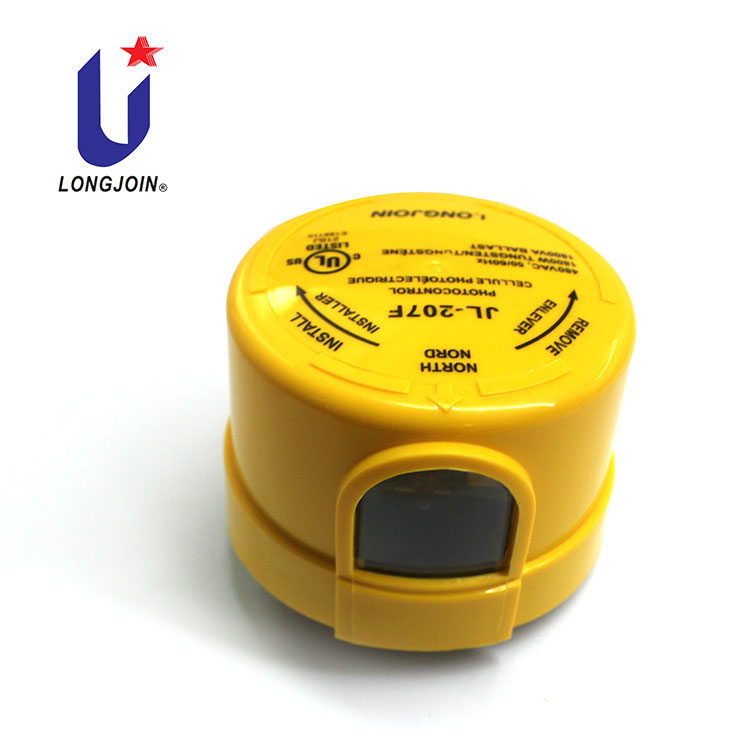
The JL-207F exists because a significant portion of North American commercial infrastructure runs on 480VAC supply; large parking structures, industrial facilities, highway lighting, and shoebox-style area lighting on three-phase circuits. Installing a 120-277VAC photocell on a 480VAC circuit isn’t a specification choice. It’s a failure waiting to happen.
Beyond voltage, the JL-207F’s 208-480VAC applicable range gives it flexibility in mixed-voltage retrofit environments where different circuits across a site may operate at different supply levels.
Where it belongs in procurement:
- Mixed LED/HID infrastructure
- Customized lighting systems
- Retrofit projects where the existing supply infrastructure operates above 277VAC
JL-207F Procurement value
There’s no substitution available for this model in its voltage range. If the supply is 480VAC, the JL-207F is the specification. The procurement question isn’t whether to use it; it’s which IP rating and surge protection configuration to select for the specific installation environment.
Why Do Three Models Exist Instead of One?
The three models reflect three genuinely different failure risk profiles in real outdoor environments:
| Risk Profile | Primary Concern | Right Model |
| Stable grid, moderate climate | Cost efficiency, basic reliability | JL-205C |
| Unstable grid, harsh climate, high surge | Maintenance cost, long relay life | JL-207C |
| 480VAC supply infrastructure | Voltage compatibility | JL-207F |
Over-specifying creates cost waste. Under-specifying creates maintenance spend and system failures. A procurement strategy that uses one model for all three profiles is guaranteed to get at least two of them wrong.
Common Photocell Procurement Mistakes to Avoid
These are the errors that show up repeatedly in street lighting tenders:
- Choosing based on unit price alone — the cheapest photocell in a high-surge environment isn’t cheap once you account for replacement and maintenance costs
- Ignoring surge environment classification — coastal and industrial zones are not the same as quiet residential streets, and the specification shouldn’t treat them as if they are
- Using one model across all geographic conditions — a project covering both a city centre and an industrial waterfront needs at least two photocell specifications
- Not considering installation constraints — specifying a twist-lock photocell for a fixture without a NEMA receptacle, or a wire-in model where the housing has no knockout, turns a simple procurement decision into a costly field modification.
How Smart Buyers Structure Their Tenders
The most efficient procurement approach segments the project by zone before selecting models:
- Standard zones (stable grid, moderate climate) — JL-205C
- High-risk zones (coastal, industrial, high lightning incidence, unstable grid) — JL-207C
- High-voltage zones (480VAC circuits, three-phase supply) — JL-207F
This approach improves maintenance planning because you know which zones carry a higher replacement risk. It simplifies spare part logistics because each zone has a defined model. And it improves long-term system reliability because each photocell is matched to the actual demands of its environment rather than averaged across all of them.
Full specifications for all three models are available on Chi-Swear’s twist-lock photocell product pages.
In Summary
The JL-205C, JL-207C, and JL-207F look similar because they share the same physical format and the same core function. The differences between them are engineering decisions made around real-world failure risks that vary by voltage environment, grid stability, surge exposure, and climate. A procurement team that understands those differences will make better decisions. That’s the shift from catalogue comparison to application intelligence.

To learn more about the JL-411 series optical controller
Please feel free to contact our Mandy😊