

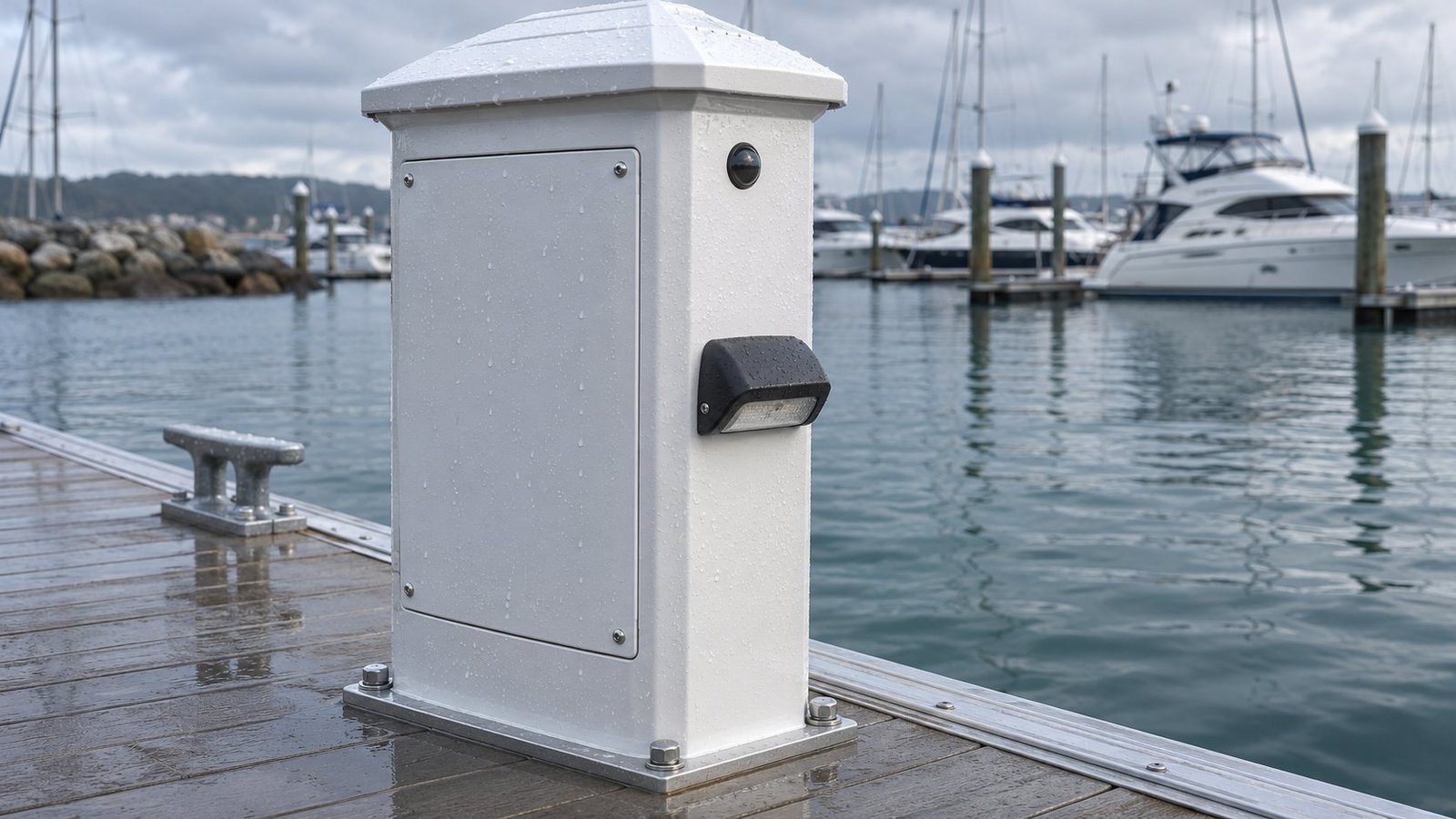
Select a dock-lighting photocell by the complete installation, not a “marine” label. Check electrical compatibility, mounting and sealing, salt exposure, condensation, UV and the sensor’s view of daylight. Then validate the exact order code with the intended LED driver and assembled enclosure.
Start with a written exposure profile
A covered marina pedestal and an exposed dock luminaire may experience different water paths, cleaning practices and sunlight. Describe where the control sits, whether the sensor penetrates the enclosure, and whether salt-laden air can reach terminals or internal hardware. Include installation orientation and the maintenance access expected over the product’s service period.
Convert that description into test requirements. Ask who owns the test plan, what assembly will be tested and what constitutes a pass. Avoid importing a salt-spray duration or service-life number from a different model or component.
Water ingress, condensation and corrosion are separate questions
| Exposure | Engineering question | Evidence to request |
|---|---|---|
| External water | Can water enter through the sensor opening, cable entry or enclosure joints? | Applicable IP documentation, exact tested assembly and mounting conditions |
| Internal condensation | Can humid air and temperature changes create moisture inside the pedestal? | System design review and agreed humidity/temperature validation |
| Salt-related corrosion | Which exposed materials and electrical paths are at risk? | Project-specified corrosion test method, sample identity and acceptance criteria |
| UV and temperature | Are the lens, housing, gasket and wiring appropriate for the exposure? | Exact material and component documentation, with assembly validation where required |
An IP rating concerns specified ingress tests; it is not a corrosion rating or a guarantee against condensation. A salt test on one metal part is not a lifetime claim for a complete photocontrol. Keep each piece of evidence attached to its actual scope.
Check the LED driver, not only the nominal wattage
Identify the driver supply and frequency, operating current, inrush characteristics and the number of drivers switched together. A rating stated for a different lamp technology is not enough to approve an LED installation. Request the selected photocontrol’s applicable LED-load information or agree on a switching validation plan.
Also define the required failure behavior. The preferred state depends on the equipment design and operator’s requirements; a generic label such as fail-on is not a substitute for evaluating the actual circuit and maintenance procedure.
Review the mounting stack as a system
Check panel thickness, opening dimensions, thread engagement, gasket contact, fastener arrangement, body clearance and lead exit. A rain cap may be an option on a model, but its presence does not establish the environmental rating of the finished pedestal. Specify what is included in the sample and what must remain unchanged for production.

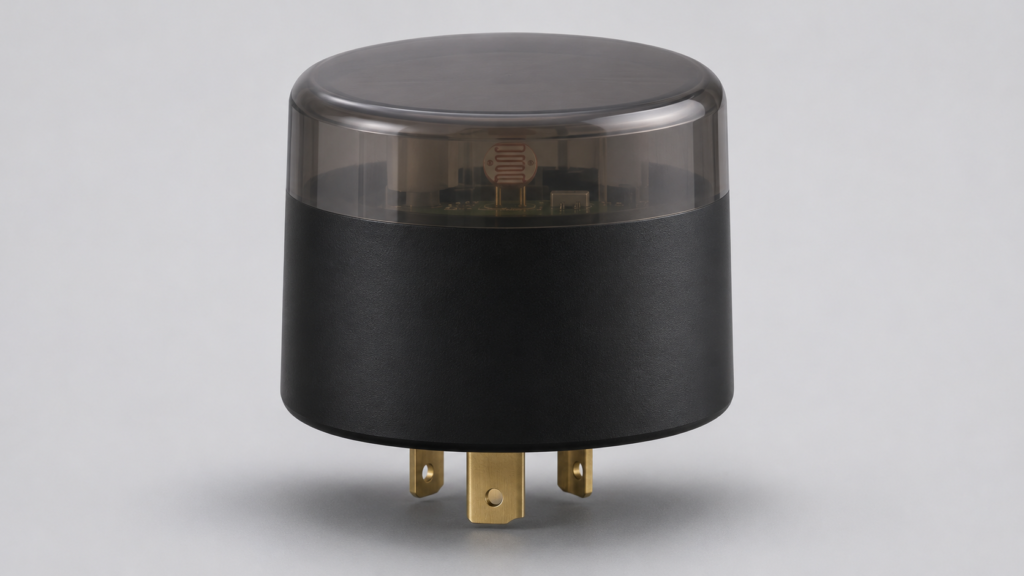
JL-104A
Swivel photocontrol candidate when the sensing direction must be adjusted. Check the mounting envelope and exact voltage version.
Plan an optical test in the final enclosure
Look for direct light from the controlled LED, reflections from light-colored panels, nearby pedestal lights and shadows from covers or vessels. Test the sensing direction with the equipment assembled. Review on/off thresholds, hysteresis and delay from the exact model documentation. A timing change should not be used as the only remedy for a sensor that sees its own light.
A practical sample-approval checklist
- Freeze the sample order code, datasheet revision, drawing and LED-driver identification.
- Review supply and switching duty with qualified electrical personnel.
- Check the installed mechanical fit, service access and potential water paths.
- Observe dusk/night/dawn behavior and artificial-light interference.
- Run the agreed environmental and switching tests with documented acceptance criteria.
- Record deviations, approve the final configuration and define production inspection points.
What should a supplier provide?
Request current drawings, electrical information, material or environmental documents applicable to the configuration, and the scope of any certification being proposed. If a required report is unavailable, record the gap and agree on testing before a purchase decision. Do not replace missing evidence with a broad “marine-grade” statement.
Can a swivel solve every sensing-position problem?
No. It provides a mounting option, while the final field of view, clearance, sealing and light-feedback behavior still need evaluation.
Can an existing street-light photocell be a dock-lighting candidate?
It may be a starting point if its function and installation fit. Suitability for a particular coastal application must be established separately.
Request an OEM Photocell Solution
Tell CHI-SWEAR about your pedestal or luminaire, destination country, operating voltage, LED driver, mounting space and estimated annual quantity in pcs. Include the environmental tests your project requires. We will review candidate configurations and the documentation needed for a sample evaluation.
Start a marina OEM inquiryUse the existing contact form →Discuss sample availability, MOQ, customization scope and lead time for the exact configuration. These are quotation-specific, not fixed promises.
A photocontrol in this application controls a lighting circuit. It is not a shore-power charger, protective device or certification of the complete pedestal. Integration and testing must be reviewed by the equipment manufacturer and qualified electrical personnel.



One Response