

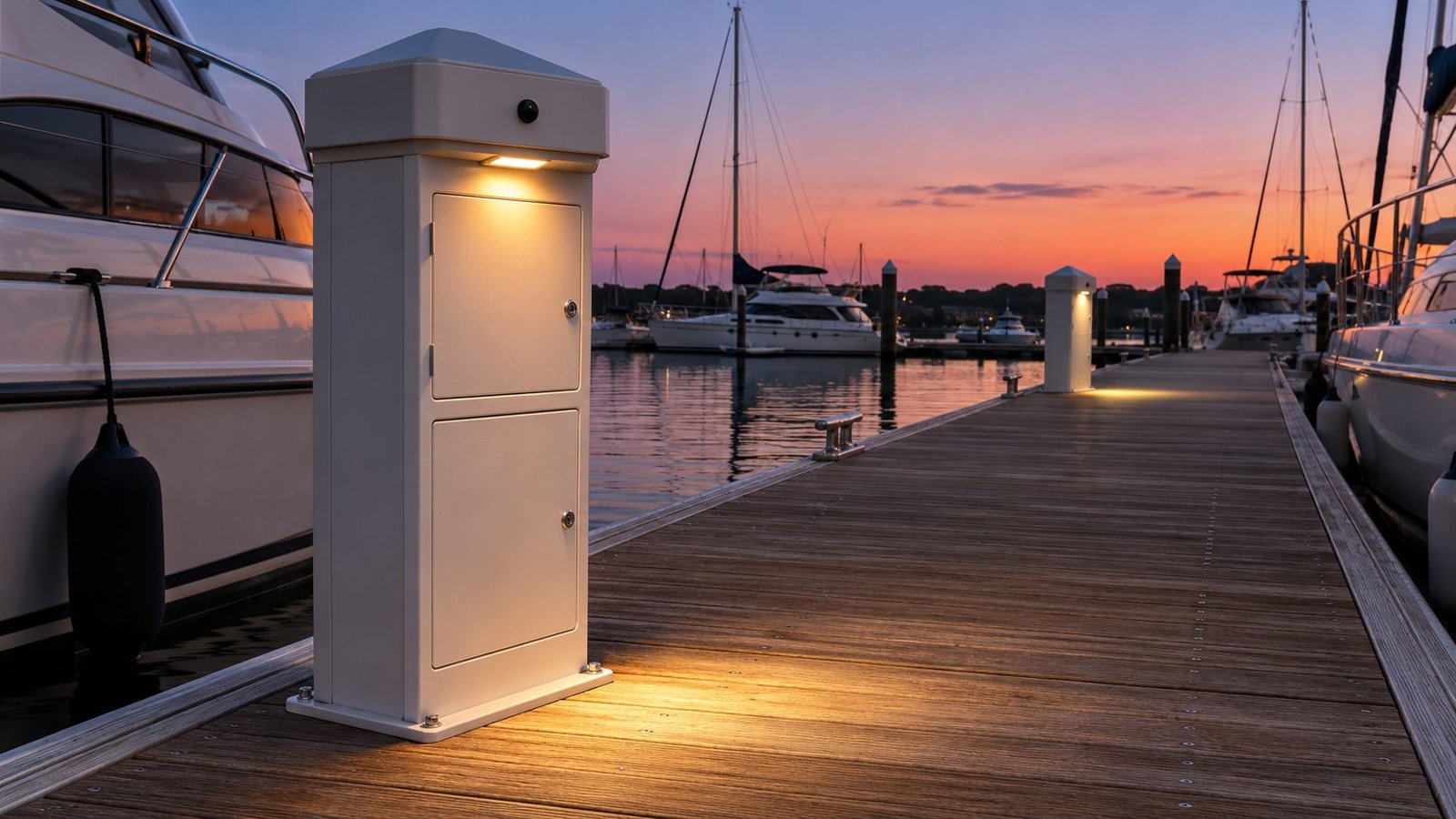
Why use a photocell in a marina power pedestal? A photocell can operate the pedestal’s designated LED lighting circuit according to ambient light, helping the connection area remain visible after dark without a daily manual switching routine. Whether control is local or centralized depends on the pedestal design, dock layout and maintenance requirements.
The lighting function is separate from shore power
Power pedestals bring electrical connections close to a vessel. Lighting has a different role: illuminating the connection area or making the equipment easier to locate at night. A light-sensitive switch serves that lighting function. It is not a charger, ground-fault protection device or substitute for the pedestal’s protective circuitry.
There is an established commercial application: Eaton’s Lighthouse product literature describes photocell-controlled LED lighting. This is evidence that the application exists, not evidence that LONG-JOIN supplies Eaton or that any candidate below fits its products.
What changes when switching follows daylight?
Ambient-light control responds to local light conditions rather than a fixed daily switch time. That can be useful when seasonal daylight or weather affects when the area becomes dark. The equipment specification still needs to define what happens during low daylight, temporary light exposure and a control failure. There is no universal operating schedule or saving percentage.
For an OEM, the practical benefit is an automatic lighting feature that can be designed into the product. For an operator, service access, predictable behavior and an identifiable replacement configuration are as important as the on/off function.
Local photocontrol or centralized lighting control?
| Question | Local control at a pedestal | Central control for a lighting circuit |
|---|---|---|
| What does the sensor observe? | The light at its own mounting position | The light at a shared reference location |
| What needs testing? | Panel fit, internal LED feedback and local shadows | Shared circuit design, total switching duty and driver inrush |
| What determines serviceability? | Access to the individual component and its wiring | Access to the shared controller and circuit arrangement |
Neither approach is automatically better. A shaded pedestal may behave differently from a sunny reference sensor. The OEM should choose the topology that matches the required lighting behavior and maintenance strategy.
Where can a compact photocell fit?
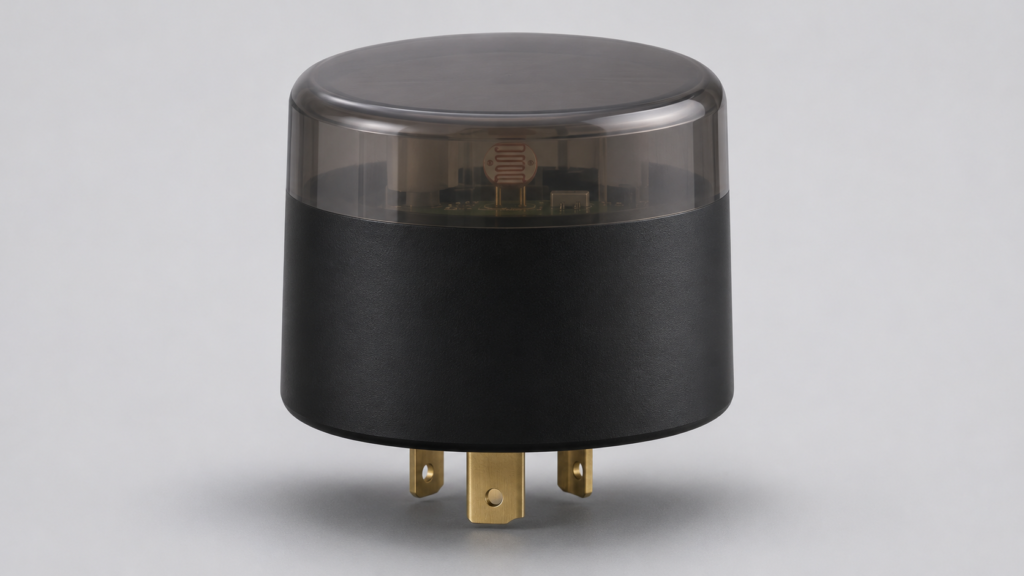
A panel-mounted button-type unit is one candidate when the enclosure provides an appropriate opening and space for the body, gasket, fastener and leads. A swivel design may help an engineer orient the sensing window. Mounting options do not remove the need to test moisture paths or light feedback in the assembled unit.

JL-103 family
Traditional button-type direct wire-in thermal photocontrol. Specify the complete order code; confirm the JL-103A variant against its datasheet.
Why light feedback matters more than it first appears
Imagine an LED illuminating the sensing window after dark. The control may interpret its own light as daylight, turn the circuit off, then see darkness again. The exact result depends on the control logic and installation. Reflections from a glossy panel, an adjacent pedestal or a bright vessel light can also influence operation.
Review the sensor’s view before freezing the enclosure design. In a prototype, observe the complete assembly through realistic dusk/night/dawn conditions. Confirm the exact model’s delay and switching behavior rather than assuming all photocells behave alike.
Information to collect before selecting a model
- The lighting-circuit supply, frequency and LED-driver identification.
- Driver input current and inrush information, not only LED wattage.
- Panel drawing, opening, mounting depth and proposed sensing direction.
- Expected environmental exposure and required test evidence.
- Target country, sample quantity and estimated annual demand in pcs.
Quick buyer answers
Can one photocell control several pedestal lights?
A shared control arrangement can be considered, but the complete load and switching architecture must be engineered. Do not connect multiple drivers based solely on a photocell’s general lamp-load rating.
Does automatic switching prove energy savings?
No. A saving claim needs a defined baseline, operating hours, measured power and test period. This application guide makes no saving-percentage claim.
Request an OEM Photocell Solution
Tell CHI-SWEAR about your pedestal or luminaire, destination country, operating voltage, LED driver, mounting space and estimated annual quantity in pcs. Include the environmental tests your project requires. We will review candidate configurations and the documentation needed for a sample evaluation.
Start a marina OEM inquiryUse the existing contact form →Discuss sample availability, MOQ, customization scope and lead time for the exact configuration. These are quotation-specific, not fixed promises.
Application reference: Eaton Lighthouse power pedestal — manufacturer product information. This independent industry example demonstrates an application, not a CHI-SWEAR customer relationship, endorsement or product compatibility claim.
A photocontrol in this application controls a lighting circuit. It is not a shore-power charger, protective device or certification of the complete pedestal. Integration and testing must be reviewed by the equipment manufacturer and qualified electrical personnel.



2 Responses