

Quick answer. No. UL Recognition confirms that a component has been evaluated to applicable requirements under specified conditions of acceptability, so that it can be built into a larger product that will itself be certified. It is not a statement that the component has met every mechanical, electrical and environmental criterion your programme requires. A NEMA photocontrol base can be UL Recognized and still fail a 200-cycle durability requirement, a 30 K temperature-rise limit or a corrosion test — because those may never have been part of the certification. Buyers have to verify the scope of the certification and evidence the additional requirements separately.

What Does UL Recognized Component Actually Mean?
UL Solutions describes component recognition as certification for components and subassemblies intended to be built into a larger, UL Certified (Listed) end product. The purpose is practical: it allows an end-product manufacturer to use pre-tested components and so simplify the path to certifying the finished product. As UL states plainly, component recognition “is not a certification for a complete, standalone product.”
Two features of that definition carry the most weight for a lighting-control OEM. The first is the Recognized Component Mark itself, which is distinct from the UL Listed Mark — a stylised backward “R” and “U”, not enclosed in a circle, with variants for the United States, Canada, and both together. The second, and the one that causes most procurement problems, is conditions of acceptability. Components are evaluated under specific conditions that dictate how they must be used inside the final product — the type of housing, wiring, temperature limitations and similar constraints. UL notes that using a component outside those conditions can void the certification.
For a photocontrol base, this means the certification attaches to the component as evaluated, in the context of how it may be installed. It does not travel automatically to a different assembly, a different enclosure, a different wiring method or a different load.
What Is the Difference Between UL Recognized and UL Listed?
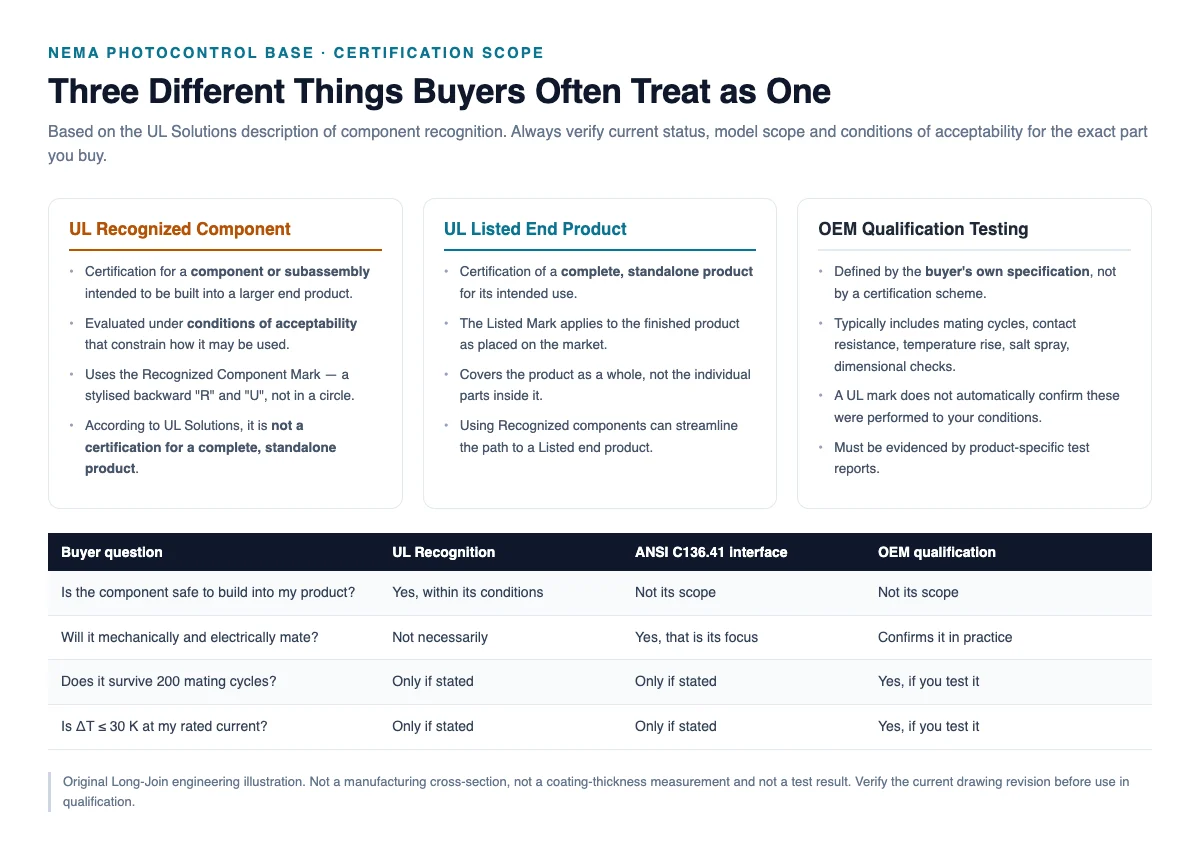
| Dimension | UL Recognized Component | UL Listed product |
|---|---|---|
| Certification purpose | Confirm a component or subassembly complies with applicable requirements so it can be built into a larger product | Certify a complete, standalone product for its intended use |
| Product scope | A part, assembly or material — not a finished appliance | The finished product as placed on the market |
| Intended integration | Designed to be incorporated; the end product is what carries the listing | Used as supplied, installed per its own instructions |
| Conditions of acceptability | Central: the component is approved only within stated conditions, and use outside them can void the certification | The product is evaluated as a whole against its standard; installation requirements apply |
| Mark | Recognized Component Mark — stylised backward “R” and “U”, not in a circle | UL Listed Mark, in a circle |
| Buyer documentation review | Check file scope, exact model, ratings and conditions of acceptability | Check the listing covers the product and its ratings as supplied |
A small precision point that matters in contracts and specifications: “UL Approved” is not a certification category. Use “UL Recognized Component” or “UL Listed”, and name the file and the model. A specification that says “must be UL approved” is not verifiable, and a supplier answering “yes” to it has answered nothing.
Does UL Recognition Automatically Confirm Every Reliability Test?
No, and the gap is easiest to see with the requirements an OEM typically adds on top. Take three common ones: a 100 or 200 cycle mating-durability requirement, a temperature-rise limit of 30 K at a specified current, and a salt-spray exposure. Each of these is an OEM qualification requirement. Certification may or may not have evaluated an equivalent characteristic, under possibly different conditions, to possibly different limits.
The distinction is between the conditions attached to the certification and the conditions of your application. If your assembly puts the base in a sealed housing at a higher ambient temperature than the conditions of acceptability allow, the certification does not cover that arrangement — regardless of what mark appears on the part. If your customer requires 200 mating cycles and the certification evaluated a different durability characteristic, the requirement is open.
Practically, this means the certification answers “may I build this in?” and the qualification programme answers “will it work in my product, in my environment, for my service life?” Both are needed, and neither substitutes for the other.
What Does ANSI C136.41 Establish?
ANSI C136.41 addresses the interface between external locking-type controls and roadway or area luminaires for dimming and related functions. Its published scope covers mechanical, electrical and marking aspects of that interface, includes 0–10 V and DALI dimming protocols, and incorporates applicable ANSI C136.10 requirements unless specifically superseded. The 2025 edition is the current published revision.
Two clarifications prevent common mistakes. First, C136.41 is an interface standard: it defines how the control and the luminaire connect and interoperate. It is not a product certification and it is not issued by UL. A product can be described as conforming to the interface requirements while its certification status is a separate question. Second, C136.10 remains relevant — the locking-type photocontrol standard — and C136.41 builds on it rather than replacing it wholesale.
What C136.41 does not do is set a universal mating-cycle count, a universal contact-resistance limit or a universal salt-spray duration for every base on the market. Those are product or customer requirements. Buyers who need them must specify them.
How Can Buyers Verify a Component’s UL Certification?
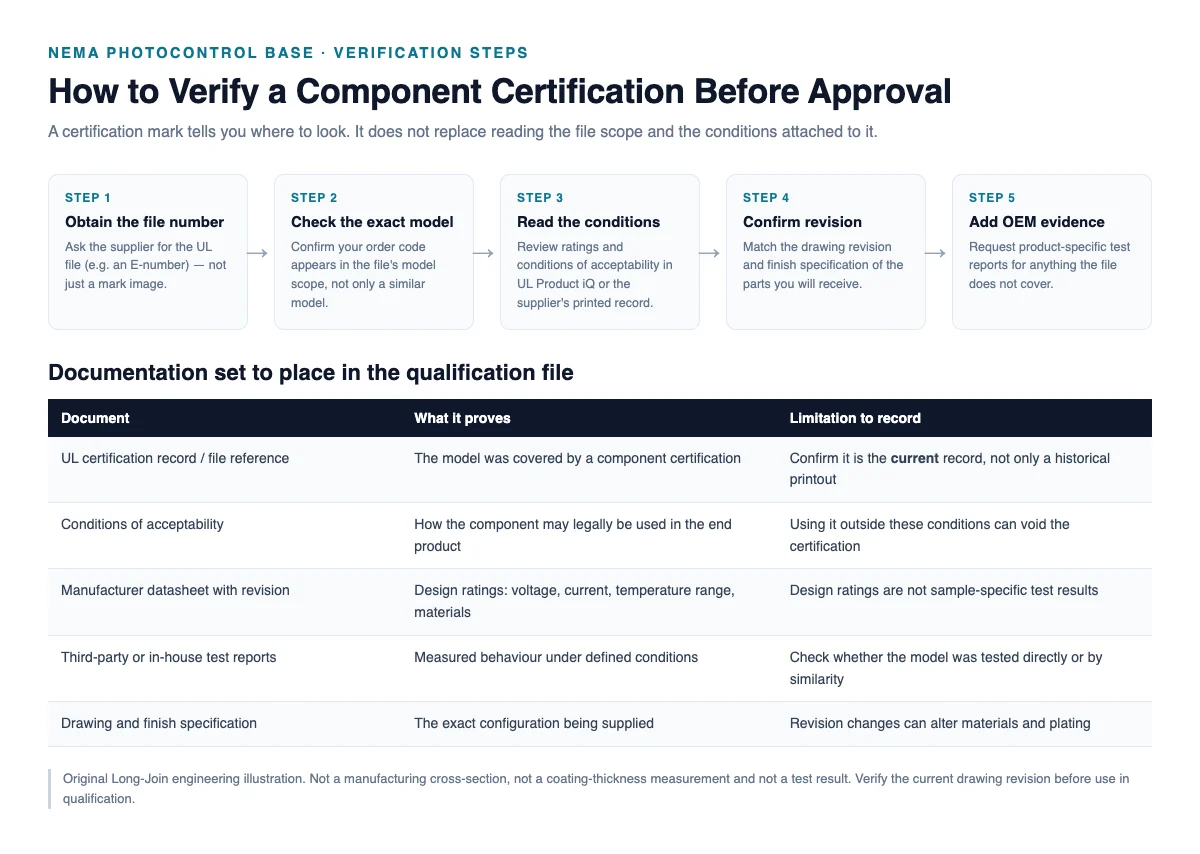
Check the UL File Number
Ask for the file reference itself, not a picture of a mark. A file number is traceable; a logo on a datasheet is not. Record it in your qualification file together with the date you checked it, because certification records change and a check performed two years ago is not a current check.
Confirm the Exact Model or Product Family
Product families often contain several configurations differing in pin count, contact arrangement, ratings and materials. Evidence for one configuration does not transfer automatically to another. Confirm that the model you intend to order — not a similar sibling — appears in the scope, and ask the supplier to state explicitly whether your order code is covered.
Review Ratings and Conditions of Acceptability
UL Product iQ, UL Solutions’ online database, allows manufacturers and designers to find recognized components and review their specific conditions of acceptability. Read those conditions against your actual assembly: housing material, wiring, temperature, mounting. This is the step where most integration problems are found before they become field problems.
Check Product Revision and Intended Application
Certification attaches to a design. If the drawing revision, the material or the finish has changed since the record you are reading, the record may no longer describe the part you will receive. Ask for the revision that the certification corresponds to, and compare it with the drawing on your purchase order.
Which Additional Tests Might an OEM Require?
| Additional requirement | What it verifies | Typically required when |
|---|---|---|
| Mating durability | Contact and locking performance after repeated cycles | Controllers are serviced or replaced in the field during life |
| Contact resistance | Interface resistance, initial and after conditioning | Signal integrity or thermal margin is critical |
| Temperature rise | Heating at rated current in the intended mounting | The assembly is sealed or the ambient is high |
| Salt spray / corrosion | Finish resistance to a corrosive atmosphere | Coastal, industrial or high-humidity deployment |
| Dimensional inspection | Interface dimensions against drawing | Mating with a receptacle from another supplier |
| Mating compatibility | Behaviour of the actual base and receptacle pair | Always — the interface is a system, not a part |
Whether any given item is a certification requirement depends on the specific standard and the product’s scope of evaluation. It should never be assumed from the presence of a mark.
JL-241J as a Practical Supplier Evaluation Example
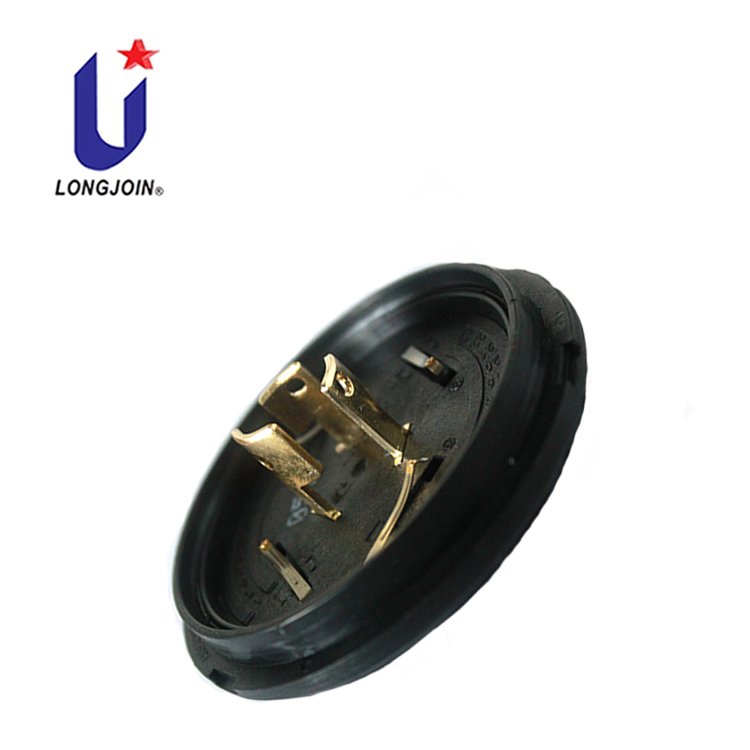
The JL-241J NEMA 7-pin base is documented by Long-Join with PBT base material, a power interface rating of maximum 480 Vac at 50/60 Hz and 15 A rated loading, a signal circuit rating of 0–30 Vdc at 250 mA, an operating range of −40 °C to +70 °C, and a sealing arrangement that must match the approved assembly drawing. It is offered against the ANSI C136.41 interface.
On certification documentation, the position is deliberately conservative. Long-Join holds a historical UL directory record, printed 26 March 2019 and updated 20 February 2019, which includes JL-241J and JL-241JF under file reference WJFX2.E188110. That record establishes historical model inclusion only. It does not, on its own, establish current online status, current model scope or the conditions of acceptability attached to the current design revision. Those must be confirmed against the live record for the exact order code before approval — which is precisely the verification sequence described above, and it is the buyer’s step to complete or to request formally.
This article does not certify current certification status, does not reproduce a certificate, and does not claim that the product has passed any test for which a report has not been provided. Product information: JL-241J NEMA photocontrol base.
Frequently Asked Questions
Is UL Recognized the same as UL Listed?
No. Recognized applies to components and subassemblies intended to be built into a larger product that will itself be certified; Listed applies to a complete, standalone product. They use different marks, and component recognition carries conditions of acceptability that constrain how the part may be used. UL describes component recognition as not being a certification for a complete, standalone product.
Does UL Recognition guarantee 200 mating cycles?
No. A cycle count of 100 or 200 is normally a customer qualification requirement, not a characteristic established by component recognition. Unless the certification documentation itself states a durability rating at that value — which is unusual — the requirement must be evidenced by a product-specific test report under your own acceptance criteria.
How do I verify a photocontrol base UL file?
Ask the supplier for the file reference and the exact model coverage, then look it up in UL Product iQ (or request the supplier’s current record) and read the ratings and conditions of acceptability. Confirm that the drawing revision you will receive matches the one the record covers. Record the date of the check — certification records change.
Is ANSI C136.41 compliance the same as UL Recognition?
No. ANSI C136.41 is an interface standard covering mechanical, electrical and marking aspects of the connection between an external locking-type control and a luminaire, including dimming protocols. UL Recognition is a component certification process. A product can conform to an interface standard and hold a certification; the two are separate claims with separate evidence.
What documents should an OEM request before approving a base?
The drawing and revision for the exact order code; the UL file reference with current model scope and conditions of acceptability; the manufacturer datasheet with revision; test reports for the durability, resistance, temperature-rise and corrosion requirements in your specification, each containing method, conditions, sample quantity, acceptance criteria and measured values; and written confirmation of the material and finish specification for the revision being supplied.
Key Takeaways
UL Recognition tells you a component may be built into a product that will be certified; it does not tell you the component meets your reliability requirements. Conditions of acceptability are part of the certification, not a footnote, and use outside them can void it. ANSI C136.41 defines the interface, not the certification. The verification sequence is short and mechanical: obtain the file reference, confirm the exact model, read the ratings and conditions, match the drawing revision, then evidence anything left open with product-specific test reports. For the JL-241J, the documented position is historical model inclusion in a UL directory record — useful as a starting point, insufficient as current proof, and exactly the kind of item a buyer should close out before volume approval.
Request JL-241J certification and engineering documentation.
Send us your order code and application details. We will return the available documentation for that exact configuration and state clearly which items require verification against the current record.
- Order code, pin configuration and required revision
- Intended end product and installation environment
- Certification and standard requirements of your programme
- Additional test requirements and acceptance limits
- Project timeline and expected annual volume
References and Technical Sources
- UL Solutions — The UL Component Recognition Classification — official definition of component recognition, the Recognized Component Mark, conditions of acceptability and the UL Product iQ database.
- UL Solutions — Components certification services — programme scope.
- ANSI C136.41-2025 — interface requirements for external locking-type controls and roadway or area luminaires.
- Long-Join JL-241J product page — product configuration and published features.
- How to Evaluate the Reliability of a NEMA Photocontrol Base Before Bulk Purchasing — pillar guide.
- What Tests Should a NEMA Photocontrol Base Pass? — test methods and report review.




One Response