

Last updated: 13 November 2026 · Long-Join technical marketing team, Shanghai
Most luminaire makers spend weeks qualifying a photocontrol and a few minutes choosing the receptacle it plugs into. That ratio is backwards. The receptacle is the part you cannot change after the housing is tooled and approved: it fixes which controls fit your fixture for the next decade, what your service crew can swap in the field, and whether a future smart-city node plugs in or requires a new luminaire. This guide is written for luminaire OEMs, contract manufacturers and lighting distributors who are sourcing the socket itself — and want to qualify the manufacturer, not just compare unit prices.
Key takeaways for receptacle buyers
- The receptacle sets the interface for the life of the housing: ANSI C136.10 (3-pin), ANSI C136.41 (5-pin / 7-pin), or a proprietary mount. Choose the standard, not the cheapest mould.
- Three datasheet rows predict field problems better than price: base material, contact material, and how the joint is sealed.
- Ask for the certification file number and check it yourself in the certifier’s public database — it takes two minutes and eliminates most or-equal risk.
- Request dimensional drawings before tooling, not after: gasket compression, wire exit and mounting-hole geometry are where third-party parts fail to interchange.
- A supplier that revisions its datasheets and answers dimensional questions in writing is a supplier that still has engineering behind the catalogue.
Check 1 — Does the interface match the standard, dimensionally?
“NEMA socket” is a family, not a single part. The three interfaces your fixture will meet in the field:
| Interface | What it carries | Typical use |
|---|---|---|
| ANSI C136.10, 3-pin twist-lock | Line, neutral, load — dusk-to-dawn switching only | Standard street lighting, area and decorative fixtures |
| ANSI C136.41, 5-pin | Switching plus 0–10 V dimming pair | Curfew dimming, energy-saving programmes |
| ANSI C136.41, 7-pin | Switching, dimming and a low-voltage signal path | Smart-city nodes, connected luminaires |
Compliance is dimensional before it is electrical. Two receptacles can both claim C136.41 and still differ in gasket thickness, thread depth or wire-exit position — and a control that locks into one will sit proud, seize, or leak in the other. Ask for the drawing package with tolerances (ours is issued per variant, for example the JL-240 series 5-pin receptacle drawing below), and check three things against your housing:
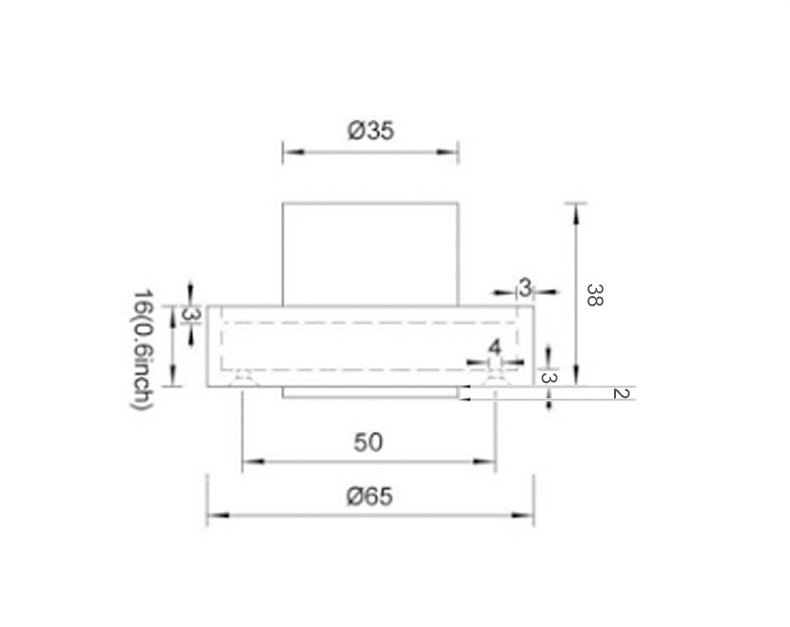
- Gasket compression: the sealing ring must compress against your housing surface, not a reference plane in the catalogue.
- Mounting geometry: hole spacing, screw bosses and the wire exit must clear your internal driver and heat-sink layout.
- Mating depth: the control must seat fully, with the locking detent engaging — a partly-seated control is an IP failure waiting for the first storm.
Check 2 — What are the base and cover actually moulded from?
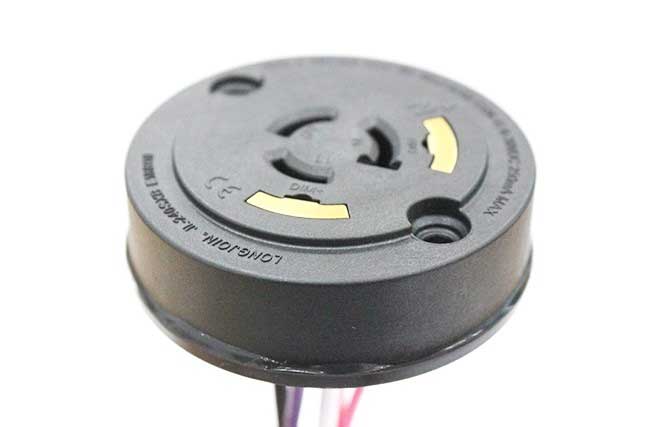
This is the single most common place to hide cost, because two receptacles that look identical from outside can differ entirely in resin. Long-Join moulds the base from PBT and the cover from PP, for reasons that matter outdoors: PBT holds dimensional stability and dielectric strength across the temperature range a black housing sees in summer, and resists the creep that lets contacts drift out of alignment. PP gives the cover toughness and UV resistance at the impact points.
What to ask a prospective manufacturer:
- Which resin, by grade, and who supplies it? “Engineering plastic” is not an answer.
- Is the resin UV-stabilised for outdoor exposure, and is there a weathering test report?
- Is regrind used, and at what percentage? Regrind is normal in many moulding shops — undisclosed regrind in a structural base is not.
Check 3 — Contact material and plating, declared in writing
Current-carrying contacts are the second place cost hides. The difference between a brass contact system and a bare-copper or thin-plated substitute shows up two or three summers later as heat rise, pitting and intermittent switching — the failure mode that has crews re-visiting the same pole. Long-Join’s 7-pin base, the JL-241J, uses H62 brass for its contacts; the material declaration is on the datasheet, and we will put the same declaration in a bid annex.
Ask for: base metal, plating (if any) and thickness, contact resistance target, and the switching-endurance test the part was qualified to. Then compare that sentence across suppliers. A manufacturer that cannot name its contact alloy does not control its own bill of materials.
Check 4 — How is the joint sealed, and does it breathe?
Water ingress is the classic outdoor failure, but the subtle version is condensation: a perfectly sealed housing that traps humid air will fog the control’s lens from the inside and drift its switching threshold. The engineering answer is a waterproof and breathable membrane — the construction used on the JL-242JV base, which equalises pressure while blocking liquid water.
Qualification questions that separate real sealing from a rubber ring and hope:
- What IP rating is claimed — and is it claimed for the receptacle alone, or for the mated pair with a control installed? The mated figure is the one that matters on a pole.
- Is there a pressure-equalisation path, and how is it protected from jet wash?
- Gasket material and hardness, and whether it is specified to survive the local UV and temperature cycle.
Check 5 — Can you verify the certification yourself?
Every serious receptacle supplier should hand you a file number you can look up in the certifier’s public database in two minutes. Long-Join’s UL file is WJFX2.E188110; the same discipline applies to CE and CB declarations, which should name the standard, the test lab and the report number. A file number you cannot verify is a marketing claim, not a certification.
Practical tip: put the file number in your supplier qualification sheet and re-check it annually. Certifications get delisted when a factory changes a component without telling the certifier — and that change usually lands on the cheapest part in the assembly.
Check 6 — Mating life and production consistency
A receptacle is a mechanical part: it is twisted, locked, unlocked and twisted again every time a control is replaced. Ask for mating-cycle test data, and ask how the factory holds dimensions across a production run:
- Is there a documented first-article inspection (FAI) and a sampling plan per lot?
- Which dimensions are checked on the line, and with what gauge — go/no-go, or a caliper reading recorded per lot?
- How are lots traced? If a housing batch fails in the field, can the supplier tell you which mould and resin lot it came from?

Check 7 — Does the supplier behave like an OEM partner?
The receptacles on your housing will be branded as your product. Judge the supplier on OEM behaviour, not catalogue breadth:
| Signal to look for | Why it matters to a luminaire OEM |
|---|---|
| Datasheets carry a revision number and date | You can prove which specification your approval was based on |
| Drawings and material declarations supplied before order | Your own certification submission does not stall waiting on documents |
| Private-label marking, base colour and lead length offered as options | The part becomes your part in the field, with your service documentation |
| Quoted MOQ and lead time confirmed in writing per variant | Purchasing can plan tooling and safety stock without renegotiating per batch |
| Sample order with the exact production variant, not a “similar” one | What you approve is what you will receive at volume |
That last point is where most OEM programmes quietly fail: the sample is approved, the volume part differs in gasket or plating, and the difference is only discovered by a service crew two seasons later. Insist that the sample carries the datasheet revision you will be buying.
Quick model shortlist for this guide
From this article straight to selection — free datasheets; unit price, MOQ and lead time within 24 hours.
| If this is your situation | Start with this model | Datasheet |
|---|---|---|
| Standard 3-pin twist-lock receptacle, UL / CE / CB listed | JL-240XA-14 3-pin receptacle | Library → |
| Compact 3-pin receptacle for smaller housings | JL-200X NEMA 3-pin receptacle | Library → |
| ANSI C136.41 5-pin dimming receptacle | JL-240SXB 5-pin dimming receptacle | Library → |
| 7-pin base for smart-city nodes, H62 brass contacts | JL-241J 7-pin base | PDF → |
| 5/7-pin base with waterproof and breathable membrane | JL-242JV base | PDF → |
Frequently asked questions
Is a 3-pin receptacle enough for a smart-city project?
Not on its own. A 3-pin interface carries switching only; connected nodes need the low-voltage path that the 5-pin and 7-pin variants of ANSI C136.41 provide. If connectivity is on your roadmap within the housing’s life, tool for 7-pin now — the receptacle is the one part you cannot retrofit cheaply.
Can we mix receptacles and controls from different manufacturers?
That is the entire point of the standard interface, and it is what keeps your aftermarket competitive. What you must verify is the dimensional drawing and the mated IP rating, because “compliant” parts from different suppliers can still differ in gasket compression and seating depth.
What should we ask for before placing a first order?
A dimensional drawing with tolerances, the material declaration for base/cover/contacts, the UL file number (ours is WJFX2.E188110), the mated IP rating, a production-variant sample, and written MOQ and lead time. Five documents, one sample, two weeks of diligence — against a decade of housing life.
Related reading on this site
- UL-listed photocells for luminaire OEMs: component choice as a certification decision — the control half of the same interface.
- How to choose the right Zhaga Book 18 base and housing for OEM projects — the alternative ecosystem, compared.
- Why smart-city projects are moving from 3-pin to 7-pin receptacles
- NEMA shorting cap vs open circuit cap: model and IP rating guide — what goes into an empty socket.
Qualifying a receptacle supplier now?
Send us four things — interface standard (NEMA 3-pin, ANSI C136.41 5/7-pin), your housing mounting constraints, annual quantity and target market. We reply within 24 hours with unit price, MOQ, lead time, dimensional drawings and the datasheet revision for the exact variant.
Private-label marking, custom lead length and base colour are quoted on request.
Request price, drawings & datasheet →
PDF datasheets → · Twist-lock product family → · NEMA socket range →


One Response