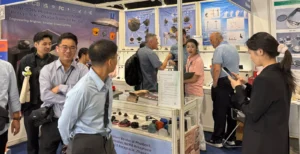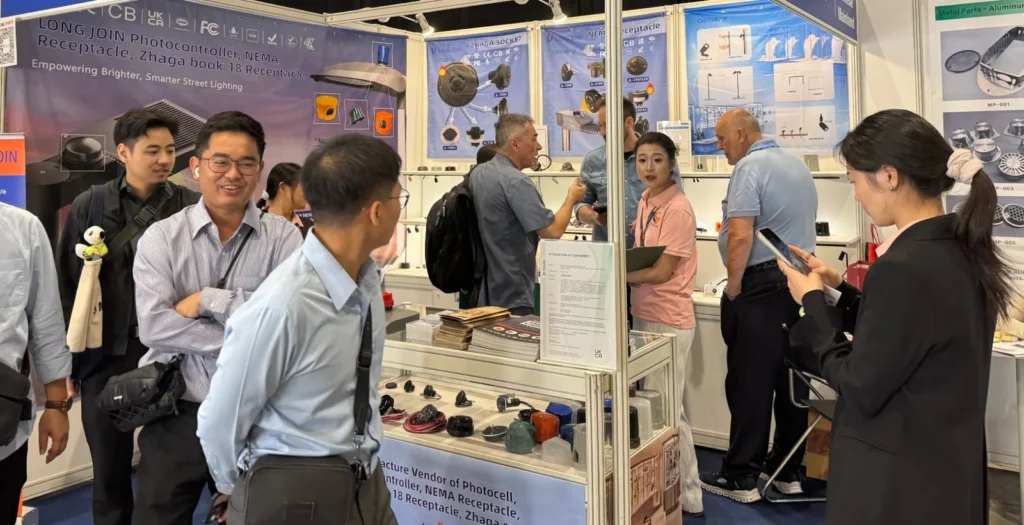
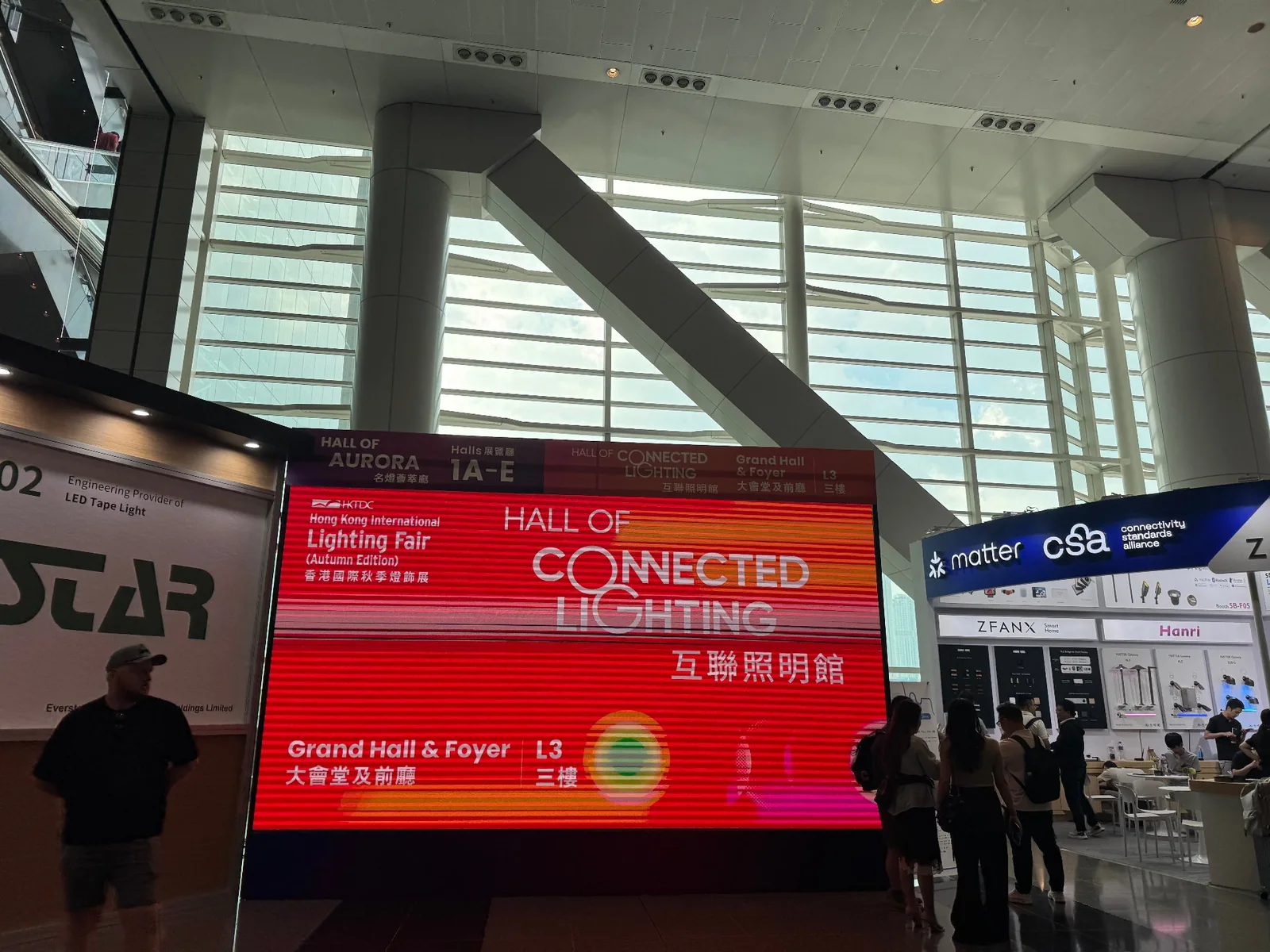
Hong Kong, 27–30 October 2026. The 28th Hong Kong International Lighting Fair (Autumn Edition) closed on 30 October together with the 11th Hong Kong International Outdoor and Tech Light Expo. Across the three co-located fairs — the two lighting events plus Eco Expo Asia — the HKTDC reported about 62,000 buyers from 152 countries and regions, with roughly 3,000 exhibitors from more than 20 countries taking part in the two lighting fairs.
For anyone buying outdoor lighting components, the useful signal was not the crowd size. It was the direction of the questions. Buyers arriving at the outdoor and technical lighting halls were asking about replacement cycles, interface compatibility, certification scope and the maintenance cost of a fixture over ten years. Those are procurement questions, and they point at the small parts inside a luminaire rather than the luminaire itself.
This article summarises what the 2026 fair actually showed, translates it into five trends worth tracking over the next 12–24 months, and then sets out how to evaluate a photocontrol supplier against those trends — including the specific electrical, certification and interface checks that decide whether a component survives its first winter in service.
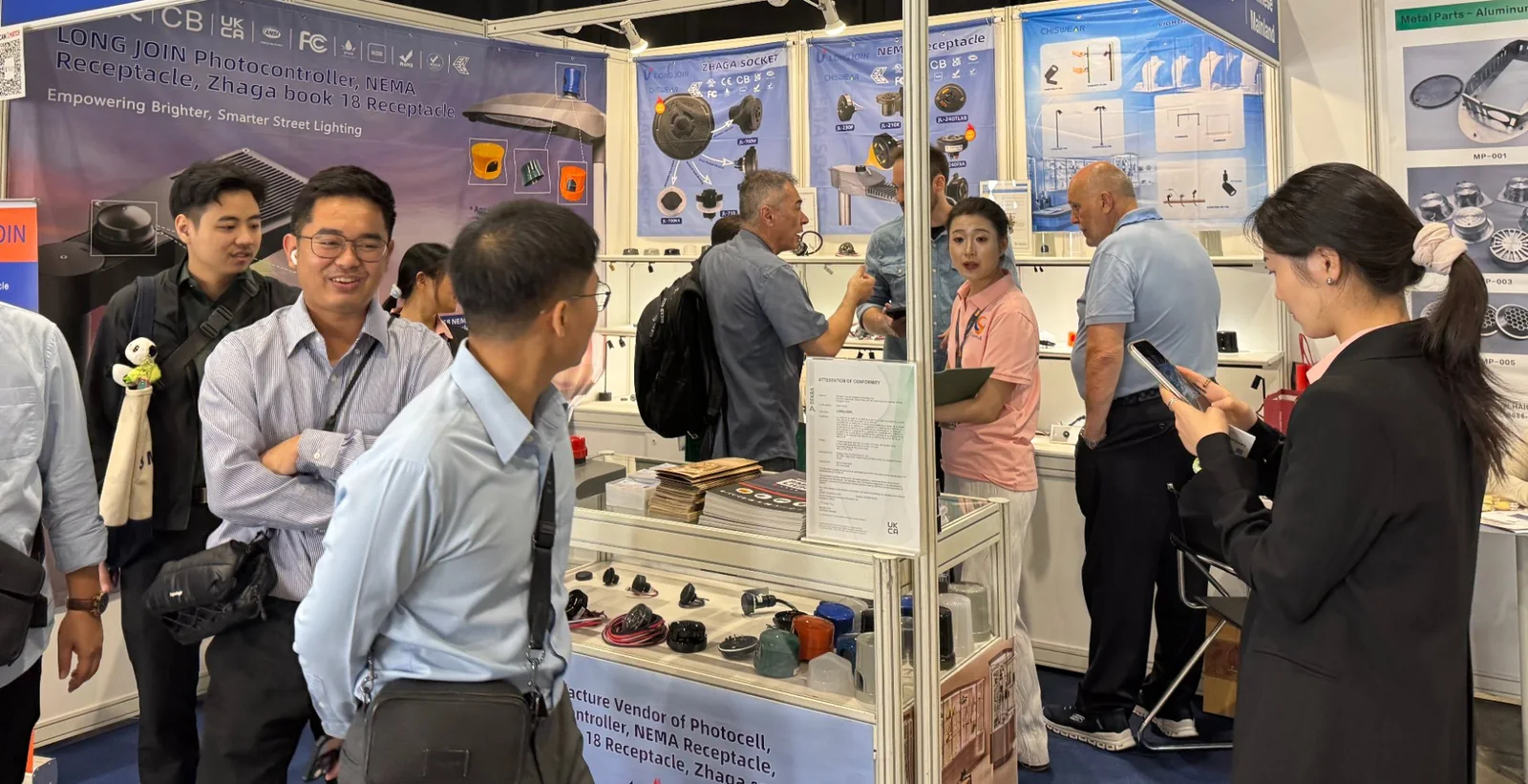
1. Hong Kong Lighting Fair 2026: Key Highlights and Market Takeaways
Exhibition overview
The Autumn Lighting Fair ran from 27 to 30 October 2026 at the Hong Kong Convention and Exhibition Centre as the 28th edition of the event. The Outdoor and Tech Light Expo, which carries the roadway, landscape, solar and smart-city categories, ran from 28 to 31 October at AsiaWorld-Expo. Splitting the two venues matters for buyers: the outdoor categories sit in a separate hall from decorative and indoor lighting, and the buyers who walk it are usually specifying for projects rather than retail ranges.
The HKTDC reported approximately 39,000 buyers at the Autumn Lighting Fair and more than 11,000 at the Outdoor and Tech Light Expo. Those two figures should not be added to the Eco Expo Asia attendance and quoted as a single lighting audience — the three events are separate shows held in the same week, and the 62,000 figure covers all three.
What the buyer survey suggests
An independent survey commissioned during the two lighting fairs, covering more than 740 exhibitors and buyers, found 63% expecting sales to increase over the next two years and 34% expecting sales to remain flat. The markets named as most promising were the Chinese Mainland at 85%, the Middle East at 84% and ASEAN at 84%. Artificial intelligence (54%), general technological advancement (44%) and smart city development (43%) were cited as the main growth drivers.
Read those numbers as sentiment, not forecast. They describe what exhibitors and buyers believed in late October 2026; they do not measure order volumes. What they do support is a practical planning assumption: buyers expect replacement and upgrade demand to continue, and they expect it outside the traditional North American and Western European core.
Product and technology directions on the floor
The fair theme was “Beyond Illumination”. The Hall of Connected Lighting gathered around 70 brands, and the outdoor expo added photovoltaic and energy-storage exhibits for the first time in 2026 — a sign that outdoor buyers are now evaluating power supply and lighting control as one package rather than two purchases. Alongside that, suppliers showed more modular fixture designs, replaceable optical and control modules, and a wider spread of IP ratings within the same product family.
| Exhibition signal | Verified evidence | Implication for buyers |
|---|---|---|
| International sourcing depth | Two lighting fairs with around 3,000 exhibitors from more than 20 countries; about 62,000 buyers from 152 countries across the three co-located fairs (HKTDC, 30 Oct 2026) | Component availability is not the constraint. Qualification discipline is what separates good and bad suppliers. |
| Buyer confidence | 63% of 740+ surveyed exhibitors and buyers expect sales growth over two years; 34% expect flat sales (HKTDC survey) | Plan for repeat replacement orders, not only one-off project purchasing. |
| Regional demand mix | Chinese Mainland 85%, Middle East 84%, ASEAN 84% named most promising markets (HKTDC survey) | Voltage variants and certification sets must be planned per destination, not per catalogue page. |
| Control and interface focus | Theme “Beyond Illumination”; Hall of Connected Lighting with about 70 brands; AI 54%, technology advancement 44%, smart city 43% as growth drivers | Control components are specified earlier, so interface decisions get locked in earlier too. |
| Outdoor energy scope | Outdoor and Tech Light Expo introduced photovoltaic and energy-storage solutions in 2026 | Outdoor buyers increasingly assess power, control and enclosure together. |
2. Five Outdoor Lighting Trends to Watch After Hong Kong Lighting Fair 2026
Trend 1: LED street lighting replacement continues to create component demand
Most municipal roadway conversion has moved past the first wave. What remains is a long tail: fixtures installed between 2010 and 2018 reaching end of warranty, retrofit programmes replacing only the luminaire head while keeping the existing pole and receptacle, and maintenance crews replacing failed controls on assets that will not be re-lamped for another decade.
Each of those activities consumes a photocontrol, a receptacle or a shorting cap. The demand is unglamorous and it is steady, and it is usually specified by the maintenance contractor rather than the original fixture manufacturer.
Trend 2: Maintenance cost is becoming a procurement criterion
A failed photocontrol looks like a cheap part. In service it is a bucket truck, two technicians, a traffic management permit and a warranty conversation. In dense urban networks the access cost per visit can exceed the component cost by an order of magnitude, which is why fleet operators increasingly evaluate the switching device on expected service life rather than unit price.
The practical consequence for buyers is that a quotation which is 30% cheaper per unit but produces repeat call-outs is more expensive than it appears. Ask suppliers for the failure mode they build to, and whether the unit fails ON or OFF, because the two produce very different maintenance tickets.
Trend 3: Standardised interfaces support replacement and later upgrades
Two interface families dominate outdoor lighting. The ANSI C136.10 locking-type receptacle is the North American default for twist-lock photocontrols, and ANSI C136.41 extends that family to dimming and control signals. Zhaga Book 18 defines a smaller interface used mainly in European and some Asian markets for pluggable sensor and controller modules.
Standardisation makes replacement predictable, but it does not make products interchangeable. A Zhaga Book 18 socket does not accept a NEMA twist-lock control, and within the NEMA family the pin count, dimming circuit and receptacle depth still vary. Verify the interface per fixture, not per category.
Trend 4: Buyers are checking certification scope and traceability
North American buyers increasingly ask for the UL 773 listing or recognition details for the exact model, not the series. European buyers ask for CE declaration and RoHS documentation. In both cases the useful question is what the certificate covers: a file number attached to a product family does not automatically extend to a new voltage variant or a new housing material.
Traceability has become part of the same conversation. Buyers want a batch or date code on the unit and a route back to test records, particularly where a utility or municipality audits the installation later.
Trend 5: Regional procurement requirements are diverging
North America. 120–277 VAC and 347 VAC configurations, UL 773 recognition, ANSI C136.10 interface, and a fail state that matches utility practice.
Europe. 230 VAC nominal operation, CE and RoHS documentation, and a growing interest in Zhaga Book 18 for new-build smart-ready luminaires, while existing stock continues to use twist-lock controls.
Middle East. High ambient temperature operation, UV-stable housings and dust-resistant sealing dominate; the survey’s 84% optimism about the region matches what exhibitors reported about project enquiries.
Latin America. Mixed 220 V and 277 V networks, wide voltage tolerance requirements, and procurement often split across multiple small orders rather than a single large tender.
3. Why Photocontrol Reliability Still Matters in Modern Street Lighting
Connected lighting gets the attention, but a large share of the installed base still needs a device that switches a circuit at dusk and off at dawn, with no gateway, no commissioning and no network subscription. That device has to work for a decade in a sealed enclosure exposed to sun, salt and temperature cycling.
A conventional photocontrol is the right answer when the requirement is a standalone, serviceable switch: a rural road, an industrial yard, a car park, a retrofit where the asset owner has no plans to add a control network. It is the wrong answer when the project genuinely needs per-luminaire metering or central fault reporting — and no supplier should pretend otherwise.
What makes the conventional device worth specifying carefully is its position in the failure chain. When a photocontrol fails, the fault appears as a dark fixture or a fixture burning at noon, and the diagnosis usually starts at the receptacle. Mechanical fit, sealing, contact material and surge handling decide whether that diagnosis ends at the component or escalates into the luminaire.
4. How to Evaluate a Reliable Photocontrol Supplier
Electrical compatibility
Start with the operating voltage and confirm the applicable range rather than the nominal figure; a 120–277 VAC unit that is expected to work on a 347 VAC circuit is a specification error that no amount of quality control will fix. Then check rated frequency, load rating in watts and VA, LED driver inrush current, surge immunity, switching thresholds in lux, time delay, and the fail state.
Inrush deserves particular attention. Modern LED drivers draw brief currents far above steady-state load, and a control rated only for resistive load can weld its contacts within months. Ask for the load table, not the headline wattage.
Product certification
Four documents answer four different questions. UL 773 addresses the safety of plug-in, locking-type photocontrols. ANSI C136.10 addresses physical and electrical interchangeability of the locking-type interface. CE is a declaration of conformity with applicable EU directives. RoHS addresses restricted substances.
None of them substitutes for another, and each one is model-specific. Request the certificate number and the covered model list, and check that the variant you are ordering appears on it.
Environmental protection
An IP rating describes ingress protection under test conditions, not long-term sealing performance. Ask about housing material and UV stabilisation, the operating temperature range, gasket and O-ring design, and how the base is sealed where the pins exit. A unit rated IP65 that is installed gasket-up on a coastal pole will behave very differently from the same unit installed under a canopy.
Production quality and consistency
Consistency is what a repeat order actually buys. A supplier worth qualifying can describe incoming inspection of contacts and housings, in-process checks on sealing and assembly, functional testing of switching thresholds and delay, batch traceability, and a change notification process for material or firmware changes.
Long-term supply and replacement support
Outdoor lighting assets live for 15–25 years. The supplier’s ability to ship the same control in year eight matters more than the price in year one. Confirm sample qualification, production lead time, replacement compatibility with earlier batches, availability of datasheets and test reports, warranty terms and the corrective action process when a batch fails.
| Evaluation area | What to request | Why it changes the decision |
|---|---|---|
| Electrical compatibility | Datasheet showing voltage range, frequency, load rating, inrush limit, surge immunity, on/off levels, time delay and fail state | A unit that trips on LED inrush turns into a maintenance item within a season. |
| Certification scope | Certificate number plus the exact model list covered | A family certificate does not automatically cover a new voltage variant. |
| Interface conformance | ANSI C136.10 or ANSI C136.41 conformance statement, as applicable | The wrong interface produces field rework, not a warranty claim. |
| Environmental rating | IP rating, housing material, UV stabilisation, operating temperature range | Sealing and UV behaviour decide service life in hot and coastal climates. |
| Quality system | Incoming inspection, in-process control, functional test coverage, batch traceability | Repeat orders must match the sample that was qualified. |
| Supply continuity | Lead time, MOQ, replacement compatibility, engineering change notification | A mid-project redesign costs more than any unit price difference. |
Need a component recommendation for a specific project? Send the voltage, load and interface details to our engineering contact page and we will reply with a suitable configuration and datasheet.
5. Long-Join Photocontrol Products for Outdoor Lighting Projects
The models below are current Long-Join production items. Specifications are taken from the published datasheets; check the datasheet for the exact variant you intend to order, because ratings differ between voltage versions within the same family.
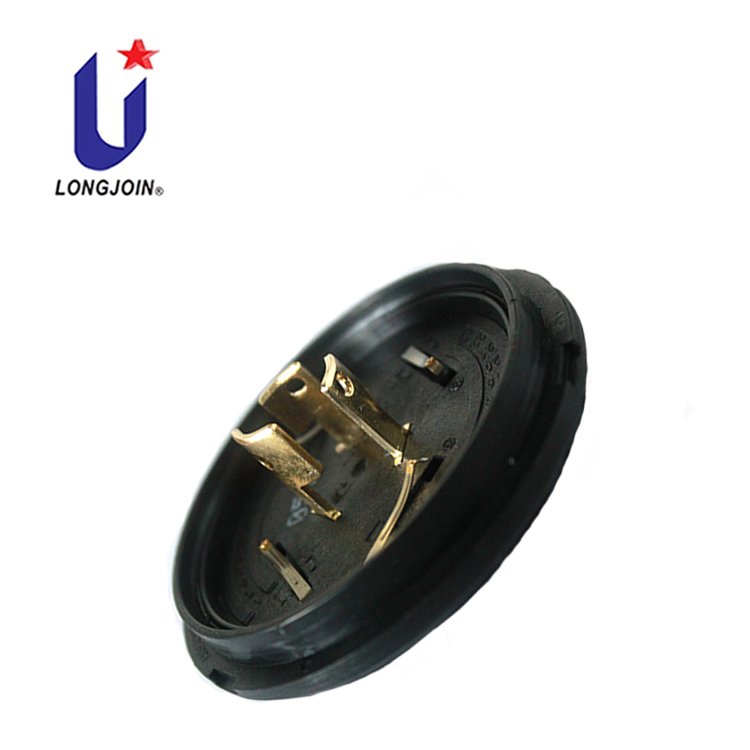
JL-205C twist-lock photocontrol
A standard locking-type control for 120–277 VAC circuits with a 3-pin ANSI C136.10 interface and a 3–20 second switching delay. It is the model most often specified for straightforward dusk-to-dawn switching on existing fixtures, including retrofit programmes that reuse the original receptacle. The related JL-210 kit pairs a control with a receptacle and wall bracket for installations where the socket is being replaced at the same time.
Procurement focus: confirm the delay window required by the utility or asset owner, and confirm that the receptacle on the fixture matches the 3-pin interface. JL-205C and JL-210 kit product page
JL-207 series
A configurable twist-lock family available as JL-207C (120–277 VAC), JL-207E (347 VAC) and JL-207F (480 VAC), built to ANSI C136.10 and UL 773, with FCC and CE marking. Rated 1000 W tungsten and 1800 VA ballast, 0.5 W standby consumption, 5–20 second delay, and IP54, IP65 or IP67 protection depending on the housing option. Fail-On and Fail-Off configurations are both available.
Procurement focus: the fail state and the IP option are the two choices that most often get lost between quotation and purchase order. JL-207 series overview

JL-217 series
A digital twist-lock control offered as JL-217C (120–277 VAC), JL-217E (347 VAC) and JL-217F (480 VAC), with applicable ranges of 105–305, 105–382 and 105–528 VAC. Load rating is 1000 W tungsten and 1800 VA ballast, with 8 A at 120 VAC and 5 A at 208–277 VAC for electronic ballast loads. Standard units provide 4 kV surge immunity; 6 kV and 20 kV options are available for exposed installations. Operating range is −40 °C to +70 °C, with IP54, IP65 or IP67 housings, UL, CE and RoHS marking.
Procurement focus: surge class and the on/off light levels, which are factory-set and can be customised to the project’s requirement. JL-217 product page
JL-240F NEMA receptacle
A waterproof twist-lock dimming receptacle for 0–480 VAC, rated 15 A, with a 0–30 VDC control signal at 250 mA maximum. The body is PBT with phosphor bronze contacts, sealed internally and externally, and the unit conforms to ANSI C136.41-2013. It is the mating half of a dimmable control installation — the part that is usually forgotten until the fixture is on the pole.
Procurement focus: lead length (16 AWG or 14 AWG), the sealing method, and whether the fixture manufacturer’s cut-out matches the receptacle footprint. JL-240F product page

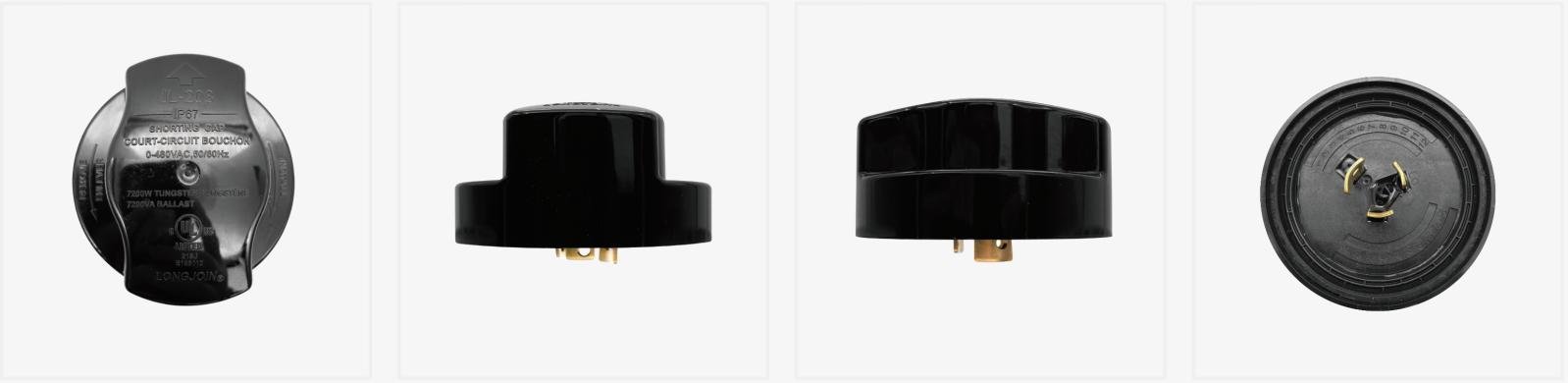
JL-208-IP67 shorting cap
A locking-type shorting cap for 0–480 VAC circuits, rated 7200 W tungsten and 7200 VA ballast, with a UV-stabilised PC enclosure on a high-impact PBT base and IP67 ingress protection. It conforms to the ANSI C136.10 interface and is used where a receptacle must be closed but no control is fitted — during commissioning, on poles awaiting controls, or where a circuit is switched elsewhere.
Procurement focus: IP rating and the gasket design, since a shorting cap is often the only thing keeping moisture out of an unused socket. JL-208-IP67 product page
Zhaga Book 18 components
For European and selected Asian projects that specify the Zhaga Book 18 socket, Long-Join supplies Book 18 sensor and controller modules including PIR and microwave versions. These are a complement to the twist-lock range rather than a replacement: Book 18 suits new-build smart-ready luminaires, while the installed base in most markets still uses the NEMA interface. Zhaga Book 18 module page
| Model | Voltage variants | Interface / reference | Typical use |
|---|---|---|---|
| JL-205C | 120–277 VAC | 3-pin, ANSI C136.10 | Standard dusk-to-dawn switching, 3–20 s delay |
| JL-207C / E / F | 120–277 / 347 / 480 VAC | ANSI C136.10, UL 773 | Configurable fail state, IP54 to IP67 housings |
| JL-217C / E / F | 120–277 / 347 / 480 VAC | ANSI C136.10 | Higher surge immunity options, 4 / 6 / 20 kV |
| JL-240F | 0–480 VAC, 15 A | ANSI C136.41-2013 | Dimmable receptacle, 0–30 VDC control signal |
| JL-208-IP67 | 0–480 VAC | ANSI C136.10 | Shorting cap for vacant receptacles, IP67 |
| Zhaga Book 18 modules | Per module datasheet | Zhaga Book 18 socket | Smart-ready luminaires, PIR or microwave sensing |
6. Photocontrol Supplier Qualification Checklist
Use this list as the enclosure to a first enquiry. A supplier that can answer all of it without a second round of questions is usually the one worth a sample order.
- Exact model and variant code, including voltage suffix
- Current datasheet for that variant, not the family brochure
- Voltage range and rated frequency
- Load compatibility: tungsten, ballast, electronic ballast, LED inrush
- Applicable certifications, with certificate number and covered model list
- Interface conformance: ANSI C136.10 or ANSI C136.41, or Zhaga Book 18
- IP rating and housing material, including UV stabilisation
- Surge immunity class and test basis
- Test evidence: functional test coverage and batch traceability method
- Sample availability and sample lead time
- Production lead time for the first order and for repeat orders
- OEM support: labelling, packaging, colour and marking options
- Warranty terms and corrective action process
7. What Street Lighting Buyers Should Prepare Before Sending an RFQ
Most delayed quotations are not the supplier’s fault. They are caused by an enquiry that omits the one parameter that changes the price. Prepare these ten items before you send, and the first reply will usually be a quotation rather than a question.
- Destination country and target market — this decides voltage and certification set
- Operating voltage, including the acceptable range
- LED driver details and load information, including inrush where known
- Photocontrol type, or receptacle type if the fixture needs the mating half
- Applicable standards and certification requirements, named per model
- Environmental requirements: temperature range, coastal exposure, IP expectation
- Estimated annual quantity, and whether demand is seasonal
- Expected delivery schedule and whether partial shipments are acceptable
- OEM labelling, packaging and documentation requirements
- Samples and technical documents needed for internal qualification
Send a complete RFQ through the Chiswear contact page and the engineering team will respond with a configuration recommendation, datasheet and pricing for the quantity you expect.
8. About Long-Join / Chiswear
Long-Join has manufactured outdoor lighting controls and interface components for more than two decades. The range covers twist-lock photocontrols, NEMA receptacles, shorting caps, wire-in and button-type photocontrols, and Zhaga Book 18 modules, produced for OEM and ODM customers across North America, Europe, the Middle East and Latin America.
Chiswear is the international technical promotion and sales channel for Long-Join products. Technical documentation, samples and quotations are handled through this site.
- Official manufacturer website: www.long-join.com
- Technical and global sales portal: chi-swear.com
- Product range: photocontrols and NEMA components
- Company background: about Long-Join and Chiswear
9. Frequently Asked Questions
What were the key outdoor lighting trends at Hong Kong Lighting Fair 2026?
The 2026 fair centred on efficiency, control and maintainability. The HKTDC survey of more than 740 exhibitors and buyers named artificial intelligence (54%), technological advancement (44%) and smart city development (43%) as the main growth drivers, while the outdoor expo added photovoltaic and energy-storage exhibits. On the floor, the practical themes were modular fixtures, replaceable control modules and a wider spread of IP ratings within single product families.
What should street lighting buyers look for in a photocontrol supplier?
Five things: a datasheet that states voltage range, load rating and inrush behaviour; certification that names the exact model; interface conformance to ANSI C136.10 or C136.41; an environment rating matched to the installation site; and evidence of repeatable production quality, including batch traceability and a change notification process. Price should be compared only after those five are equal.
Why is UL 773 important when purchasing photocontrols?
UL 773 is the safety standard for plug-in, locking-type photocontrols used in outdoor lighting. A UL 773 listing or recognition tells the buyer that the device has been evaluated against a defined set of construction and performance requirements. It is specific to the model listed, so a certificate covering one voltage variant does not automatically extend to another variant in the same family.
What is the difference between a NEMA photocontrol and a NEMA receptacle?
The photocontrol is the switching device: it senses light level and opens or closes the circuit. The receptacle is the socket permanently mounted on the luminaire, which provides the mechanical interface, the contacts and the wiring connection. A twist-lock control needs a matching receptacle to function, and the two are usually purchased separately — which is why receptacle specification is often the step that delays an order.
How do buyers select the correct photocontrol voltage?
Start with the actual supply voltage at the fixture, then confirm the control’s applicable range rather than its nominal rating. North American roadway circuits commonly use 120–277 VAC, with 347 VAC in parts of Canada and 480 VAC in some commercial and industrial installations. A control rated 120–277 VAC should not be specified for a 347 VAC circuit, even where the fixture otherwise matches.
Why does photocontrol reliability affect municipal lighting maintenance costs?
Because the component is cheap and the visit is not. Replacing a failed control requires a bucket truck, two technicians, traffic management and administrative closure — costs that typically dwarf the unit price. A control that fails ON or OFF unpredictably generates repeat visits, so the effective cost of a low-quality unit is measured in call-outs rather than in purchase price.
Can Long-Join provide photocontrol samples and OEM quotations?
Yes. Long-Join supplies samples for qualification and quotes OEM and ODM volumes for twist-lock photocontrols, NEMA receptacles, shorting caps and Zhaga Book 18 modules. Send the model, voltage, interface, estimated annual quantity and destination market through the Chiswear contact page, and the team will reply with a datasheet, sample lead time and pricing.
10. Request Photocontrol Samples, Datasheets and OEM Pricing
Looking for a reliable photocontrol supplier for your next street lighting project?
Long-Join and Chiswear can help you evaluate suitable photocontrol and NEMA receptacle configurations for your lighting application. Send your technical requirements, expected annual quantity and target market to request datasheets, samples and an OEM quotation.
Email: wally@ljsensor.com
Manufacturer: www.long-join.com
Contact: Request a quote
Request Photocontrol Samples & OEM Quotation
References and Sources
- HKTDC press release, 30 October 2026: Autumn Lighting Fair, Outdoor and Tech Light Expo, Eco Expo Asia draw some 62,000 buyers
- HKTDC Hong Kong Means Business: Smart solutions, new markets shape lighting and green fairs
- HKTDC Media Room, fair press releases: mediaroom.hktdc.com
- Hong Kong Trade Development Council, exhibition programme: hktdc.com
- Zhaga Consortium, Book 18 specification: zhagastandard.org
- Long-Join product documentation: long-join.com
Related reading from this site: Long-Join at the 10th Hong Kong International Outdoor and Tech Light Expo, and the photocontrol FAQ for installation questions.